Nov 2026· Italian National Conference on Sensors· 0 citations· 24 references
Privacy-Preserving Technologies in Data
Abstract
Hierarchical federated learning (HFL) incorporates edge aggregation into federated learning (FL), thereby reducing communication overhead and improving scalability in wireless edge networks. Incentive design in HFL must account for how payments across the cloud–edge–device hierarchy affect the data contributions of participants with private costs. Moreover, participation in HFL consumes local device resources, making effective incentives essential for motivating self-interested devices to participate. To address these issues, we propose a two-tier incentive mechanism for HFL, namely TIM-HFL, in which the lower layer addresses information asymmetry between access points (APs) and devices through a contract-theoretic mechanism and derives closed-form expressions for the data contributions optimized under the proposed reward rule and the corresponding contract rewards, with the resulting contract satisfying individual rationality and incentive compatibility constraints. At the upper layer, we formulate a Stackelberg game between the server and APs and derive a closed-form expression for the optimal reward coefficient, thereby enabling coordinated cross-layer optimization without requiring iterative alternating optimization between the two incentive layers within each global training round. Simulation results demonstrate that TIM-HFL improves model performance and system utility under both independent and identically distributed (IID) and non-IID settings, while showing consistency between the analytical solutions and numerical optimization results.

The results indicate that software engineering work practices are chosen opportunistically, adapted and configured to provide value under the constrains imposed by the startup context.
Nicolò Paternoster, Carmine Giardino, M. Unterkalmsteiner et al.· Information and Software Tec...· 394 citations· ⚡54
This state-of-practice investigation was performed using a literature review followed by a multiple-case study approach and presents how inconsistency between managerial strategies and execution can lead to failure by means of a behavioral framework.
Carmine Giardino, Xiaofeng Wang, P. Abrahamsson· International Conference on...· 175 citations· ⚡19
This study conducts a case survey study based on the secondary data of the major pivots happened in 49 software startups, and demonstrates that customer need pivot is the most common among all pivot types.
Sohaib Shahid Bajwa, Xiaofeng Wang, Anh Nguyen-Duc et al.· Empirical Software Engineeri...· 127 citations· ⚡15
It is found that roles of MVPs in startups were not fully aware by entrepreneurs, and entrepreneurs should consider a systematic approach to fully explore the value of MVP, as a multiple facet product (MFP).
Anh Nguyen-Duc, P. Abrahamsson· International Conference on...· 93 citations· ⚡9
It is found that what perceived as biggest challenges by software startups do vary across different life cycle stages, even though its significance decreases when the learning focuses of the startups move from problem to solution and their products mature.
Xiaofeng Wang, Henry Edison, Sohaib Shahid Bajwa et al.· International Conference on...· 62 citations· ⚡6
A comprehensive overview of how enhanced sampling methods are reshaping the field, with a particular focus on the data-driven construction of collective variables, is provided.
Kai Zhu, Enrico Trizio, Jintu Zhang et al.· Chemical Reviews· 58 citations
Related blog posts
MIT News · Artificial Intelligence· news.mit.eduNov 17, 2026
By studying the computational foundations of language learning, Associate Professor Jacob Andreas builds intelligent systems that can communicate effectively with humans.
MIT News · Artificial Intelligence· news.mit.eduNov 17, 2026
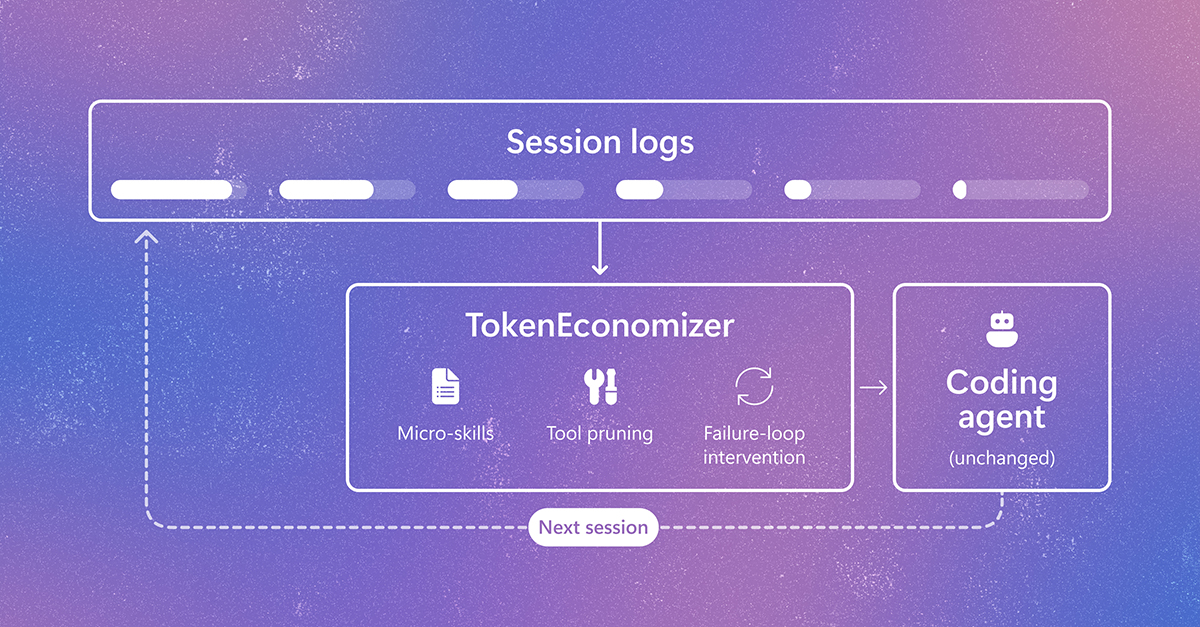
AI coding agents are increasingly help developers fix bugs and build features largely on their own, but every interaction with their models consumes tokens. In each session, an agent sends instructions, tool descriptions, and session history to its model. Most efforts to reduce this cost focus on individual tasks. Yet developers return to the same […] The post TokenEconomizer: Learning from Experience to Make AI Coding Agents More Efficient appeared first on Microsoft Research.
MIT News · Artificial Intelligence· news.mit.eduNov 9, 2026