A closed-loop threshold-aware training strategy in which the dismissal threshold is recalculated during training and used to penalize cancer-positive images that approach the dismissal region supports closed-loop threshold-aware training for high-recall selective dismissal.
Abstract
Reducing the review of clearly cancer-negative screening mammograms could lower radiologist workload without compromising cancer detection. We propose a closed-loop threshold-aware training strategy in which the dismissal threshold is recalculated during training and used to penalize cancer-positive images that approach the dismissal region. We evaluated the method on NLBS and RSNA using five controlled training configurations, with case-level assessment based on a one-sided 99\% Clopper--Pearson upper bound for cancer prevalence among dismissed cases. The proposed model achieved the highest case-level dismissal rates at both 98\% and 95\% recall targets. On NLBS, dismissal reached 19.74\% and 21.70\%, while the cross-entropy baseline did not meet either recall target. On RSNA, dismissal improved from 7.04\% to 14.31\% and from 13.49\% to 19.69\%. In external RSNA$\to$NLBS evaluation, the proposed model achieved dismissal rates of 12.95\% and 19.87\% at the 98\% and 95\% recall targets, respectively. These results support closed-loop threshold-aware training for high-recall selective dismissal.
The strongest current evidence indicates that artificial intelligence used as triage plus decision support within a double-reading programme increases cancer detection and sensitivity while leaving specificity unchanged and substantially reducing reading workload.
M. S. Ibrahim, Enock Kumi Ackaah, Charity Benewa Acheampong et al.· Journal of Advances in Medic...· 0 citations
Background: WDBC is a small historical benchmark, and near-ceiling performance alone provides limited evidence of transportability. Methods: We evaluated five model families for discrimination, calibration, and paired statistical testing. We utilized sensitivity-oriented out-of-fold (OOF) thresholds and decision curve...
Younes Nadir, M. Rachdi, Abdellah Bakhouyi et al.· Applied Sciences· 0 citations
Background: Breast imaging ends in a management decision, from routine return to biopsy, yet most models are evaluated by accuracy alone and say nothing about when they may be wrong. We present a trust-aware multimodal model that reads paired mammography and ultrasound, recommends one of three BI-RADS-derived managemen...
M. Nouman, R. Haraguchi· BioMedInformatics· 0 citations
Pulmonary nodule malignancy prediction typically depends on image-trained specialist deep learning (DL) models that require substantial annotated imaging data and task-specific training. We investigate whether a generalist large language model (LLM), reading only a faithful natural-language rendering of standard nodule...
Md. Rabiul Islam, Samir Abdaljalil, E. Serpedin et al.· 0 citations
A medical model's benchmark score does not establish that the same conclusion holds under a different evaluation. This study tests whether claims about model ranking, score reliability and screening performance survive changes in cohort, prompt, negative spectrum, specified prevalence and operating threshold. We audit...
Exploring how generative AI could make machine vision more accessible to businesses. The post GenEye in a Box: Making Machine Vision Something You Can Just Ask For appeared first on GPT-Lab.
Microsoft Research Blog· microsoft.comAug 11, 2026
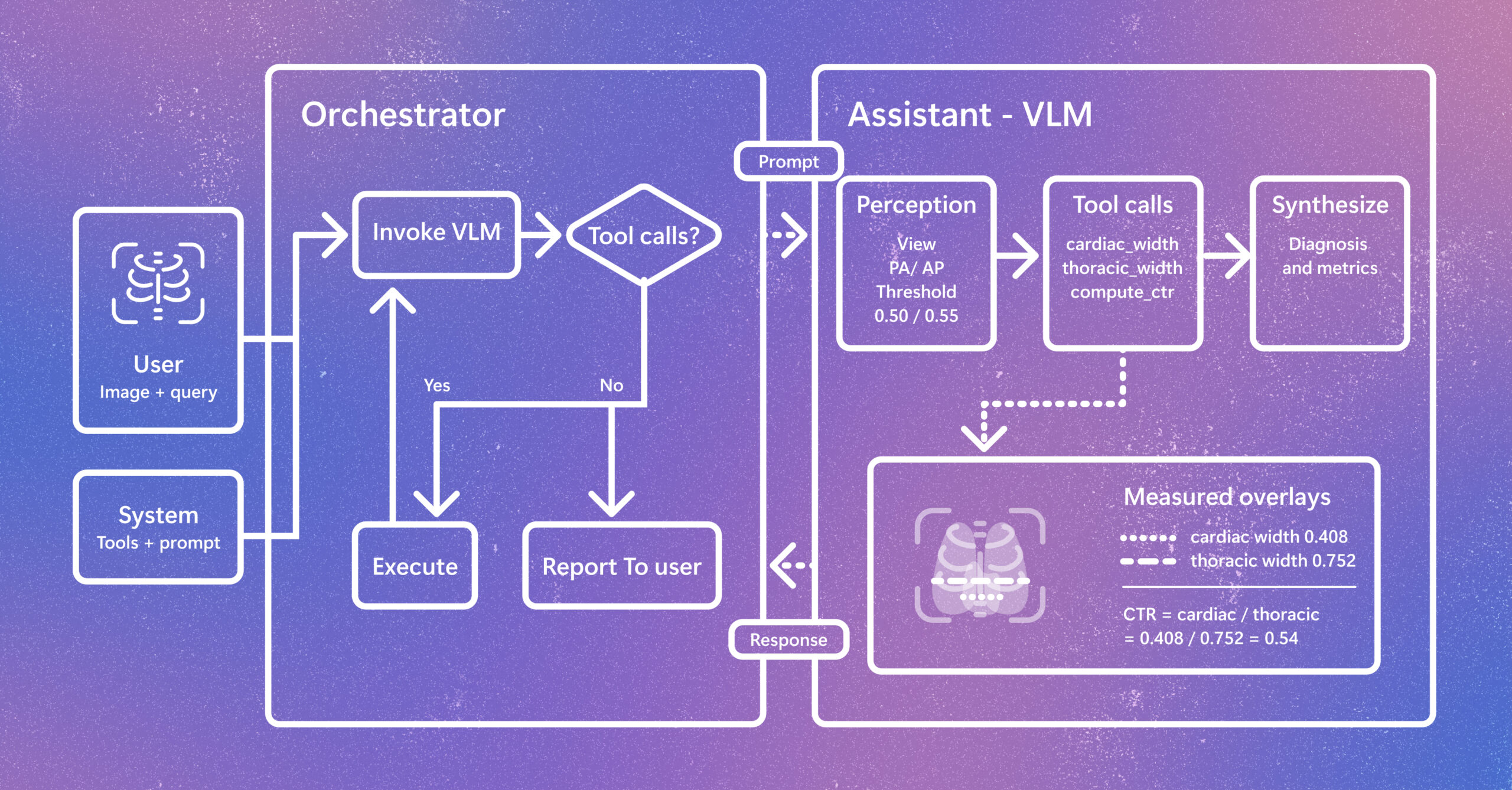
Radiology AI is evolving beyond report generation. CARE-X explores a unified approach that combines flexible reasoning, calibrated predictions, and measurement-based tools for chest X-ray interpretation. The post Introducing CARE-X: Towards Clinically Useful Radiology VLMs with Auxiliary Supervision, Reward-Aligned Learning, and Tool-Augmented Measurement appeared first on Microsoft Research.