Jan 2026· arXiv.org· Vol abs/2601.14121· 1 citation· 33 references
Computer Science
TL;DR
This work evaluates the performance of a news article retrieval pipeline, NewsRECON, which leverages a corpus of over 85,000 articles and investigates the potential of news article corpora as an alternative to RIS, linking images to relevant articles to infer their dates and locations from article metadata.
Abstract
Identifying when and where a news image was taken is crucial for journalists and forensic experts to produce credible stories and debunk misinformation. While many existing methods rely on reverse image search (RIS) engines, these tools often fail to return results, thereby limiting their practical applicability. In this work, we address the challenging scenario where RIS evidence is unavailable. We investigate the potential of news article corpora as an alternative to RIS, linking images to relevant articles to infer their dates and locations from article metadata. We evaluate the performance of a news article retrieval pipeline, NewsRECON, which leverages a corpus of over 85,000 articles. Experiments on the TARA dataset show that NewsRECON outperforms prior work and can be combined with a multimodal large language model (MLLM) to achieve new SOTA results in the absence of RIS evidence. Furthermore, NewsRECON generalizes to the 5Pils-OOC benchmark despite geographic and temporal shifts. We make our code available.
An adaptive CNN architecture is introduced that shares most of the structure for multiple tasks including source detection, article illustration and geolocation of articles, and a new loss function based on Great Circle Distance is proposed for geolocation.
U.gayathri, M. Balaram· Journal of Science & Technol...· 0 citations
The Media Bias Detector is introduced, a scalable computational framework that integrates large language models (LLMs) with near-real-time news scraping to extract structured annotations, including political lean, tone, topics, article type, and major events, across hundreds of articles per day.
Samar Haider, Amir Tohidi, Jenny S. Wang et al.· Science Advances· 0 citations
News articles often contain omitted temporal expressions, such as day-only or month-only mentions, which must be interpreted with reference to the publication date. When such articles are indexed or processed as standalone text in search and retrieval-augmented generation (RAG) systems, these omissions can cause tempor...
Automatic dense video captioning remains a challenging task, particularly for long and information-rich content such as TV news. However, the highly structured format of TV news programs offers opportunities for efficient segmentation strategies. In this work, we show how diarization-based segmentation can exploit this...
A. Brimont, Titus Zaharia, Ruxandra Tapu· 0 citations
ReGround is introduced, a large-scale dataset for reviewer comment grounding that links 10,267 reviewer comments to 16,274 evidence in the original anonymous submission of 3,656 papers and exposes grounding reviewer comments as a difficult and practically important problem for scientific document understanding.
This work formalizes news-corpus poisoning of probabilistic forecasters, a threat model distinct from prior RAG poisoning, which targets factual answers or opinion polarity rather than calibrated probabilities.
Yuan-Lai Lu, Yu-Kuan Zhang· 1 citation
Related blog posts
MIT News · Artificial Intelligence· news.mit.eduNov 20, 2026
Senior Research Scientist Jim Glass discusses how his MIT-IBM Computing Research Lab collaboration connects perception and language, and addresses the shortcoming of current models.
MIT News · Artificial Intelligence· news.mit.eduNov 19, 2026
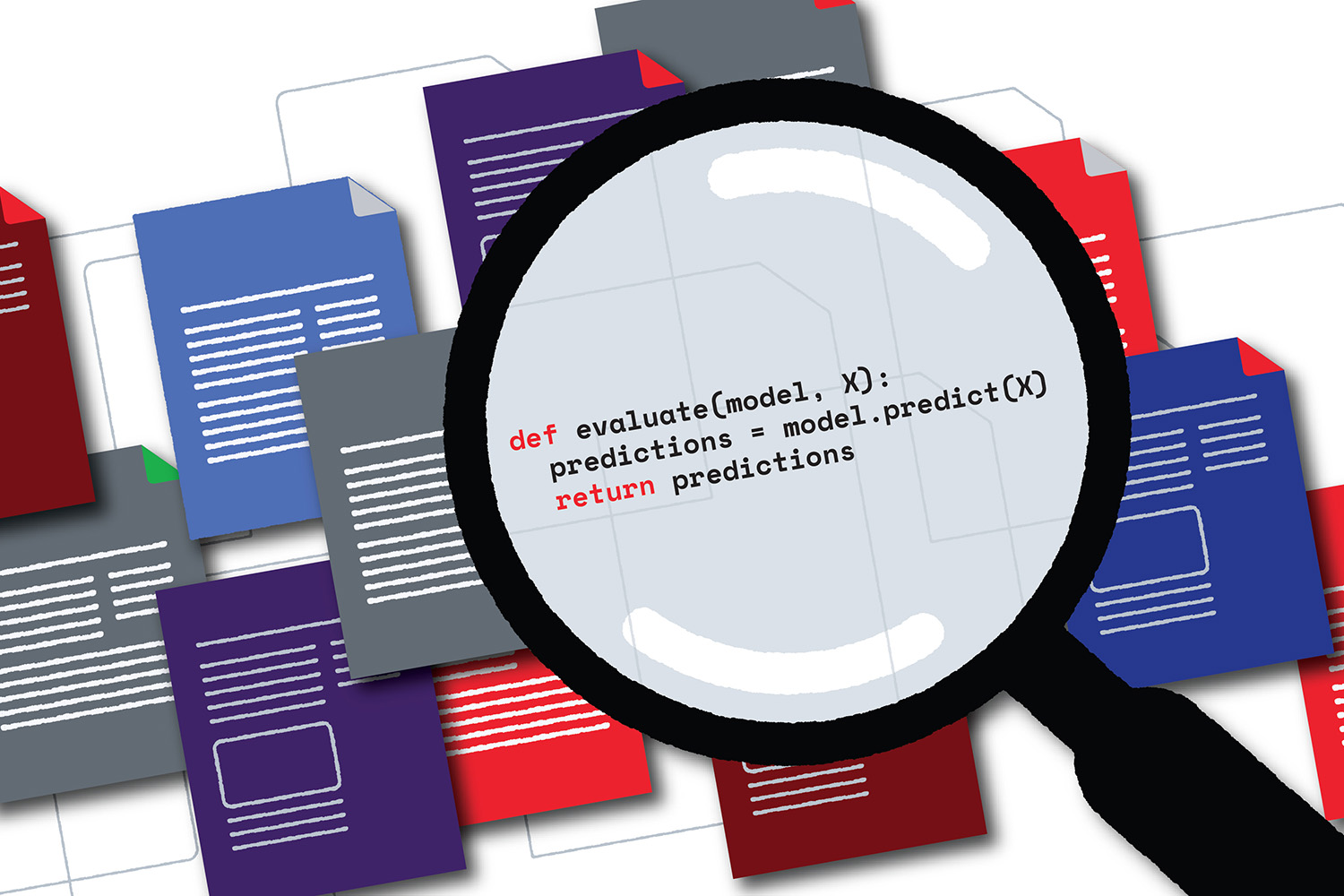
An MIT and Dana-Farber Institute-led team used large language models to examine nearly 4,000 studies and hundreds of code repositories, revealing gaps in the information needed to scrutinize and reuse published research.
By studying the computational foundations of language learning, Associate Professor Jacob Andreas builds intelligent systems that can communicate effectively with humans.
We use cookies to run the site and, with your consent, for analytics and to show ads.
See our Cookie Policy.