It is shown that edge symmetries can be exploited to design syndrome-extraction circuits from the underlying components, rather than from the full quantum code, to produce depth-optimal circuits from the underlying components.
Abstract
Quantum low-density parity-check (qLDPC) codes offer a promising route to scalable fault-tolerant quantum computing, but their practical implementation requires efficient circuits for syndrome extraction. Many qLDPC families are assembled from a small set of components through explicit constructions that imprint edge symmetries on their Tanner graphs. We show that these symmetries can be exploited to design syndrome-extraction circuits from the underlying components, rather than from the full quantum code. For Lifted Product and Balanced Product codes this approach yields an analytical construction with provably optimal or near-optimal CNOT depth. For Quantum Tanner codes it produces depth-optimal circuits on every instance we test, including codes up to nearly 600 data qubits.
In this work, we propose a novel design of high-rate Calderbank--Shor--Steane (CSS) quantum low-density parity-check (QLDPC) codes based on quasi-dyadic matrices. The Tanner graphs associated with the two component classical codes used to construct the proposed CSS codes are characterized by a girth of at least $6$. We...
Alessio Baldelli, Si-Si Miao, Laurent Schmalen et al.· 0 citations
CSS-T codes are quantum error-correcting codes that play an important role in fault-tolerant quantum computation, as they help mitigate the proliferation of errors. They admit a transversal T-gate and are defined from a pair of nested classical binary linear codes satisfying a specific algebraic condition expressed in...
Delio Jaramillo-Velez, Alessandro Neri, Adway Patra et al.· 0 citations
Quantum low-density parity-check (QLDPC) codes are a leading candidate for achieving low-overhead fault-tolerant quantum computing. However, the time overhead of logical operations in QLDPC codes remains a key challenge. Code surgery, a space-efficient technique for fault-tolerant logical measurements, incurs this over...
Lucas Berent, Lawrence Z. Cohen, A. O. Quintavalle· 0 citations
Inspired by recent affine-permutation-based code constructions and the long-range connectivity available in reconfigurable neutral-atom arrays, Cornucopia codes are introduced, a family of practical, hardware-efficient quantum low-density parity-check codes that achieve an ultra-high encoding rate exceeding $1/2 while...
Efficiently characterizing quantum error correcting codes is a key challenge on the path to fault-tolerant quantum computation. Stabilizer codes, a central class of such codes, are defined by a set of stabilizer generators. Here, we present an algorithm that uses random single-qubit measurements to learn the stabilizer...
This work treats degenerate decoding as probabilistic inference in an undirected graphical model: the probability of each logical class is the partition function of an unconstrained, strictly positive Markov random field over the code's check variables, a construction that generalizes the random-bond Ising mapping of t...
R. Krishnamoorthy, Florian Gerhardt, Johannes Knaute et al.· 2 citations· ⚡1
Related blog posts
MIT News · Artificial Intelligence· news.mit.eduOct 2, 2026
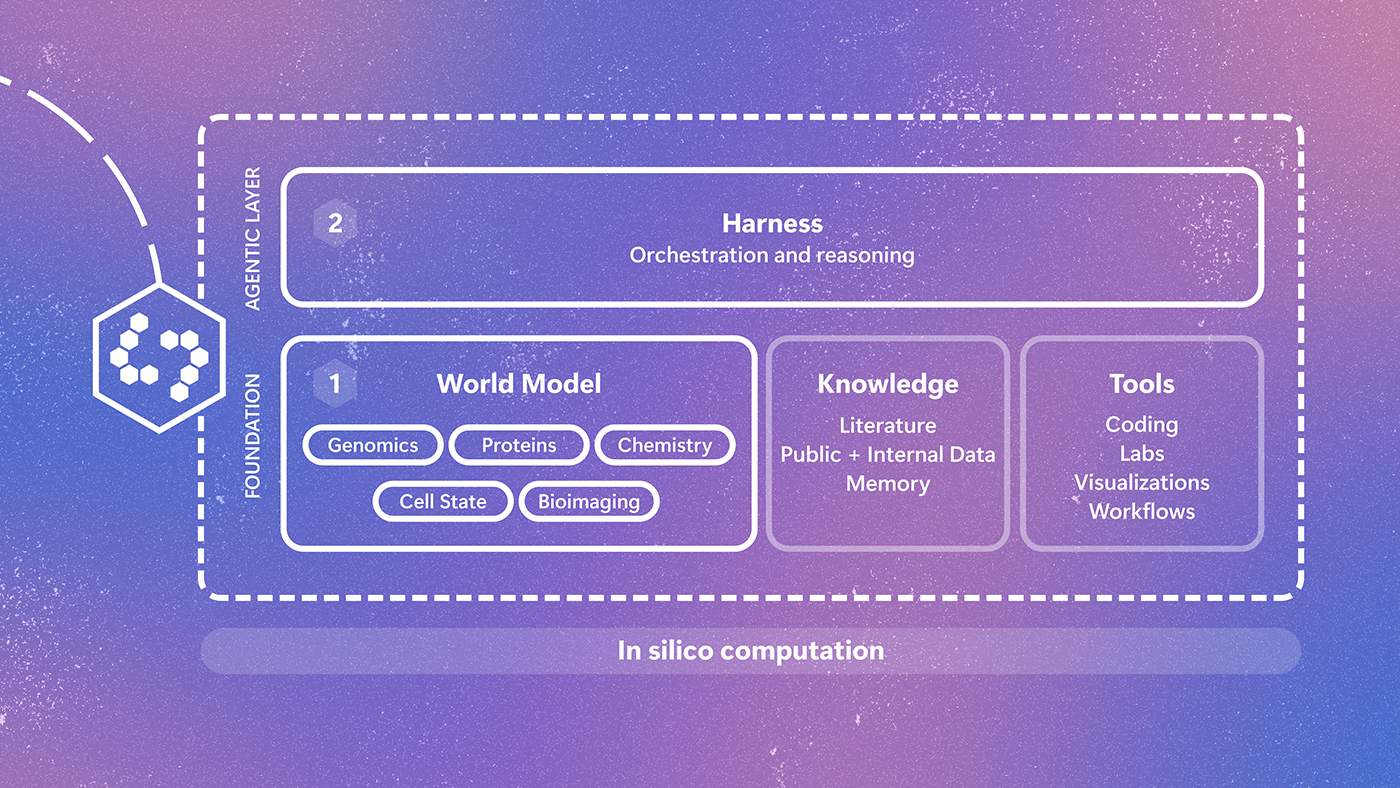
Biology doesn't operate in silos, and neither should the AI representation of it. Quine is an early-stage research effort to create a multimodal world model of biology. By connecting insights across biological scales and modalities, Quine helps scientists computationally search a space far larger than intuition allows and prioritize hypotheses before they reach the lab. Experimental results provide important feedback, helping researchers sharpen future research directions. The post Introducing Q…