Skip to content

What Is Worth Representing? Representational Empowerment for Continual Model Construction

Sep 2026 · 0 citations · 64 references
Computer Science

TL;DR

Representational Empowerment (RepEmp) is proposed to score candidate elements by how much they expand the agent's future capacity to model and plan, complementing the classic definition of empowerment, but redefined as control over internal representations instead of external states.

Abstract

The first problem of modeling the world is not just estimating the right parameters or causal structure, but deciding what should be represented at all. We frame this problem as continual model construction: an agent maintains an environment-specific model M of an inaccessible world W and curates a persistent library L of reusable representational elements across environments. We propose Representational Empowerment (RepEmp) to score candidate elements by how much they expand the agent's future capacity to model and plan, complementing the classic definition of empowerment, but redefined as control over internal representations instead of external states. We realize the framework as a hierarchical Curator-Actor architecture and test it across three experiments. In a closed-vocabulary causal-learning task, human participants construct causal models at varying abstraction granularities to maximize goal reachability rather than fidelity to the world, a signature better predicted by RepEmp than by information-gain alternatives. Matched simulations reveal that RepEmp-guided construction contributes more than exploration to sufficient structure recovery and cross-task transfer. Finally, in an open-vocabulary planning domain, an LLM-augmented Curator builds more compact symbolic libraries, which also generalize better than baselines. Ablating RepEmp eliminates these benefits. Together, these results identify RepEmp as a key principle for continual model construction: deciding what to build, retain, and reuse under bounded resources.

View source

Similar papers

#computer vision Preprint Aug 2026

A Unifying Perspective on Causal World Models: From Observations to Representations to Structure

This paper provides a formal definition of Causal WMs (CWMs) grounded in the tasks they are intended to support, connecting existing work in causal representation learning, object-centric learning, causal discovery, structural causal models, and model-based decision-making.

Avinash Kori, Fabrizio Russo · 0 citations
Book Open access Sep 2026

Navigating Latent Worlds: A Hypertextual Taxonomy of World Models as Nonlinear Knowledge Structures

World models, learned internal representations that simulate environment dynamics, predict future states, and enable counterfactual reasoning, have emerged as a central construct in the pursuit of autonomous intelligence. Yet existing surveys catalogue world models along purely architectural or application-domain axes,...

Raghav Sharma, Manan Mehta, Adit Kotwal · 0 citations
Book Open access Oct 2026

Not All Differences Matter: Variability Exploration of Domain Models via Agentic AI

Domain modeling is inherently interpretive: the same textual description may yield solutions that differ in structure, abstraction, and scope. Not all such differences constitute errors. Some reflect legitimate alternative representations and well-justified modeling decisions, while others stem from misconceptions or m...

Iris Reinhartz-Berger, Maxim Bragilovski, Arnon Sturm · 0 citations
#human-computer interacti... Preprint Sep 2026

Recursive Organization Improvement: A Modeling Specification for Human--Agent Organizations

Stronger AI agents do not automatically produce better organizations: teams must also learn which work arrangements to retain and when to reconsider them. We propose a modeling specification for recursive organization improvement and evaluate it through an executable checker, a public-record mapping, and controlled sim...

Zi-Long Wang · 0 citations
#artificial intelligence Preprint Sep 2026

Structure-Mapping-Guided Self-Explanation for Learning Mathematical Procedures

A structure-mapping-guided self-explanation as a computational account of the cognitive biases that reduce search effort and make this inference tractable and a testable hypothesis about human self-explanation from worked examples are proposed.

Shi-Xuan Lee, Christopher J. Maclellan, Daniel Weitekamp · 1 citation

Related blog posts

MIT News · Artificial Intelligence Sep 29, 2026

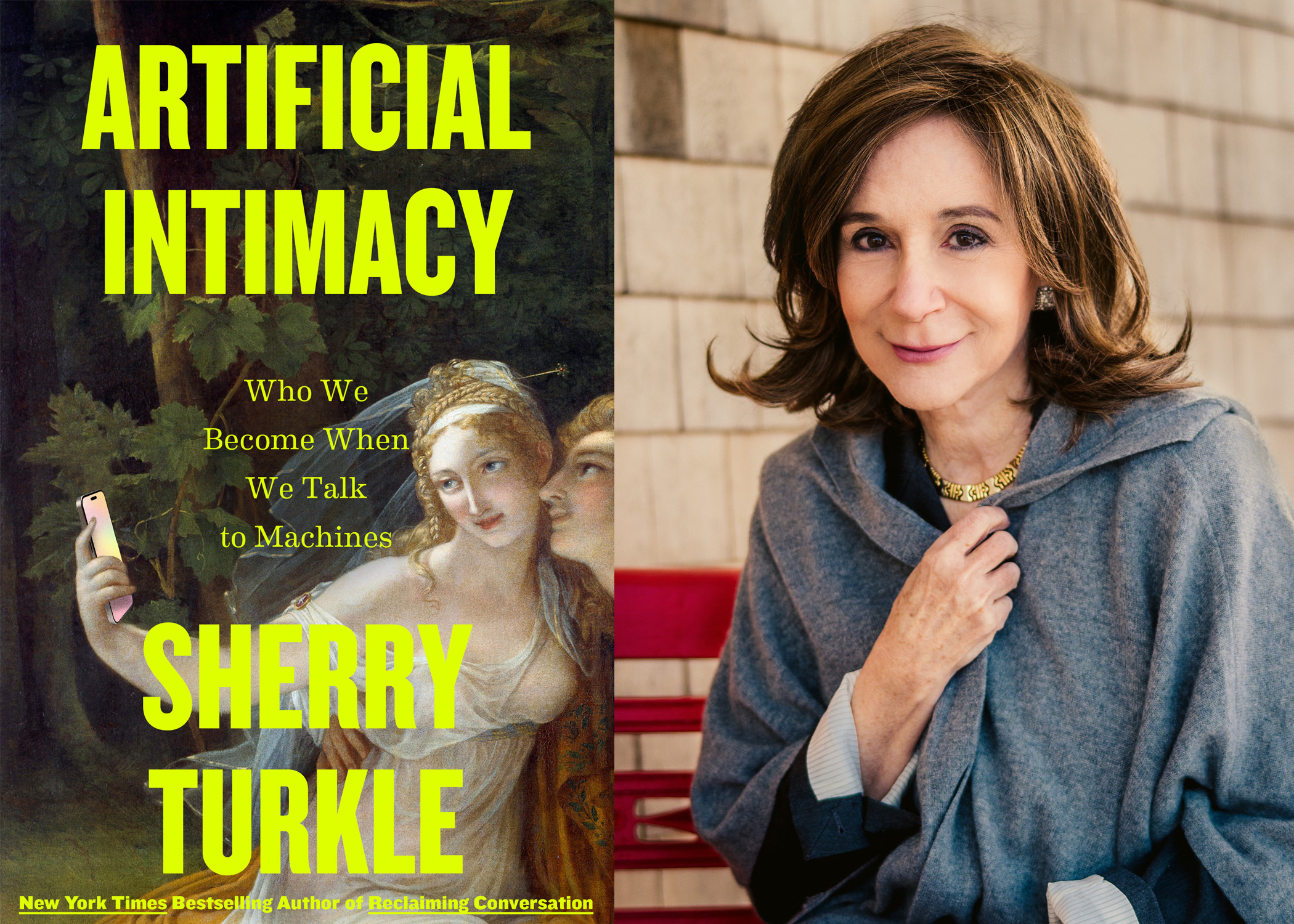
Who we become when we talk to machines

Professor Sherry Turkle’s new book, “Artificial Intimacy,” offers a withering critique of chatbots and the antisocial dynamics she believes they encourage.

We use cookies to run the site and, with your consent, for analytics and to show ads. See our Cookie Policy.