Mar 2026· arXiv.org· Vol abs/2603.23101· 0 citations· 59 references
Computer Science
TL;DR
This work proposes SpecXMaster, an intelligent framework leveraging Agentic Reinforcement Learning (RL) for NMR molecular spectral interpretation that enables automated extraction of multiplicity information from both 1H and 13C spectra directly from raw FID (free induction decay) data.
Abstract
Intelligent spectroscopy serves as a pivotal element in AI-driven closed-loop scientific discovery, functioning as the critical bridge between matter structure and artificial intelligence. However, conventional expert-dependent spectral interpretation encounters substantial hurdles, including susceptibility to human bias and error, dependence on limited specialized expertise, and variability across interpreters. To address these challenges, we propose SpecXMaster, an intelligent framework leveraging Agentic Reinforcement Learning (RL) for NMR molecular spectral interpretation. SpecXMaster enables automated extraction of multiplicity information from both 1H and 13C spectra directly from raw FID (free induction decay) data. This end-to-end pipeline enables fully automated interpretation of NMR spectra into chemical structures. It demonstrates superior performance across multiple public NMR interpretation benchmarks and has been refined through iterative evaluations by professional chemical spectroscopists. We believe that SpecXMaster, as a novel methodological paradigm for spectral interpretation, will have a profound impact on the organic chemistry community.

MACROS establishes a scalable foundation for fully automated structure elucidation, and catalyzes accelerated molecular discovery toward autonomous laboratories, and augments chemists via collaboration to deliver sixfold faster, 40% more accurate elucidation.
Bing-Sen Xue, Zhuo-Jun Jiang, Jian-Hao Zhang et al.· 0 citations
Infrared spectroscopy serves as an indispensable analytical tool across materials science, pharmaceutical development, and the life sciences. Computational insights derived from first-principles methods enhance the interpretation of vibrational spectra, yet their application remains hindered by high computational cos...
Giulio Benedini, M. Hellström, Lucas Visscher· Journal of Chemical Theory a...· 0 citations
Most computationally predicted materials are never synthesized because conventional synthesis optimization is slow, expertise-dependent, and iterative. Here we present a closed-loop framework that automates this expert workflow by placing human tacit knowledge in the loop through a large language model (LLM) that disti...
Fang Sheng, S. Torrisi, Amanda A. Volk et al.· 0 citations
This perspective argues that computational data should be regarded not merely as a complement to experimental data, but as deliberately designed, domain-specific infrastructure for chemical AI.
Ross James Urquhart, Tell Tuttle· Chemical Science· 0 citations
Evaluations across scientific, multimodal, agentic, and general-purpose benchmarks show that Intern-S2-Preview-397B achieves competitive or leading results in multiple settings.
Lei Bai, Jiaqi Cao, Chiyu Chen et al.· 3 citations
Related blog posts
MIT News · Artificial Intelligence· news.mit.eduNov 17, 2026
By studying the computational foundations of language learning, Associate Professor Jacob Andreas builds intelligent systems that can communicate effectively with humans.
Microsoft Research Blog· microsoft.comNov 16, 2026
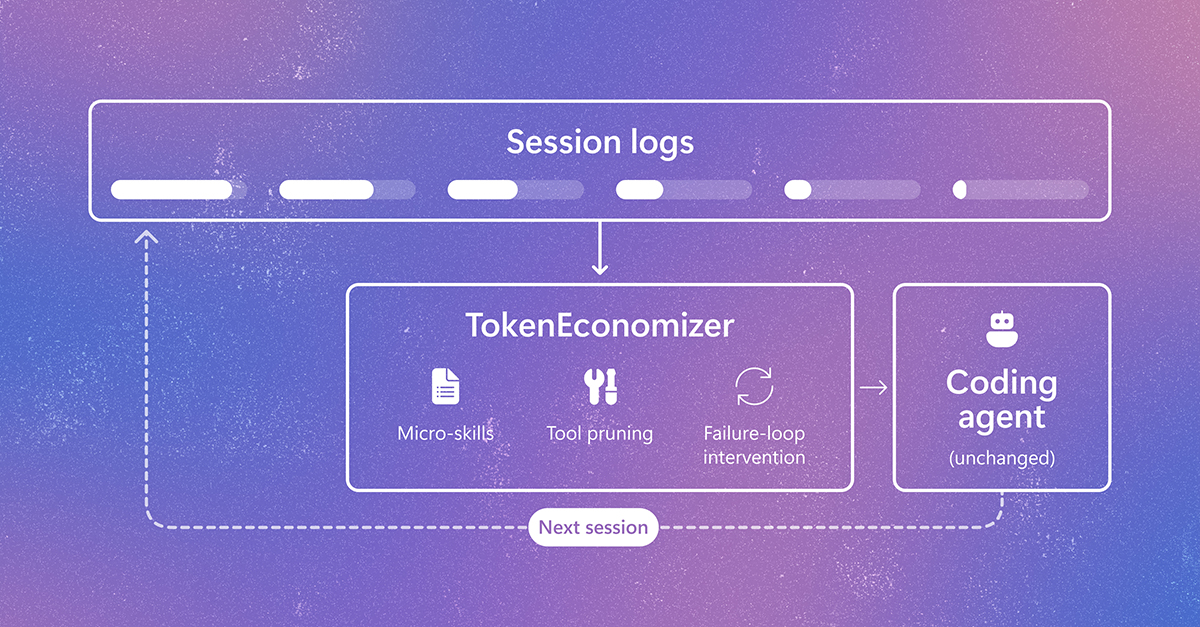
AI coding agents are increasingly help developers fix bugs and build features largely on their own, but every interaction with their models consumes tokens. In each session, an agent sends instructions, tool descriptions, and session history to its model. Most efforts to reduce this cost focus on individual tasks. Yet developers return to the same […] The post TokenEconomizer: Learning from Experience to Make AI Coding Agents More Efficient appeared first on Microsoft Research.
MIT News · Artificial Intelligence· news.mit.eduNov 13, 2026