Skip to content

CrystalGRW: generative modeling of crystal structures with targeted crystallographic properties via geodesic random walks

Aug 2026 · Scientific Reports · Vol 16 · 0 citations · 83 references
Medicine

TL;DR

CrystalGRW is introduced, a diffusion-based generative model on Riemannian manifolds that proposes candidate crystal configurations in stable phases, validated through density functional theory calculations, thereby accelerating materials discovery and inverse design.

Abstract

Determining whether a candidate crystalline material is thermodynamically stable depends on identifying its true ground-state structure, a central challenge in computational materials science. We introduce CrystalGRW, a diffusion-based generative model on Riemannian manifolds that proposes candidate crystal configurations in stable phases, validated through density functional theory calculations. Our model is designed for de novo generation, which creates crystal structures together with their compositions. The crystal properties, such as fractional coordinates, atomic types, and lattice matrices, are represented on suitable Riemannian manifolds, ensuring that new predictions generated through the diffusion process preserve the periodicity of crystal structures. We also incorporate an equivariant graph neural network to account for rotational and translational symmetries within the model. CrystalGRW generates crystal structures that are stable and closely resemble their density-functional-theory ground states. The model also supports conditional control, such as enforcing a specified crystallographic point group, thereby accelerating materials discovery and inverse design by providing symmetry-consistent, energetically stable candidate crystals for experimental validation.
Read PDF

Similar papers

Preprint Aug 2026

DynaCrys: Crystal Generation with Dynamic Space-Group Diffusion

The search for new crystalline materials spans an enormous compositional and structural space. Generating candidates in this space requires jointly modeling discrete crystallographic symmetry, elemental composition, and continuous geometry. We introduce DynaCrys, a generative model for crystals in which the space group...

Zhuo-Tao Jin, Xiao-Yu Wang, Nicholas Brawand et al. · 1 citation
#machine learning Preprint Sep 2026

Riemannian Flow Models with Reinforcement Learning for Molecular Crystal Structure Prediction

Crystal structure governs material properties, making crystal structure prediction (CSP) a fundamental problem in materials science. Generative models are a promising approach for solving this problem, but the prevalence of polymorphism, coupled with large unit cells and complex packing geometry, makes the molecular CS...

T. Egg, Harry W. Sullivan, Maya M. Martirossyan et al. · 0 citations
Aug 2026

A Dual-Mode Crystal Structure Prediction Framework for Fixed Element Sets and Fixed Structural Prototypes.

Crystal structure prediction (CSP) is a cornerstone technology for the efficient discovery and rational design of functional materials. Here, we propose a deep-learning-enabled dual-mode CSP framework that simultaneously supports two complementary tasks: predicting stable crystal structures for given elemental composit...

Chen Qin, Xiang-Yan Luo, Zhi-Xiang Fan et al. · 0 citations
Preprint Oct 2026

GEODE: Symmetry-Preserving Cartesian Diffusion for Crystal Generation

Most known inorganic crystals exhibit symmetric atomic arrangements, yet generative models often fail to reproduce them. Explicitly enforcing these symmetries has so far yielded fewer stable and novel structures than unconstrained generation. We introduce Generative Equivariant Orbit Diffusion Engine (GEODE), to our kn...

Yuchen Lou, A. Ganose · 0 citations
Open access Sep 2026

Deterministic combinatorial calculation of lattice parameters using Python

Introduction: Determining lattice parameters is crucial for characterizing crystalline materials, as these constants dictate their physical and chemical behavior. While Rietveld refinement is the standard, it can be unnecessarily complex when the goal is limited to finding lattice parameters, particularly for low-sy...

Jones Soares, Jobson Soares · 0 citations
Preprint Sep 2026

Transferable Graph Neural Network Surrogates for Molecular Dynamics Across Crystal Symmetries

We present a transferable graph neural network (GNN) surrogate framework for molecular dynamics (MD) that directly predicts atomic displacements and propagates atomistic configurations without explicit force evaluation or numerical time integration. The central objective of this work is to establish whether a common GN...

J. Immanuel, A. Mahata, Aniruddha Maiti · 0 citations

Related blog posts

Microsoft Research Blog Jul 13, 2026

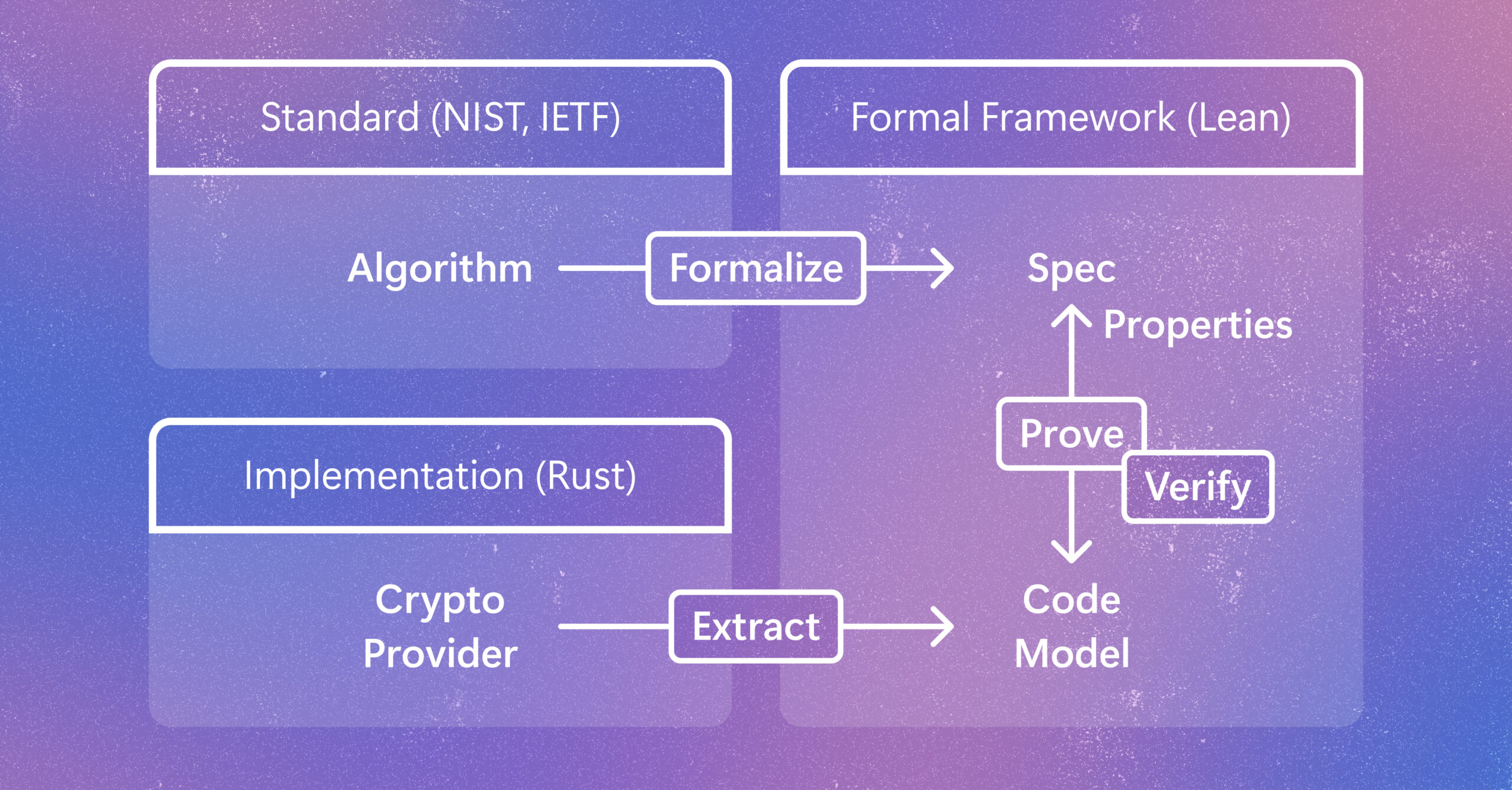
Verifying Rust cryptography in SymCrypt, from standards to code

Cryptographic code supports vital protections in modern computing systems. Learn how a new method helps verify code as developers write it while preserving speed and adaptability as it gets implemented and evolves. The post Verifying Rust cryptography in SymCrypt, from standards to code appeared first on Microsoft Research.

We use cookies to run the site and, with your consent, for analytics and to show ads. See our Cookie Policy.