This paper addresses infinite-dimensional Bayesian inference for inverse problem of partial differential equations with model parameters in infinite-dimensional Hilbert space by introducing a well-defined neural ordinary differential equation in infinite-dimensional space which encodes the prior information.
Abstract
This paper addresses infinite-dimensional Bayesian inference for inverse problem of partial differential equations with model parameters in infinite-dimensional Hilbert space. To effectively incorporate prior information, we propose a novel continuous normalizing flows based infinite-dimensional model. Specifically, by introducing a well-defined neural ordinary differential equation in infinite-dimensional space, a simple reference measure can be transformed into a more complex measure which encodes the prior information. A corresponding theoretical framework is established to ensure the well-posedness of our proposed Bayesian prior in infinite-dimensional space. We also provide training methods of the prior for two distinct data settings, along with two sampling algorithms for the resulting Bayesian posterior. The proposed framework is applied to three representative inverse problems: the simple smooth inverse problem, inverse scattering problem, and the inverse heat conduction problem. Numerical experiments support the theoretical analysis and demonstrate the efficiency of the proposed algorithms.
A novel Data-driven STochastic Asymptotic Regularization (\texttt{D-STAR}) method is proposed for solving linear and nonlinear ill-posed inverse problems, which incorporates a data-driven drift and a stochastic diffusion mechanism. Both known and unknown noise level cases are accommodated by the method, thereby making...
A modern all-at-once framework for PDE-based Bayesian inversion is proposed by introducing the PDE residual as probabilistic information and the new hybrid likelihood function eliminates PDE solves, thus reducing expensive computational costs, while performing rigorous Bayesian inference.
T. Nguyen, Fabian Schneider, L. Taghizadeh· 0 citations
Prior information for real-world physical quantities is most elegantly expressed via partial differential equations (PDEs). In this paper, we propose a novel way to solve PDEs using probabilistic inference on a factor graph. In general, factor graphs provide a natural way to encode prior knowledge into a model as expli...
Анна Петровна Казачкова, Leonhard Hennicke, Rainer Schlösser et al.· arXiv.org· 0 citations
In the past two decades, the Bayesian approach to inverse problems in infinite dimensional spaces has seen significant developments in theory, Markov chain Monte Carlo (MCMC) methods, and in applications. The Bayesian approach in finite dimension produces posterior distributions of finite dimensional random variables....
Sampling from the posterior is the central task of computational Bayesian inverse problems. The standard workhorse in Bayesian inference---Markov chain Monte Carlo (MCMC)---is sequential, yields correlated samples, and must be rerun for each new observation. Conditional flow matching offers an amortized alternative: a...
Jan Blechschmidt, O. Ernst, Moritz Poguntke et al.· 0 citations
Many Bayesian inverse problems are characterized by two parameter vectors with distinct roles. A medium property, operator coefficient, or geometry block enters the forward model nonlinearly, whereas a volumetric, initial condition, or boundary condition source enters linearly. General-purpose nonlinear surrogates must...
Zi-Heng Zhang, Ding-Cheng Luo, Thomas O'Leary-Roseberry et al.· 0 citations
Related blog posts
MIT News · Artificial Intelligence· news.mit.eduNov 17, 2026
By studying the computational foundations of language learning, Associate Professor Jacob Andreas builds intelligent systems that can communicate effectively with humans.
Microsoft Research Blog· microsoft.comNov 16, 2026
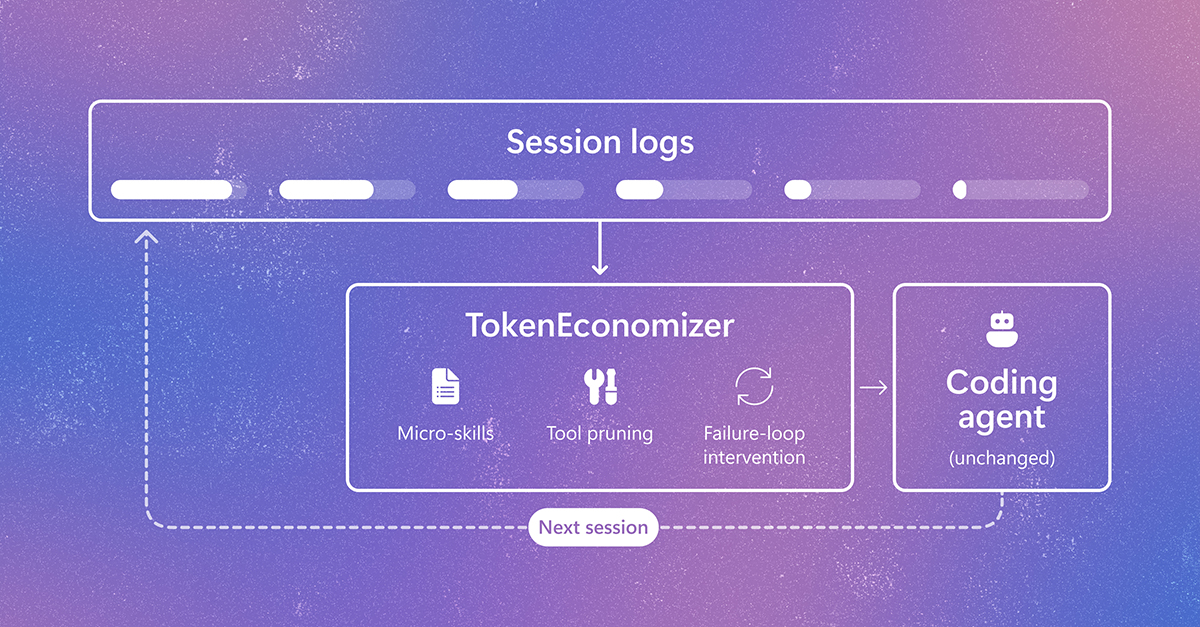
AI coding agents are increasingly help developers fix bugs and build features largely on their own, but every interaction with their models consumes tokens. In each session, an agent sends instructions, tool descriptions, and session history to its model. Most efforts to reduce this cost focus on individual tasks. Yet developers return to the same […] The post TokenEconomizer: Learning from Experience to Make AI Coding Agents More Efficient appeared first on Microsoft Research.
MIT News · Artificial Intelligence· news.mit.eduNov 13, 2026