Skip to content

Hierarchical Channel Stacking: A Structured Decision Framework for AI-Generated Image Detection

Aug 2026 · 0 citations · 14 references
Computer Science

TL;DR

HCS is introduced, a compact framework for AI-generated image detection that converts intermediate CNN activations into a structured 60-dimensional representation organized across three progressively deeper backbone stages that achieves 86.7% accuracy and 86.7% macro-F1 on the held-out test set.

Abstract

Many synthetic-image detectors produce accurate predictions but offer limited insight into how those decisions are formed. This paper introduces Hierarchical Channel Stacking (HCS), a compact framework for AI-generated image detection that converts intermediate CNN activations into a structured 60-dimensional representation organized across three progressively deeper backbone stages. HCS uses per-channel Level-1 classifiers and a Level-2 aggregator to produce image-level predictions while preserving explicit hierarchical structure for analysis. On a benchmark spanning GAN and diffusion generators, HCS achieves 86.7% accuracy and 86.7% macro-F1 on the held-out test set. Stage ablation shows that the full three-stage system outperforms reduced single-stage and two-stage variants, indicating that the hierarchy carries complementary predictive information. Stage-level contribution analysis further shows that, in the analyzed detector setting, fake GAN and fake diffusion images exhibit distinct stage-level contribution profiles. These results position HCS not simply as a compact detector, but as a structured framework for studying how synthetic-image detectors assemble evidence across representation levels.


View source

Similar papers

Open access Sep 2026

Vision Transformer Architectures for Next-Generation Image Classification: Attention-Driven Visual Understanding

Vision Transformer (ViT) architectures have emerged as powerful alternatives to conventional convolutional neural networks for image classification because they model long-range visual dependencies through self-attention. This paper presents a software-based image classification framework that uses a pre-trained ViT-Ba...

Sadeqa and Dr. Bitla Prabhakar · 0 citations
Preprint Sep 2026

Look Closer: Patch-wise Supervision for AI-Generated Image Detection

How much of an image does a detector need to see? Small RGB regions can retain useful evidence of image synthesis even when they reveal little of the full scene. Motivated by single-patch detection, we study patch-wise supervision: a shared backbone classifies explicit crops, each crop receives its own loss, and patch...

Zhi-Da Zhang, Tao Wu, Si-Yu Liu et al. · 0 citations
Review Open access Oct 2026

Adaptive Multi-Generator Deep Learning for AI-Generated Image Detection

This study reviews key developments in multi-generator detection and presents an adaptive framework that pairs specialized CNN backbones with transfer learning, dynamic gating weights, and systematic degradation testing, and outlines an efficient route toward modular deployment.

Aarti D. Galdhar, Urmila B. Shelke, Dr. H. B. Jadh · 0 citations
Open access Aug 2026

Few-shot image classification algorithm based on deep learning and feature fusion

Few-shot image classification remains difficult because a model must identify novel classes from only one or a few labeled examples while preserving discriminative local information. Metric-learning methods based on Earth Mover’s Distance (EMD) improve local correspondence by representing an image as a set of regional...

Huie Zhang, Mary Jane C. Samontet · 0 citations
#generative ai Book Open access Nov 2026

Training-Free Detection of AI-Generated Images Based on Coherence Analysis of Image Representations

This work proposes a training-free framework for AI-generated image detection based on perturbation-induced representation coherence, and achieves the highest mean AUROC among the evaluated training-free methods, while remaining competitive with training-based approaches.

Ji Li, Kai Wang · 0 citations
Open access Sep 2026

An attention-guided global and local fusion framework for lesion-focused image classification

Lesion-focused image classification presents a core analytical challenge, as discriminative signals are often sparse, spatially dispersed, and easily obscured by background noise, while conventional convolutional neural networks (CNNs) process entire images uniformly and may dilute signal relevance. This study hypothes...

Mst Shafia Tasnim, Md Samaun Elahee, Tanjim Taharat Aurpa et al. · 0 citations

Related blog posts

MIT News · Artificial Intelligence Oct 28, 2026

Making machines that can listen

Professor Paris Smaragdis develops computers with superhuman hearing for applications like speech recognition, music understanding, and environmental monitoring.

Microsoft Research Blog Aug 11, 2026

Introducing CARE-X: Towards Clinically Useful Radiology VLMs with Auxiliary Supervision, Reward-Aligned Learning, and Tool-Augmented Measurement

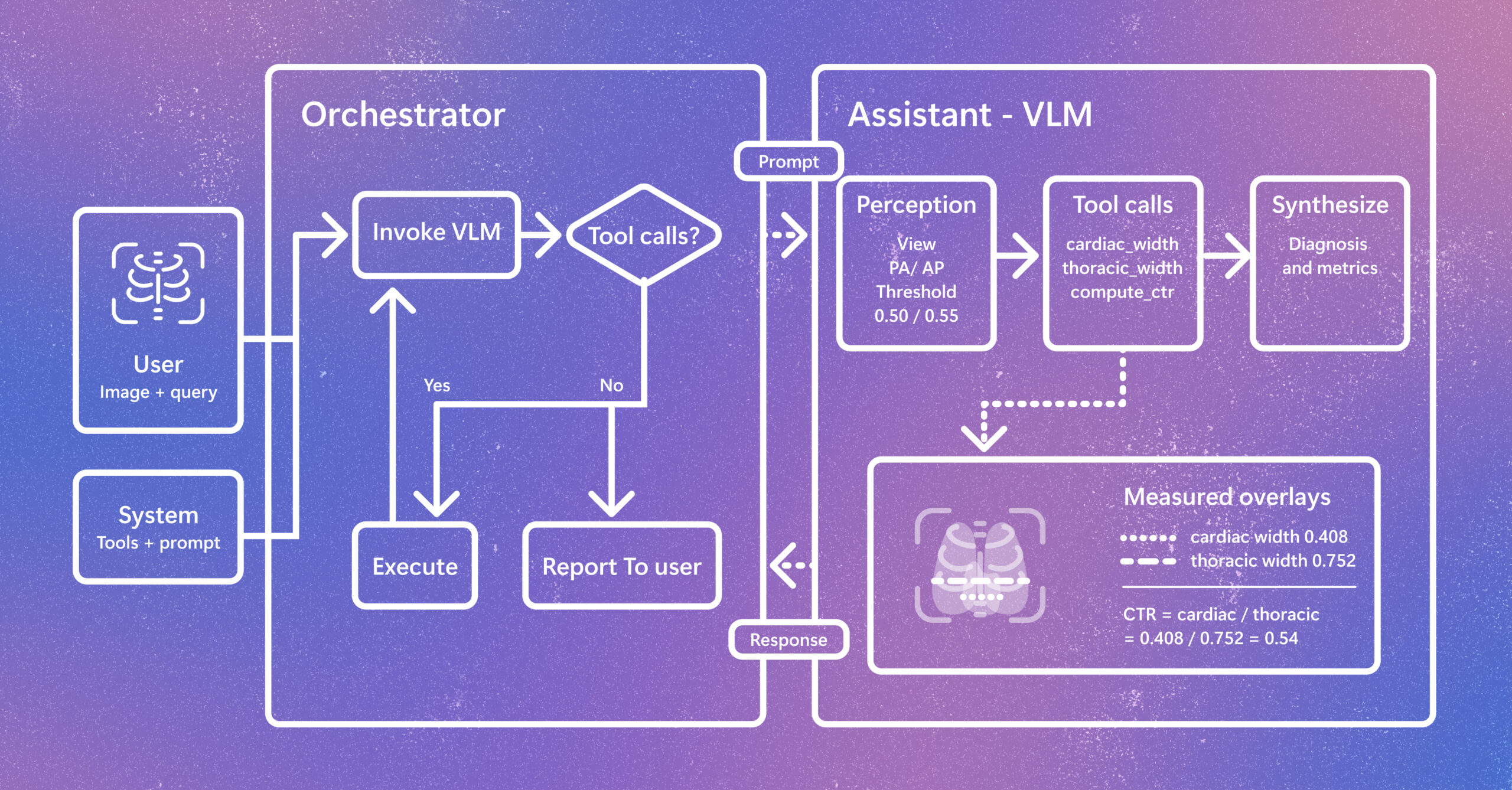
Radiology AI is evolving beyond report generation. CARE-X explores a unified approach that combines flexible reasoning, calibrated predictions, and measurement-based tools for chest X-ray interpretation. The post Introducing CARE-X: Towards Clinically Useful Radiology VLMs with Auxiliary Supervision, Reward-Aligned Learning, and Tool-Augmented Measurement appeared first on Microsoft Research.

We use cookies to run the site and, with your consent, for analytics and to show ads. See our Cookie Policy.