Skip to content

HB-PVI: A Hierarchical Bayesian Personalization and Value-of-Information Framework for Complex Activity Recognition

Sep 2026 · 0 citations · 31 references
Computer Science

TL;DR

The results argue for a population-first deployment policy whenever personalization gains are small relative to labeling, computation, and harm costs, and show that value-of-information reasoning, not raw predictive accuracy, should drive personalization decisions in health-sensing applications.


Abstract

Personalization can improve activity-recognition performance, but participant-specific gains are heterogeneous, and every additional calibration label has an acquisition cost. This study presents HB-PVI, a hierarchical Bayesian personalization and value-of-information framework jointly modeling participant heterogeneity, the benefit and harm of four personalization mechanisms, and the economic value of an additional label, for the 47-participant MUSIC-CAR complex-activity cohort. A leakage-safe, leave-one-participant-out evaluation combines a sequential-Monte-Carlo participant-effect updater with a Student-$t$ hierarchical gain model and a one-step expected-value-of-sample-information (EVSI) stopping rule. Adapter personalization produced small positive mean F1 gains, growing from 0.00099 at one label to 0.00198 at ten, while adapter-plus-head and prototype-residual personalization were negative on average. Under the primary practical-benefit threshold ($\Delta_{\min}=0.01$) and cost setting, one-step EVSI was zero at every decision state, so the policy purchased no labels and retained population inference for all 47 participants, matching always-stop exactly (region-of-practical-equivalence probability $=1$). Relative to fixed ten-shot adapter personalization, this reduced labeling by 100\% while keeping the posterior mean F1 loss at 0.00217 (95\% credible interval, 0.00048 to 0.00389), with posterior probability 0.9992 of remaining below the 0.005 tolerance. HB-PVI was utility-optimal in 199 of 216 cost-threshold settings and in every setting at or above the primary label cost. These results argue for a population-first deployment policy whenever personalization gains are small relative to labeling, computation, and harm costs, and show that value-of-information reasoning, not raw predictive accuracy, should drive personalization decisions in health-sensing applications.
View source

Similar papers

#artificial intelligence Preprint Sep 2026

More Features Are Not More Evidence: Limits of Training-Free Human Activity Recognition with Jev

The results show that training-free sensor decisions depend not only on the information available in the signal, but also on whether the model can use the representation through which that information is exposed, and the sensor-to-model interface should be treated as part of the model evaluation rather than as a neutra...

Orhan Konak · 0 citations

Age-Conditioned Evaluation of Handcrafted Polysomnography Models for Cognitive-Impairment Prediction

A CPU-oriented system that represented each study with 830 handcrafted demographic, physiological, and annotation-derived features indicated that all-pair discrimination did not persist among age-comparable participants and identifies age-conditioned cross-source generalization as the principal limitation of the submit...

Satwik Kapavarapu, N. Hoang, Andrei Malagusan · 0 citations
Open access Oct 2026

Compact and Explainable Human Activity Recognition with Boruta-RFE Feature Selection and SHAP Interpretation

Human activity recognition (HAR) based on wearable sensors commonly involves high-dimensional sensor-derived features, which may contain substantial redundancy and complicate model interpretation. In this study, we developed and evaluated a compact and explainable machine-learning framework using the UCI Human Activity...

Hui-Yuan Gao, Nian-Wen Wang, Zhong-Hua Wan et al. · 0 citations
Open access Oct 2026

Compact target-aware stability-based feature selection for cross-dataset wearable activity monitoring

Wearable activity-recognition models may lose reliability when transferred across participants, sensor placements, sampling rates, acquisition protocols, and activity definitions. This study evaluates a compact unsupervised target-aware feature-selection strategy for cross-dataset wearable activity monitoring under a p...

Sarra Ayouni, Maha Sliti, Abeer Abdulaziz Alghanem et al. · 0 citations
Review Open access Sep 2026

Cognitive Load or Timely Answers? Cognitive Effort Markers in Context-Aware EMA Sampling

Mobile self-reports provide subjective and contextual information that passive sensors cannot recover, but frequent prompts compete with everyday activities and are often answered late. Here, we show that situational context and recent response history predict whether an ecological momentary assessment response begins...

Xiao-Yue Li, Haonan Zhao · 0 citations

Related blog posts

MIT News · Artificial Intelligence Nov 17, 2026

Learning the language of machine learning

By studying the computational foundations of language learning, Associate Professor Jacob Andreas builds intelligent systems that can communicate effectively with humans.

Microsoft Research Blog Nov 16, 2026

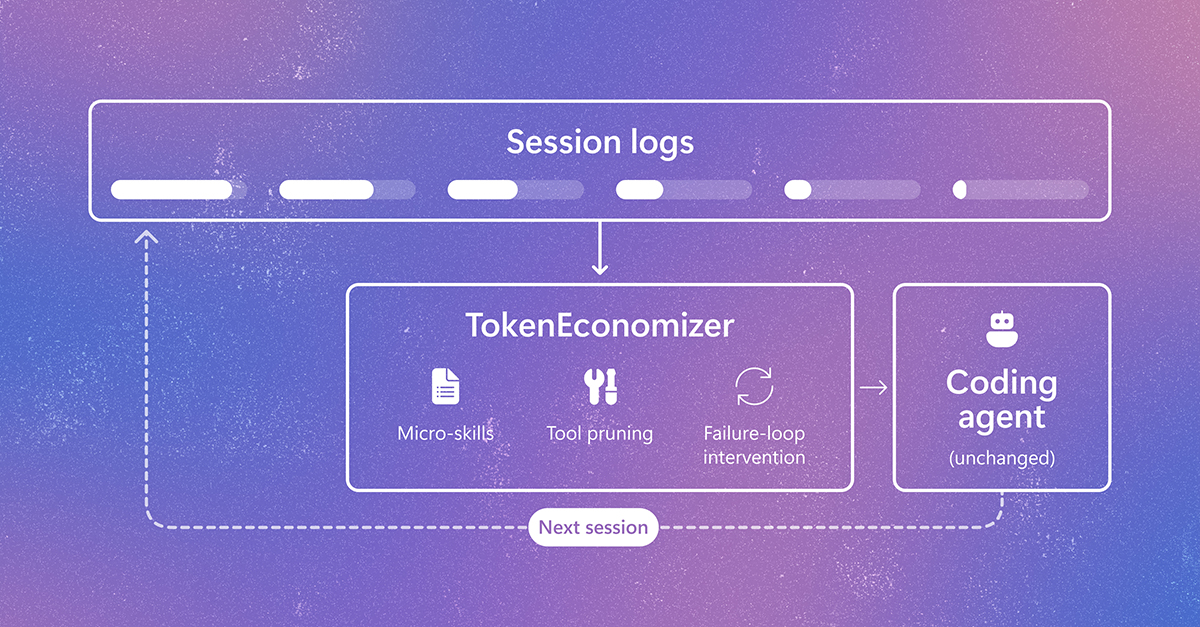
TokenEconomizer: Learning from Experience to Make AI Coding Agents More Efficient

AI coding agents are increasingly help developers fix bugs and build features largely on their own, but every interaction with their models consumes tokens. In each session, an agent sends instructions, tool descriptions, and session history to its model. Most efforts to reduce this cost focus on individual tasks. Yet developers return to the same […] The post TokenEconomizer: Learning from Experience to Make AI Coding Agents More Efficient appeared first on Microsoft Research.

We use cookies to run the site and, with your consent, for analytics and to show ads. See our Cookie Policy.
