A novel interpretation of sfGOT through the lens of the Hilbert-Schmidt Independence Criterion is provided, showing that minimizing the sfGOT distance between two graphs is equivalent to maximizing statistical dependence between the spectral embedding of their nodes.
Abstract
We propose a graph dictionary learning (GDL) framework where each graph is represented as a zero-mean Gaussian distribution derived from its filtered Laplacian. Each observed graph is approximated by a barycenter over learned atom graphs, computed under the filter graph distance (fGOT), a graph comparison metric sensitive to global structural properties. The reconstruction error between the observed graph and its barycenter is measured by the surrogate fGOT (sfGOT) distance, a tractable approximation of fGOT that handles graphs without known node correspondence, and is minimized end-to-end via backpropagation. We further provide a novel interpretation of sfGOT through the lens of the Hilbert-Schmidt Independence Criterion, showing that minimizing the sfGOT distance between two graphs is equivalent to maximizing statistical dependence between the spectral embedding of their nodes. Experiments on benchmark datasets demonstrate competitive performance over existing GDL methods on graph clustering and classification tasks.
Structured Connection Graph Learning (SCGL), a block-coordinate algorithm that combines closed-form updates, manifold projections, and spectral constraints, and converges to stationary points of the resulting nonconvex problem, is developed.
Leonardo Di Nino, Gabriele D’Acunto, Sergio Barbarossa et al.· 0 citations
This paper proposes a feature-graph-guided adaptive Log-L2,1 sparse NMF with anchor dual graphs under a logarithmic framework that jointly integrate sample structure preservation, feature structure preservation, and feature-aware sparse learning within a unified graph-NMF model.
Quanrun Li, Tao Ma, Fangchen Xu et al.· Mathematics· 0 citations
The proposed DD-AG2m alternates between AG2m optimization on the original (global) graph and AG2m optimization on the partitioned graphs, and introduces a two-level variant that performs global optimization steps on a coarse graph obtained by randomly subsampling nodes within each subdomain.
Laurynas Varnas, Julien Herrmann, Alexander Heinlein et al.· 0 citations
Across five graph benchmarks, the performance of SDRs is competitive with that of real-valued dense embeddings on node classification and link prediction, while the architecture exhibits portability, resilience to noise, and robustness to data corruption.
Generating categorical graphs requires choosing node and edge types that form a coherent structure without depending on node order. Many graph generators encode categories as fixed one-hot vectors, which can impose an artificial geometry in which categories are equidistant. We propose Embedded Graph Flows (EGF), a gene...
Ethan Ma, Zi-Han Wang, C. Chow et al.· 0 citations
Experiments show that the proposed SCoGL variants improve graph recovery and enhance downstream tasks such as graph signal denoising when signal observations are scarce.
Ming-Xiao Liu, Bahar Oveisgharan, Bing-Yan Zou et al.· 0 citations
Related blog posts
MIT News · Artificial Intelligence· news.mit.eduOct 2, 2026
Martin Trust Center Managing Director Bill Aulet introduces Dear Dreamer, a free platform for middle and high school students who want to learn about entrepreneurship.
Microsoft Research Blog· microsoft.comSep 30, 2026
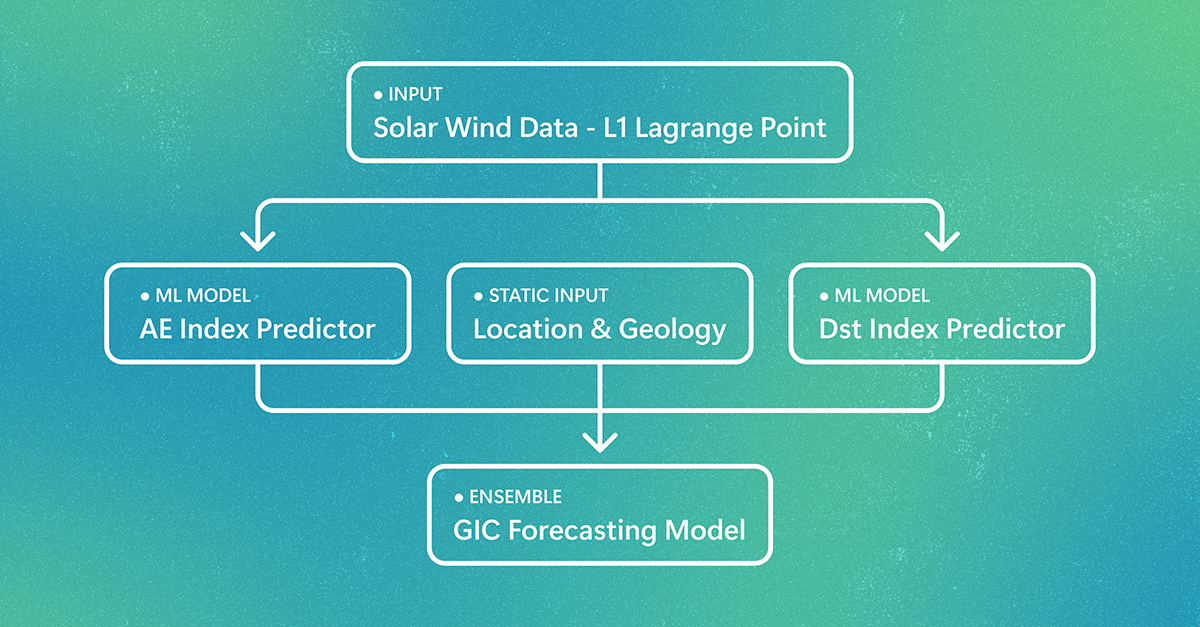
Extreme space-weather events can damage power systems on Earth and degrade GPS accuracy and satellite operations. A new machine learning system can predict where damage is likely to occur 30-60 minutes before a storm arrives. The post Forecasting space weather risks on power grids appeared first on Microsoft Research.
We use cookies to run the site and, with your consent, for analytics and to show ads.
See our Cookie Policy.