This paper builds on the singular value decomposition factorization of adapters to develop a framework based on Stein variational gradient descent (SVGD), which delivers strong model calibration and attains higher prediction accuracy than SVGD and related uncertainty estimation methods that are formulated in Euclidean space.
Abstract
Several geometry-aware approaches to low-rank adaptation have emerged for parameter-efficient fine-tuning of large pre-trained models. These methods aim to take full advantage of the geometric structure of low-rank manifolds for improving the efficiency in subspace utilization and reducing redundancy by enforcing orthogonality constraints during optimization. The strong empirical results of these techniques have motivated further study into whether predictions from such geometry-based adaptation methods could be overconfident. In this paper, we build on the singular value decomposition factorization of adapters to develop a framework based on Stein variational gradient descent (SVGD). In this formulation, the low-rank matrices are transported along the Stiefel manifold to match the targeted distributions while retaining their crucial geometric structure. Since this geometry-aware SVGD approach provides multiple solutions during inference, it supports uncertainty quantification and produces better-calibrated adapters on the Stiefel manifold. Extensive experiments show that our method delivers strong model calibration and attains higher prediction accuracy than SVGD and related uncertainty estimation methods that are formulated in Euclidean space.
Downstream adaptation of large pretrained models (LPMs) via full-parameter fine-tuning is computationally prohibitive. Parameter-efficient fine-tuning (PEFT) methods, such as the widely used Low-Rank Adaptation (LoRA), reduce this cost but still parameterize dense updates over the selected weight matrices. This support...
Zhongyi Wen, Zhikai Zhai, Guo-Min Sun et al.· IEEE Transactions on Pattern...· 0 citations
Divergence-based regularization and Sharpness-Aware Minimization (SAM) are two prominent approaches for improving generalization in deep learning, both motivated by robustness to perturbations. However, their relationship has remained largely unexplored. Building on classical second-order expansions of $f$-divergences,...
Deep vision models often degrade under distribution shift. Test-time adaptation can improve robustness but typically requires iterative optimization, hyperparameter tuning, and multiple forward-backward passes. We propose Zero-Training Fisher Geometry Alignment (ZFGA), a closed-form method that improves robustness unde...
Behraj Khan, T. Syed, Syed Ahmad Chan Bukhari· 0 citations
We study Bayesian optimization (BO) through the lens of information geometry. Pulling back the Fisher information metric through the surrogate posterior map yields a local sensitivity tensor on the input space, which leads to an upper bound on the gradient of reparameterizable acquisition functions. This view explains...
Saksham Kiroriwal, Julius Pfrommer, Jürgen Beyerer· 0 citations
In this paper, we are concerned with matrices formed by block-diagonal factors interleaved with fixed permutations -- a flexible family of structured matrices. This class has recently drawn interest in deep learning architectures for its balanced expressivity-efficiency trade-off, yet efficient computational strategies...
This work introduces a Nested Inductive Bias framework that utilizes a two-stage diffeomorphic composition to formally pull back non-Euclidean target geometries onto the SPD manifold, and proposes the Rational Conformal Metric (RCM), designed to establish state-of-the-art geometric robustness against outliers by boundi...
Tushar Das· 0 citations
Related blog posts
MIT News · Artificial Intelligence· news.mit.eduOct 2, 2026
Martin Trust Center Managing Director Bill Aulet introduces Dear Dreamer, a free platform for middle and high school students who want to learn about entrepreneurship.
Microsoft Research Blog· microsoft.comSep 30, 2026
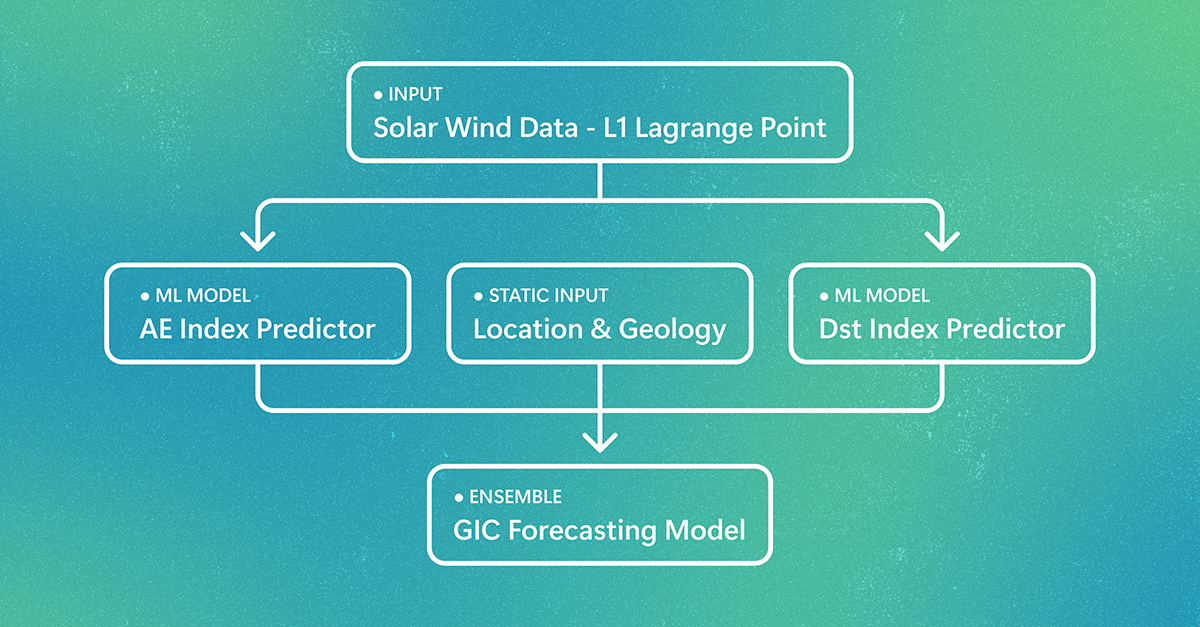
Extreme space-weather events can damage power systems on Earth and degrade GPS accuracy and satellite operations. A new machine learning system can predict where damage is likely to occur 30-60 minutes before a storm arrives. The post Forecasting space weather risks on power grids appeared first on Microsoft Research.
We use cookies to run the site and, with your consent, for analytics and to show ads.
See our Cookie Policy.