In molecular discovery, molecule size is coupled to composition, structure, and other target properties. Yet most 3D generators require molecule size to be specified before generation. Here, we introduce Equivariant-Free Transformer-Autoencoded Latent Flow Matching, a two-stage generative framework that relies entirely on a single fixed-dimensional molecule-level latent representation to generate variable-size molecules. The second-stage flow matching model samples this latent vector, and an autoregressive Transformer decoder then determines molecule size while generating atom types, coordinates, and chemically informative states. Canonical atom ordering and rigid-pose alignment enable standard Transformers without equivariant layers, while joint decoding of molecular geometry and an enriched chemical state enables reliable, deterministic, chemistry-guided graph recovery without requiring a learned dense pairwise bond decoder. The same fixed-dimensional latent supports unconditional and property-conditioned flow matching, while optional property supervision adds an internal ranking readout, with no separate predictor or reference calculations. On PCQM4Mv2, EF-TALFM achieves the highest fraction of molecules that are unique, training-set novel, pass sanitization and PoseBusters sanity checks, 89.4\%, compared with 75.6\% for UAE-3D and 69.8\% for FlowMol. EF-TALFM also achieves higher measured computational throughput for training and sampling. Across ten target HOMO--LUMO gaps, internal ranking doubles the density functional theory (DFT)-verified hit rate within $0.1\,\mathrm{eV}$, while preserving 97\% novelty among unique verified hits. These results demonstrate that fixed-dimensional molecule-level generation followed by symmetry-resolved autoregressive realization provides a practical architecture for open-ended and property-directed 3D molecular design.

Target-aware three-dimensional (3D) molecular generation aims to produce candidate molecules with chemical validity, conformational plausibility, and target compatibility under protein binding pocket constraints. Existing pocket conditioned diffusion models rely primarily on local geometric and atom-level state modelin...
Jia-Hao Liu, Yong-Xuan Lai, Jie Xia et al.· IEEE journal of biomedical a...· 0 citations
TreeRef is proposed, a tree-based molecular representation that assigns molecular topology and topology-dependent local 3D geometry to a naturally variable-size tree and TreeRef-BFN is developed, a Bayesian Flow Network with a standard Transformer backbone that globally couples these locally defined variables and joint...
Rui-Qing Sun, Sen Yang, Da-Wei Feng et al.· 0 citations
Generative models produce three-dimensional molecular structures with high geometric accuracy, yet they are trained on distributions of atomic coordinates without explicit access to the underlying physics. The potential energy surface (PES) describes how the energy changes around a molecular geometry, and the RMSD betw...
S. Darouich, Juliane Geisler, Jacob W. Toney et al.· 0 citations
Foundation machine-learning interatomic potentials cover broad configurational and chemical spaces, but their reliability can vary across the atomic environments encountered during a simulation. Here we introduce the calibrated Mahalanobis (CALM) extrapolation grade $\gamma$, a piecewise differentiable per-atom quantit...
Yu. Lysogorskiy, A. Bochkarev, R. Drautz· 0 citations
PolyLatentFlow, a framework based on continuous-time flow matching in latent space for unconditional and conditional polymer generation, together with LlamaUni, a multimodal representation combining polymer sequence and 3D structural information are introduced.
By studying the computational foundations of language learning, Associate Professor Jacob Andreas builds intelligent systems that can communicate effectively with humans.
Microsoft Research Blog· microsoft.comNov 16, 2026
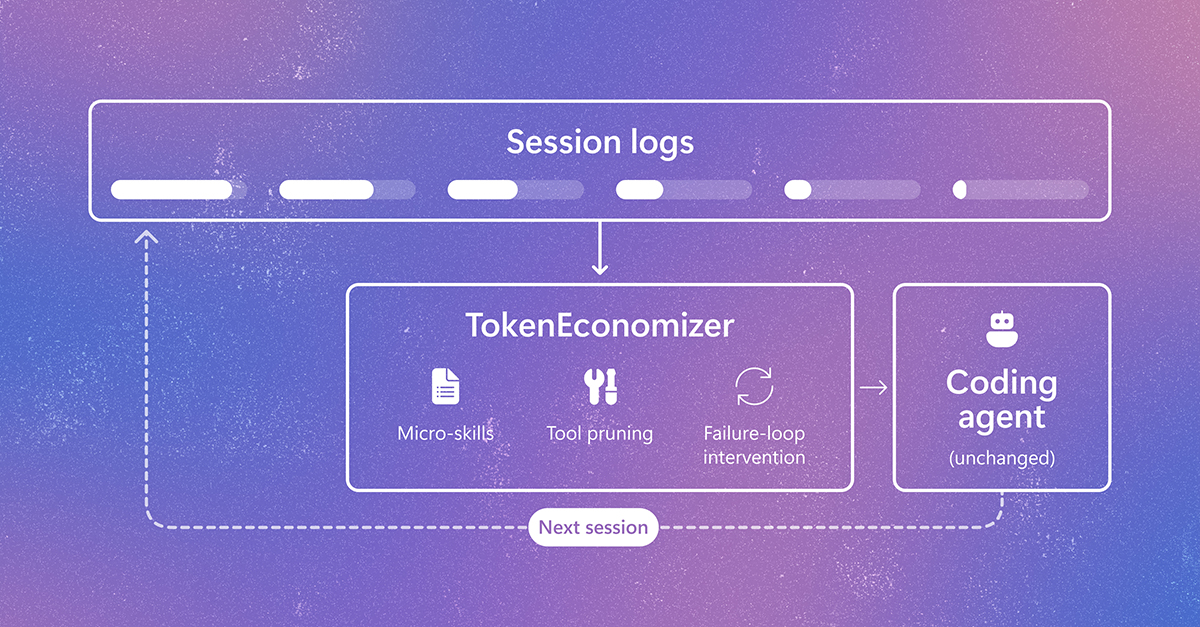
AI coding agents are increasingly help developers fix bugs and build features largely on their own, but every interaction with their models consumes tokens. In each session, an agent sends instructions, tool descriptions, and session history to its model. Most efforts to reduce this cost focus on individual tasks. Yet developers return to the same […] The post TokenEconomizer: Learning from Experience to Make AI Coding Agents More Efficient appeared first on Microsoft Research.
MIT News · Artificial Intelligence· news.mit.eduNov 13, 2026