Skip to content

PCA-Enhanced Adaptive NVAR Framework for High-Resolution Sea Surface Temperature Forecasting in the East Sea

Jun 2026 · arXiv.org · Vol abs/2606.12141 · 0 citations · 27 references
Computer Science

TL;DR

The proposed reduced-order framework is evaluated using autonomous rolling forecasts up to a 90-day horizon and compared with Standard NVAR (Next Generation Reservoir Computing) and a Persistence baseline, achieving up to 96.52% improvement in mean squared error relative to Persistence while maintaining stable predictive performance throughout extended forecasting.

Abstract

Accurate forecasting of sea surface temperature (SST) is essential for marine ecosystem monitoring, climate assessment, fisheries management, and operational ocean forecasting. While numerical ocean models provide reliable predictions, they are computationally expensive, and conventional machine learning methods often suffer from high-dimensional inputs and error accumulation during long-term autonomous forecasting. This study extends our previously proposed Adaptive Nonlinear Vector Autoregression (Adaptive NVAR) framework to high-resolution real-world SST prediction by integrating Principal Component Analysis (PCA) through Singular Value Decomposition (SVD). Daily SST fields from the GLORYS12V1 reanalysis dataset covering the East Sea, Yellow Sea, and East China Sea are compressed into a lower-dimensional latent representation that preserves the dominant spatial variability. The proposed reduced-order framework is evaluated using autonomous rolling forecasts up to a 90-day horizon and compared with Standard NVAR (Next Generation Reservoir Computing) and a Persistence baseline. Across all three regions, Adaptive NVAR consistently suppresses long-term error accumulation, achieving up to 96.52% improvement in mean squared error relative to Persistence while maintaining stable predictive performance throughout extended forecasting. Although the adaptive architecture incurs a higher one-time offline optimization cost than Standard NVAR, inference is completed in milliseconds, making the proposed framework an efficient and scalable approach for long-term, high-resolution ocean state forecasting.


View source

Similar papers

Aug 2026

Advancing oceanographic forecasts in the Bay of Bengal: an AI-based spatiotemporal prediction for SST and MLD

A deep-learning model based on ConvLSTM to forecast SST and MLD in the Bay of Bengal for up to four weeks ahead contributes to improved ocean variable forecasting and demonstrates potential for ISMR prediction and disaster management.

B. Kumar, Rahul Kumar, B. Gayen et al. · 0 citations
Open access Oct 2026

Improved Skills for Predicting Sub‐Seasonal to Seasonal Global Sea Surface Temperature

ABSTRACT Accurate prediction of global sea surface temperature at sub‐seasonal to seasonal (S2S) timescales is critical for drought and flood forecasting, as well as for improving disaster preparedness in human society. Operational physics‐based numerical models are run to predict S2S sea surface temperature and corres...

Long-Hao Wang, Xuan-Ze Zhang, Ruby L. Leung et al. · 0 citations
Open access Sep 2026

How ocean thermal structure and atmospheric steering govern typhoon evolution: evidence from interpretable machine learning

This study develops a tree-based framework for simultaneous multi-step prediction of typhoon trajectory and intensity in Western North Pacific (WNP), and applies SHapley additive explanations (SHAP) to quantify the contribution of individual environmental drivers to each forecast.

H. Dang, M. Roantree, V. Tran · 0 citations
#machine learning Preprint Aug 2026

Structured Neural Modeling of Daily Arctic Sea-Ice Concentration Evolution: Physical-Trajectory-Driven Learning and Forecast-Domain Adaptation

Experiments show that the constructed base evolution core can accurately and stably simulate daily sea ice evolution at both short-term and annual scales under reanal?ysis forcing, and can be effectively transferred to the forecast domain through lightweight adaptation, achieving stable prac?tical forecasting capabilit...

Ma-Qun Zhang, Feng Gao, Wan-Kun Chen et al. · 0 citations
Open access 2026

A Depth-Aware Ensemble Deep Learning Framework With Layer-Wise Recursive Prediction for Multisource Subsurface Ocean Temperature and Salinity Forecasting

Accurate prediction of upper ocean temperature (UOT) and salinity (SS) within the critical 0–50-m depth range is essential for understanding climate variability and supporting sustainable marine ecosystem management. However, existing approaches often struggle to capture complex spatiotemporal dependencies and explicit...

Yue-Shan Chang, Yan-Jhen Liao, Basanta Haobijam et al. · 0 citations

Related blog posts

MIT News · Artificial Intelligence Nov 17, 2026

Learning the language of machine learning

By studying the computational foundations of language learning, Associate Professor Jacob Andreas builds intelligent systems that can communicate effectively with humans.

Microsoft Research Blog Nov 16, 2026

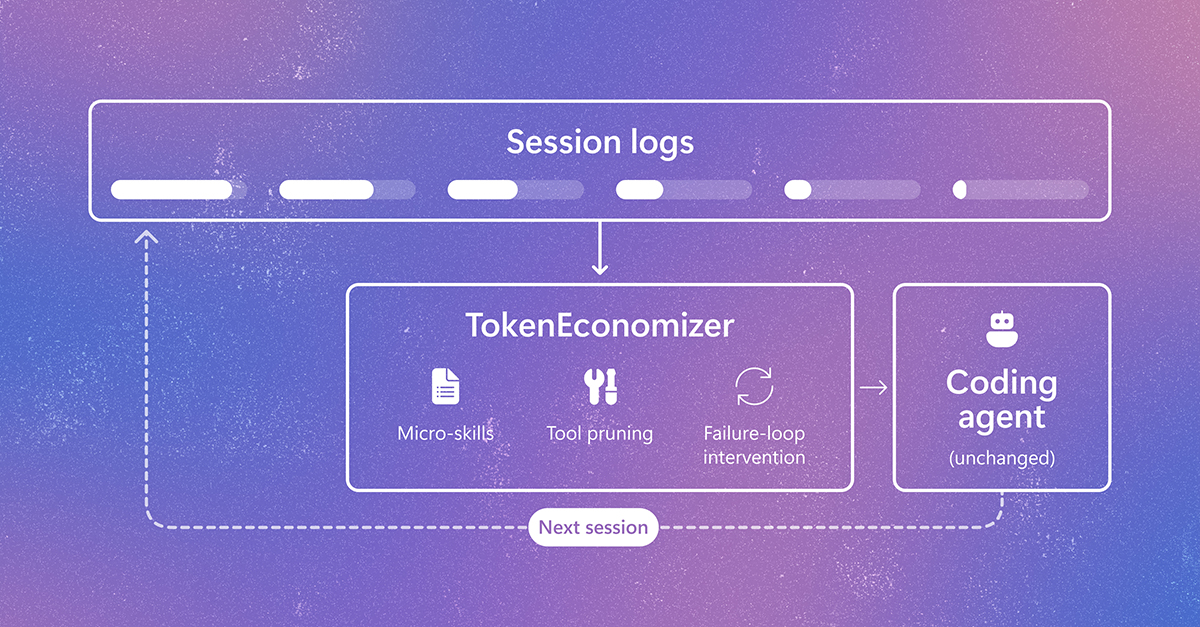
TokenEconomizer: Learning from Experience to Make AI Coding Agents More Efficient

AI coding agents are increasingly help developers fix bugs and build features largely on their own, but every interaction with their models consumes tokens. In each session, an agent sends instructions, tool descriptions, and session history to its model. Most efforts to reduce this cost focus on individual tasks. Yet developers return to the same […] The post TokenEconomizer: Learning from Experience to Make AI Coding Agents More Efficient appeared first on Microsoft Research.

We use cookies to run the site and, with your consent, for analytics and to show ads. See our Cookie Policy.