Overall, Code2Skill transforms procedural knowledge embedded in repositories into grounded, verifiable, and transferable agent skills, providing initial evidence that the pipeline can expand with the growing volume of AI-generated software.
Abstract
Reusable skills give agents transferable procedural knowledge, making scalable acquisition essential for extending agents beyond prior experience. Existing methods face two limitations: trajectory-based synthesis requires interactions with specific environments, while document-derived skills may lack executable evidence and verification. Source code offers a complementary path: it requires no prior agent experience yet provides executable evidence for grounding abstractions. We present Code2Skill, a fully automated pipeline that transforms selected code units into implementation-anchored records of atomic operations, composite workflows, and recurring patterns, then verifies each record through source-body-blind reconstruction and source-aware comparison. Applied to 19,769 popular, actively maintained GitHub repositories, Code2Skill produces CodeSkillBank, a grounded bank of 1,006,822 accepted records with workflow, boundary, provenance, and source-evidence metadata. Across 72 protocol-matched evaluations covering nine model settings and eight benchmarks, models augmented with retrieved CodeSkillBank skills improve by 11.7% on average over matched baselines and outperform them in 57 cases. Under a unified downstream interface, Code2Skill also outperforms trajectory-derived skill banks on all seven shared benchmarks, showing that repository-derived skills can provide useful procedural knowledge before agents accumulate sufficient interaction experience. Skills synthesized from tested AI-generated code achieve a 93.50% pass rate, compared with 93.00% for human-written code, providing initial evidence that the pipeline can expand with the growing volume of AI-generated software. Overall, Code2Skill transforms procedural knowledge embedded in repositories into grounded, verifiable, and transferable agent skills.

This paper proposes SkillAlchemy, an admission-centered framework for source-grounded skill creation that identifies implicit requirements through contrastive evidence, admits candidate procedures based on evidence-supported scope, and compiles the admitted content into a grammar-guided skill package.
Heng Wang, Shuyue Wei, Boyi Liu et al.· 0 citations
Executable environments are critical for post-training agents on tasks that require tool use and multi-step interaction, but constructing executable tasks together with their environments remains difficult to scale. Skills provide reusable domain knowledge, operational procedures, and tool-use instructions, but a subst...
Wei-Yi Xu, Xiao-Wen Yang, Wen Da et al.· 0 citations
CodeActionBench is introduced, a benchmark of 25 manipulation tasks that evaluates this capability through agentic Code-as-Policy and provides a controlled testbed for measuring how general-purpose models translate their capabilities into manipulation behavior and for examining typical failure scenarios in that process...
Yiheng Lyu, Xueying Jiang, Wen-Hao Li et al.· 3 citations
ACES (Agentic Continuous Evaluation of Skills), a repository-native framework for evaluating skills and product capability packages as executable agent artifacts, is presented.
Christopher Kevin, Narendran Raghavan, J. Puget et al.· 3 citations· ⚡1
As agents rapidly evolve, existing benchmarks can become saturated, limiting their ability to distinguish capabilities and reveal remaining failure modes. Particularly in scientific domains, constructing and updating benchmarks requires substantial time, labor, and domain expertise, making it difficult to keep evaluati...
Dongki Kim, Namkyeong Lee, Surag Nair et al.· 0 citations
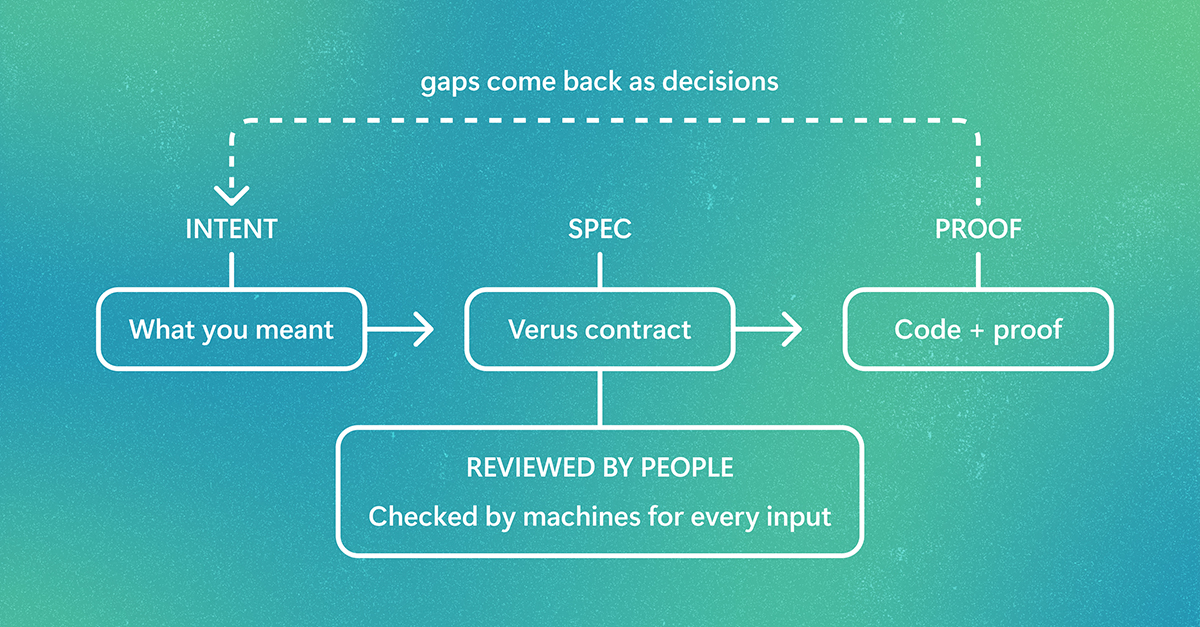
AI agents can generate code at a scale that’s hard for humans to review line-by-line. PDD Kit helps ensure the code is doing what the developer intended by creating formal specifications and testing against them. It converts developer intent into a Verus specification, proves AI-generated code meets it for every input, and uses tests where proofs aren't practical. Developers review intent, not every line. The post Formally verifying agent-written full-stack web apps with PDD Kit appeared first o…
We use cookies to run the site and, with your consent, for analytics and to show ads.
See our Cookie Policy.