This paper presents various feature scopes used in wireless sensor networks (WSNs) and illustrates distinct approaches like relay node placement, efficient communication, machine-learning systems i.e. reinforcement learning, and heuristic techniques.
Abstract
Recent demand for Internet of things (IoT) based sensing devices has increased in many significant areas, such as greenhouse monitoring, remote patient monitoring, military applications, wild-life tracking and habitat monitoring, precision agriculture, etc. Moreover, some critical issues are present in the perpetual sensor network like node energy consumption rate, coverage/connectivity, quality of service, network throughput and charging cycle capacity of sensor node batteries. Thereby, various network issues can arise, especially regarding coverage holes, proper connectivity, and network life-time. In this paper, we have studied these problems well and have shown the necessary constraints for the connectivity of the IoT sensor network. Moreover, we have also presented various helpful IoT applications and energy harvested IoT sensor networks. Any network can perform well for a long time because of energy management which is very crucial. This paper presents various feature scopes used in wireless sensor networks (WSNs). It also illustrates distinct approaches like relay node placement, efficient communication, machine-learning systems i.e. reinforcement learning, and heuristic techniques. It also discusses real-world deployments to highlight practical connectivity challenges and failures.

WSNs have become a key component of the modern monitoring and automation infrastructure, allowing the realtime data gathering, intelligent decision-making, and the integration with Internet of Things (IoT) platforms. WSNs are a scalable, adaptable and autonomous solutions to a wide variety of fields, such as environmen...
Sivasakthi K, Kirubhanandan C. G., M. Prithya et al.· 2026 2nd International Confe...· 0 citations
Reliable and energy-efficient wireless sensor networks (WSNs) are important for continuous monitoring in nuclear facilities, where limited battery resources, restricted maintenance access, and safety-critical operation require stable and efficient communication. This study evaluates four routing protocols for IoT-based...
M. Eltokhy, I. Fayed, E. H. Ali· Energies· 0 citations
Future studies should place greater emphasis on energy-autonomous systems, edge intelligence, secure and interoperable architectures, digital twins, adaptive autonomous control, and realistic evaluation of emerging communication technologies for greenhouse applications.
J. Popoola, B. Iyaomolere, K. Akingbade et al.· Saudi Journal of Engineering...· 0 citations
This paper derives the energy model for single-node communication and extends it to multiple-sensor-node communication where several sensors concurrently transmit their information and derives an energy model for a battery-free sensor node that relies on the energy harvested from ambient sources to drive its operation.
Siaka Konaté, Changli Li, Drissa Traoré et al.· Computer Networks and Commun...· 0 citations
A systematic review evaluating a final cohort of n=86 contemporary energy management frameworks published between 2020 and 2026 highlights how the strategic integration of cohesive, cross-layer hybrid optimization strategies can mitigate active energy dissipation, providing actionable technical recommendations for futu...
David Ochola, Okuthe P. Kogeda· Digital· 1 citation
The IoT technology has evolved at such a high pace, and we are now able to make smart monitoring systems in inaccessible areas like in the ocean using the same connected devices. Based on the requirements of environmental protection, the marine ecosystems require continuous monitoring in regard to climate analysis, pre...
G. Dalton, A. B. V. Louis, C. R. Thilahar et al.· Scientific Reports· 0 citations
Related blog posts
MIT News · Artificial Intelligence· news.mit.eduNov 17, 2026
By studying the computational foundations of language learning, Associate Professor Jacob Andreas builds intelligent systems that can communicate effectively with humans.
MIT News · Artificial Intelligence· news.mit.eduNov 17, 2026
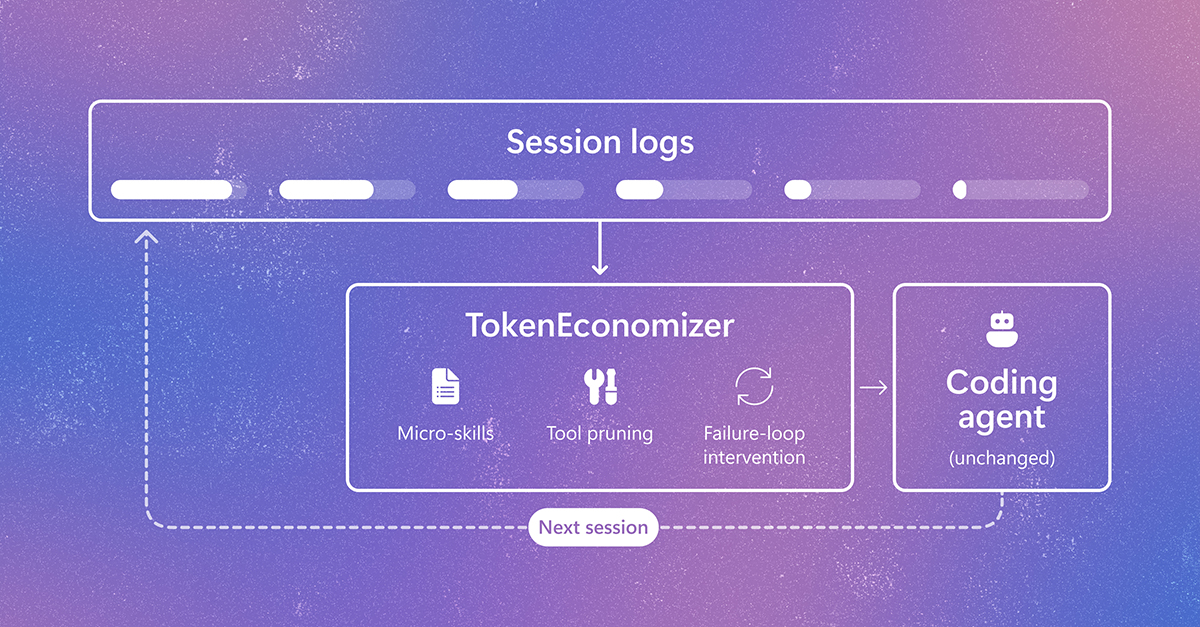
AI coding agents are increasingly help developers fix bugs and build features largely on their own, but every interaction with their models consumes tokens. In each session, an agent sends instructions, tool descriptions, and session history to its model. Most efforts to reduce this cost focus on individual tasks. Yet developers return to the same […] The post TokenEconomizer: Learning from Experience to Make AI Coding Agents More Efficient appeared first on Microsoft Research.
MIT News · Artificial Intelligence· news.mit.eduNov 9, 2026