Skip to content

Physics-Informed Multi-Task Surrogate Model for the Martian Nightside Thermosphere

Sep 2026 · 0 citations · 20 references
Physics Computer Science

Abstract

Modeling the Martian nightside thermosphere remains challenging due to sparse in situ sampling and strong coupling among transport, magnetic, and seasonal processes. Purely data-driven models can produce non-physical artifacts, such as density inversions, in poorly sampled altitude regimes. We present a multi-task physics-informed neural network that simultaneously predicts the base-10 logarithmic densities of four neutral species (O, CO$_2$, N$_2$, and Ar) using more than a decade of MAVEN/NGIMS observations (MY 32-38, 2014-2025). A shared backbone learns a common representation of the nightside thermospheric state and branches into species-specific output heads. A weak monotonicity prior is incorporated via automatic differentiation by penalizing positive vertical gradients in logarithmic density. Experiments using an orbit-disjoint train/validation/test split show that physics-informed regularization substantially reduces non-physical inversions while preserving predictive skill and slightly improving it in the best-performing configuration, as measured by RMSE, MAE, and $R^2$. The resulting model provides a computationally efficient surrogate for nightside thermospheric reconstruction with improved vertical consistency.


View source

Similar papers

Preprint Sep 2026

FAST-ML: A Hybrid Physics-Machine Learning Framework for Tropical Cyclone Intensity Forecasting

FAST-ML demonstrates that observation-driven parameter learning within physically constrained dynamics simultaneously enhances accuracy, interpretability, and computational efficiency, and demonstrates that observation-driven parameter learning within physically constrained dynamics simultaneously enhances accuracy, in...

Shi-Jie Xiao, Jonathan Lin, Thomas Ehrmann et al. · 0 citations
Review Aug 2026

Physics-Informed Neural Operator Surrogate for 2D Magnetohydrodynamic Reconnection

Direct numerical simulation of magnetic reconnection is limited by the scale separation of resistive magnetohydrodynamics. At large Lundquist numbers $S$ the current layer thins as $S^{-1/2}$, forcing fine grids and short time steps that make parameter scans prohibitively expensive. Deep learning neural operators offer...

Kushaal Kumar Pothula, Arunav Kumar · 0 citations
#machine learning Open access Oct 2026

The Neuro-Physical Inverter: A Modular Framework for Magnetotelluric Inversion Coupling Ensemble Conditioning with Residual Learning

We present the Neuro-Physical Inverter (NPI), a modular, uncertainty-aware framework for geophysical inversion that couples ensemble-based conditioning with constrained residual learning, demonstrated in the 1D magnetotelluric (MT) setting as a controlled testbed. The framework operates in two stages. An Ensemble-Condi...

Jae Deok Kim, Sai Ravela, R. Evans · 0 citations
Preprint Aug 2026

Physics-Informed Learning of Probabilistic Gegenbauer Reconstruction for Transport-Dominated Problems

A physics-informed machine-learning framework is proposed that predicts probability distributions over candidate Gegenbauer parameter pairs, enabling probabilistically weighted reconstruction while accounting for parameter uncertainty and achieves a more favorable accuracy--cost trade-off than problem-specific model re...

Lei Yan, Yan Jiang · 0 citations
#diffusion models Open access Oct 2026

NeuPlume: generative inversion of atmospheric point-source emissions from sparse observations

NeuPlume is presented, a neural-physical framework that formulates inversion as observation-guided generation and selection of complete three-dimensional concentration fields and provides an extensible methodology for jointly estimating source parameters and concentration fields.

Lei Wang, Xin Ma · 0 citations
Open access Sep 2026

Machine-learned mapping functions for the asymmetric troposphere

This work marks the first global machine learning-based empirical MF models that directly capture atmospheric asymmetry, offering a flexible and physically consistent alternative to traditional models in space geodesy.

Zhen-Yi Zhang, B. Soja · 1 citation

Related blog posts

MIT News · Artificial Intelligence Nov 17, 2026

Learning the language of machine learning

By studying the computational foundations of language learning, Associate Professor Jacob Andreas builds intelligent systems that can communicate effectively with humans.

Microsoft Research Blog Nov 16, 2026

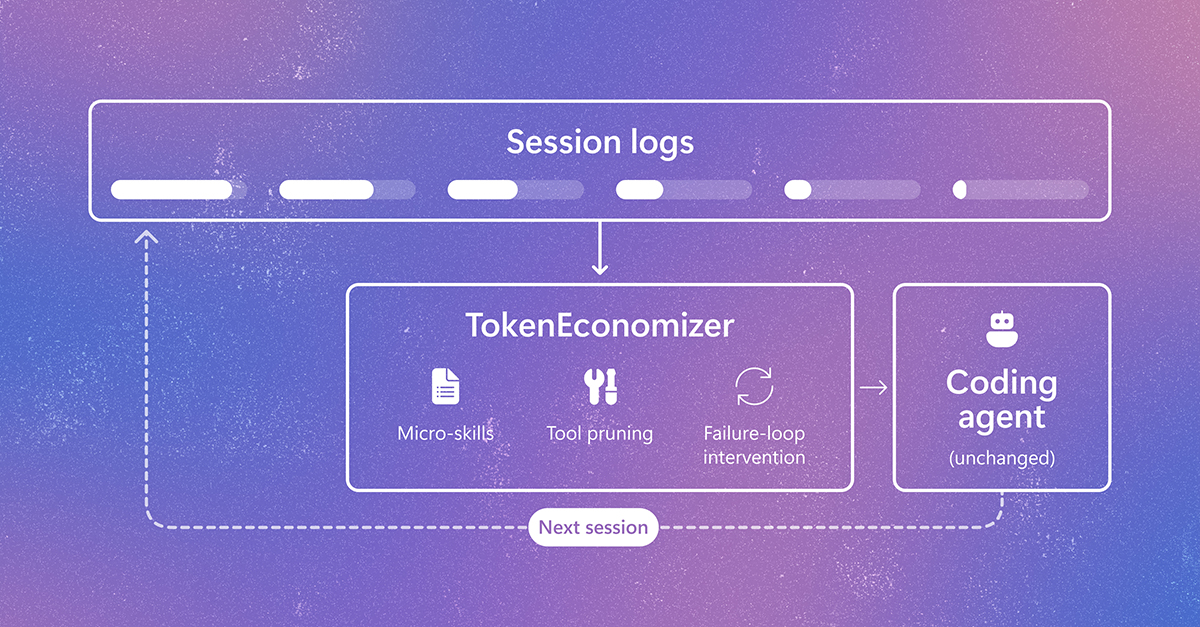
TokenEconomizer: Learning from Experience to Make AI Coding Agents More Efficient

AI coding agents are increasingly help developers fix bugs and build features largely on their own, but every interaction with their models consumes tokens. In each session, an agent sends instructions, tool descriptions, and session history to its model. Most efforts to reduce this cost focus on individual tasks. Yet developers return to the same […] The post TokenEconomizer: Learning from Experience to Make AI Coding Agents More Efficient appeared first on Microsoft Research.

We use cookies to run the site and, with your consent, for analytics and to show ads. See our Cookie Policy.