May 2026· arXiv.org· Vol abs/2605.20311· 0 citations· 47 references
Computer Science
Abstract
Guided-wave structural health monitoring enables damage localization in composite plates using sparse networks of bonded piezoelectric transducers. However, supervised localization remains weakly constrained when measurements are available from only a limited set of damage locations. Because exhaustive spatial coverage is impractical, models trained at observed locations may generalize poorly to unseen regions. We propose WaveGraphNet, an inverse-forward graph-learning framework for guided-wave damage localization in carbon-fiber-reinforced polymer (CFRP) plates. The sensing network is represented as a graph, with transducers as nodes and measured pitch-catch paths as edges. The inverse branch uses order-invariant message passing and a geometry-constrained decoder to map path-wise energy deviations to a damage coordinate. An independently trained forward branch predicts the energy-deviation pattern associated with a candidate coordinate. At test time, gradients propagated through the forward branch update only the inverse-predicted coordinate to reduce the discrepancy between the measured and predicted response patterns. The framework is evaluated on the OGW-1 benchmark using three spatial hold-out splits in which complete damage regions are excluded from training. Comparisons include non-graph and graph-learning baselines together with the training-free Reconstruction Algorithm for Probabilistic Inspection of Damage (RAPID). Under the validation-selected settings, refined WaveGraphNet achieves the lowest reported test mean absolute error on all three splits. Refinement reduces the standalone localization error by 23.6 percent-67.9 percent, with an average relative reduction of 50.4 percent. These results demonstrate that learned forward-response consistency can improve guided-wave localization under limited spatial training coverage.

Guided wave-based structural health monitoring (SHM) relies critically on sensor placement, as sensor layouts must provide sufficient information for subsequent damage inference. However, practical constraints on sensor quantity often degrade the spatial resolution of damage localization. Existing sensor placement opti...
Zheng Zhou, Lu-Yang Zhao, Xin Zhou et al.· IEEE Transactions on Instrum...· 0 citations
Shear horizontal (SH) guided waves with nondispersive low-order modes are well suited for small crack detection in pipelines, playing a crucial role in maintaining pipeline safety. However, the curved structural characteristics of pipeline welds make traditional SH guided wave electromagnetic acoustic transducer (EMAT)...
Yu-Chao Jin, Pan Hu, Yan-Jun Pei et al.· IEEE Transactions on Instrum...· 1 citation
Accurate reconstruction of particle distributions in three-dimensional particle-reinforced materials is essential for understanding their mechanical behavior and performance. However, recovering internal particle configurations from boundary-measured wave signals remains a challenging inverse problem due to complex wav...
Sheng Sang, Eric Johnson· Smart materials and structur...· 0 citations
Ultrasonic guided waves acquired using permanently bonded piezoelectric transducers enable large-area monitoring of composite structures. For practical structural health monitoring; however, both the location and the condition of a structural change are critical. This paper presents a data-driven multi-task framework f...
Diogo L. Mourinho, Mu-Chao Zhang, H. Ramos et al.· Applied Sciences· 0 citations
Accurate damage localization in carbon fiber-reinforced polymer (CFRP) laminates is an essential prerequisite for structural health monitoring (SHM). Nevertheless, Lamb wave propagation in anisotropic composite laminates is direction-dependent, dispersive, and highly susceptible to structural discontinuities; these eff...
Qi-Tong Li, Zhen-Hua Wen· Smart materials and structur...· 0 citations
Although the guided wave testing is a common method for the non-destructive testing of plates, continuous wave excitation is rarely employed in practical applications. Therefore, this study proposes a damage localization method that integrates compressive sensing and continuous wave excitation, which achieves damage lo...
Wentao Wang, Xiao-Fan Yu, Dongming Hou et al.· Structural Health Monitoring· 0 citations
Related blog posts
MIT News · Artificial Intelligence· news.mit.eduNov 17, 2026
By studying the computational foundations of language learning, Associate Professor Jacob Andreas builds intelligent systems that can communicate effectively with humans.
Microsoft Research Blog· microsoft.comNov 16, 2026
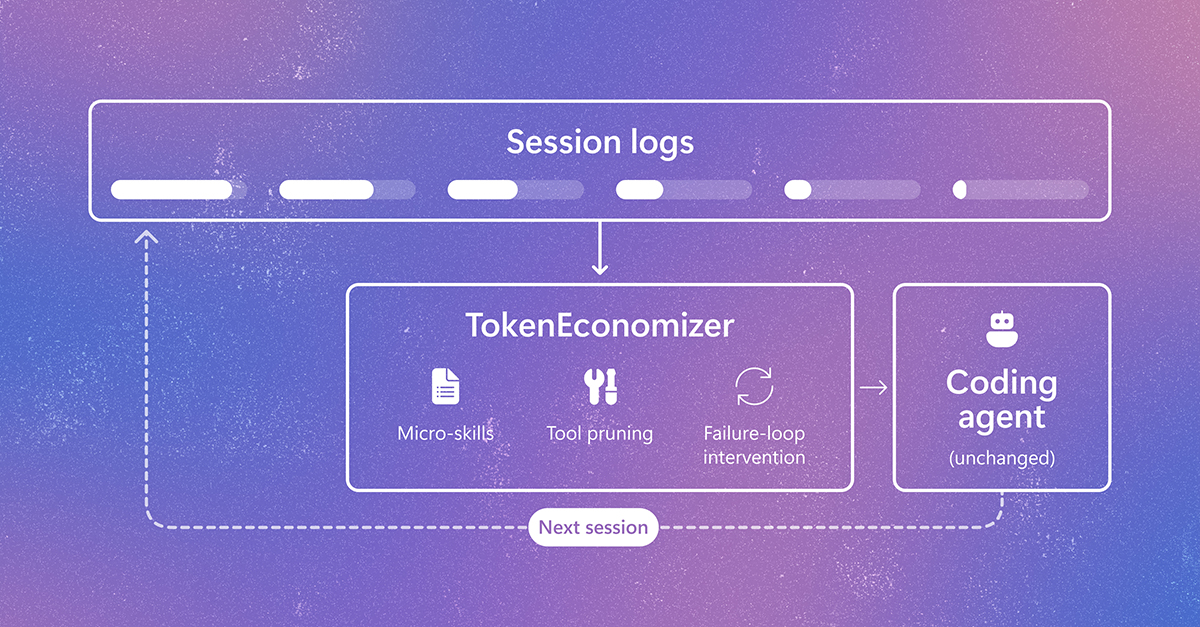
AI coding agents are increasingly help developers fix bugs and build features largely on their own, but every interaction with their models consumes tokens. In each session, an agent sends instructions, tool descriptions, and session history to its model. Most efforts to reduce this cost focus on individual tasks. Yet developers return to the same […] The post TokenEconomizer: Learning from Experience to Make AI Coding Agents More Efficient appeared first on Microsoft Research.
MIT News · Artificial Intelligence· news.mit.eduNov 13, 2026