How AI trained on birds is surfacing underwater mysteries
Climate & Sustainability
More from the blog
Training and Finetuning Multi-Vector Embedding Models with Sentence Transformers

When AI art has no author: Study finds generated images often can’t be traced to training data
A new method for surgically removing training examples from a model reveals that as datasets grow, the link between what a model learns and what it produces dissolves.
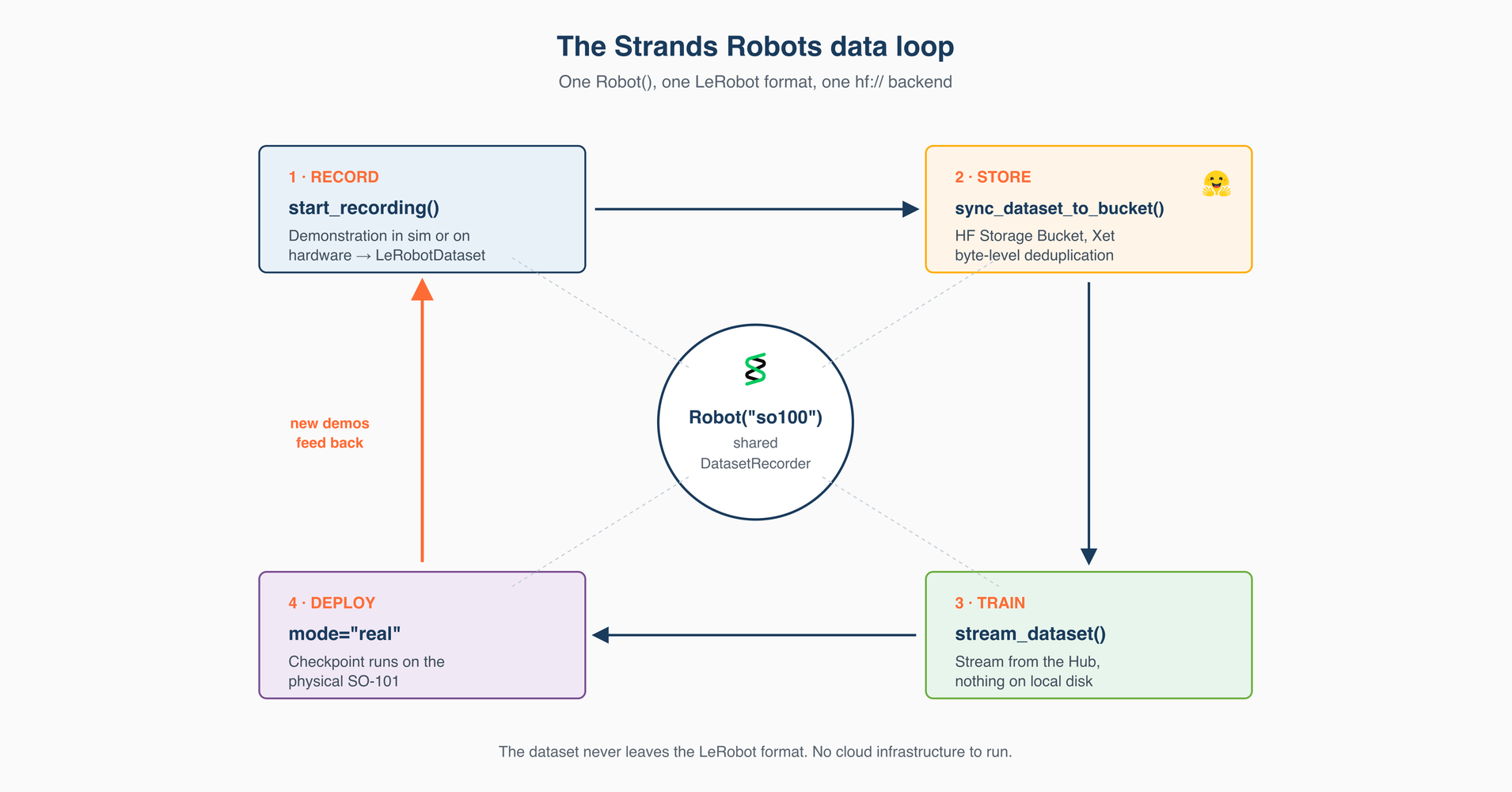
Record, train, and deploy from one place with Strands Agents, LeRobot, and Hugging Face Storage Buckets
A Blog post by Amazon on Hugging Face
AI agents create virtual playgrounds to help robots get crucial training data
“SceneSmith” system uses collaborative AI agents to create realistic 3D environments of places like kitchens, hotels, and living rooms, where robots can simulate everyday chores.
Related papers
AI and Bullshit
It is argued that both AI and bullshitters are untrustworthy informants, and for similar reasons, it is natural to describe AI’s informational outputs as bullshit, as it signals their distinctive kind of epistemic deficiencies, which they share with bullshit.
An explainable generative AI framework for detecting low-rate API-based DDoS attacks in cloud environments
Adaptive Repayment Optimisation for SME Lending: A Stochastic Programming Framework with Generative AI Explanation
The Adaptive Repayment Optimisation Engine is introduced, a novel framework that applies constrained stochastic optimisation to the design of loan repayment schedules for small and medium-sized enterprises (SMEs) and contributes to the operations research literature by bridging stochastic programming, explainable AI, and financial regulation in a novel application domain.
Artificial Intelligence for Real-Time Cyber Threat Classification and Emerging Threat Detection: A Structured Review of Methods, Datasets, Challenges, and Research Directions
The reviewed literature indicates that AI-based methodologies often demonstrate superior detection capabilities for intricate and previously unseen attack patterns compared to traditional methods; however, direct performance comparisons are complicated due to discrepancies in datasets, experimental designs, and evaluation protocols.