Introducing AnyLanguageModel: One API for Local and Remote LLMs on Apple Platforms
More from the blog
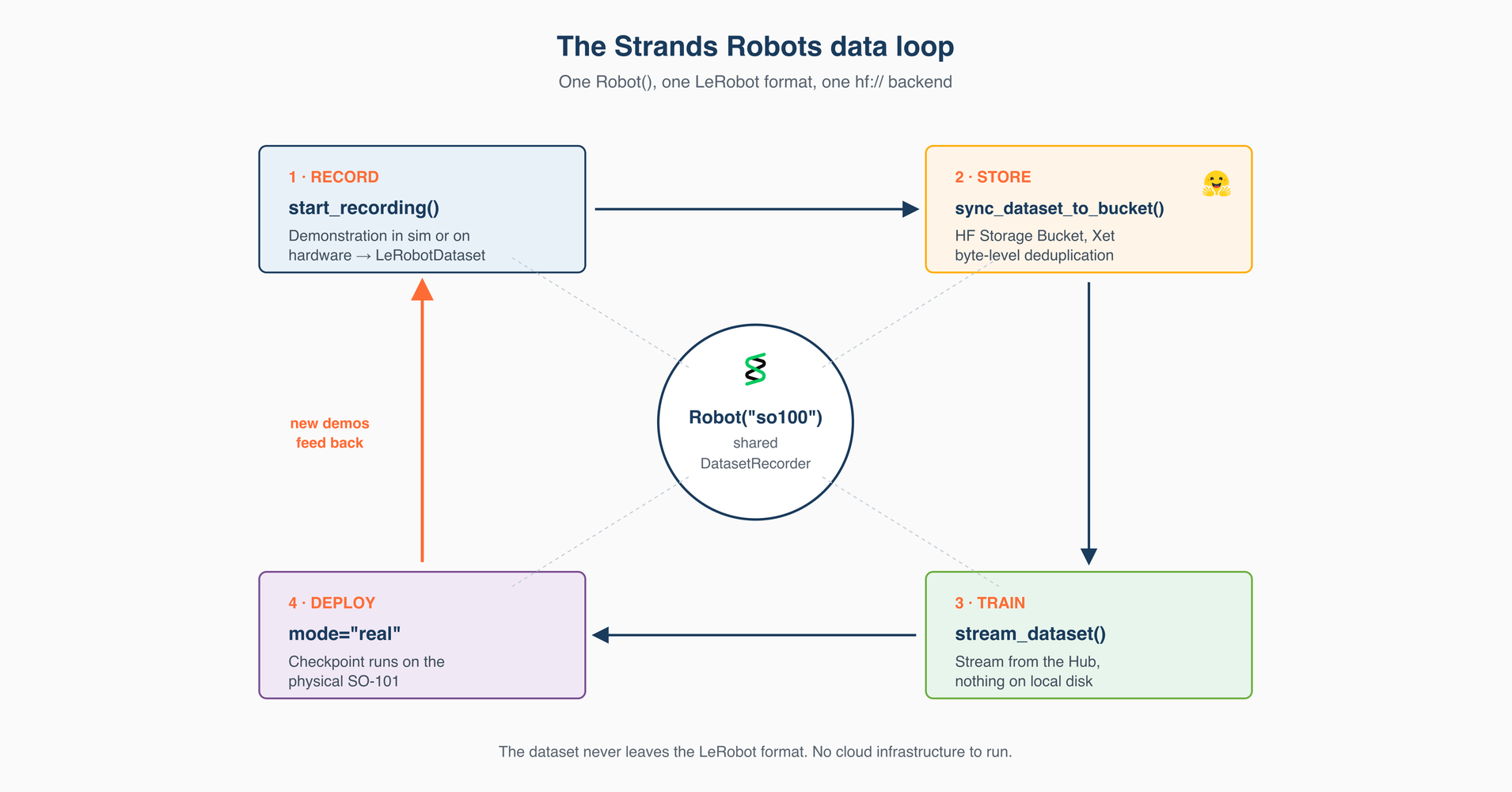
Record, train, and deploy from one place with Strands Agents, LeRobot, and Hugging Face Storage Buckets
A Blog post by Amazon on Hugging Face

Introducing Gemini 3.7 Flash
Gemini 3.7 Flash is our most intelligent workhorse model yet for coding and agents.

Introducing OlmoEarth embeddings: Custom embedding exports from OlmoEarth Studio for downstream analysis
A Blog post by Ai2 on Hugging Face
Related papers
Constitutional Midtraining: Content Presence Drives Alignment Gains
Post-training alignment is often shallow, eroding under fine-tuning. It remains untested as to whether constitutional midtraining interventions can produce durable alignment when cleanly isolated from post-training. We build a 394M-token constitutional corpus from Anthropic's Constitution and apply constitutional midtraining at 120B scale, where principled, values-based content is inserted into midtraining. A 2x2 design (curriculum ordering x deliberative reasoning) was used to produce four constitutionally midtrained conditions, plus a control, which were evaluated on self-generated and established benchmarks including alignment under pressure, value conflict resolution, blackmail, and emergent misalignment. All models were evaluated across three stages: post-midtraining, post-SFT, and post-benign fine-tuning. Constitutionally midtrained models outperformed the control on alignment generalization and durability, notably on blackmail: SFT instilled a blackmail propensity in all models, but constitutional midtraining blunted it, with the advantage surviving benign fine-tuning (-17.5pp). This durability did not extend to settings that required active resistance to in-context pressure or conflict, where the advantage attenuates after SFT. The presence of constitutional content at midtraining also mattered more than its structure, and constitutional midtraining incurred no capability cost, on average, at any stage (MMLU, ARC-Easy, piqa, GSM8K). A modest amount of constitutional content at midtraining could therefore yield broad, persistent alignment gains, offering a cheap, complementary addition to SFT-centered pipelines. Code, data, and models are available.
First Make It Playable, Then Make It Good: Staged Interaction Learning for Small Dialogue-Game Agents
It is suggested that imitating full trajectories helps with playability, while turn-level and teacher-guided training usually improve decision-making and increase the overall score, and small models are performant simply by using careful curation strategies rather than aggressive changes.
Understanding Multilingual Medical ASR Adaptation Through Layer-Wise Analysis
This paper investigates how multilingual medical adaptation reshapes the internal representations of Whisper models through layer-wise encoder analysis, and shows that English medical fine-tuning produces the dominant encoder shift, whereas multilingual continuation largely preserves the adapted representation space.
Speculative Probing: LLM Monitoring at Speculative-Decoding Cost
It is found that the speculative-decoding module in recent LLMs can be repurposed for efficient high-quality classification by appending a trained soft prompt at the end of the target sequence, which can repurpose the speculative-decoding module into a sequence classifier.