ReNFT is proposed, which repairs a high-reward, low-diversity adapter through internal probability-mass recalibration through internal probability-mass recalibration, offering a complementary alternative to external interventions.
Yu-Chen Bao, Chao Wen, Haowei Wang et al.· 0 citations
DaEdiTikZ is introduced, the first large-scale dataset of revision-derived scientific figure edits, constructed by mining 391K plausible TikZ edit pairs from arXiv, GitHub, and TeX SE and inferring 781K directed edit instructions with a VLM conditioned on rendered figures and TikZ code.
C. Greisinger, Zhixue Zhao, Steffen Eger· 0 citations
Experiments on ModelNet40 point clouds, arbitrary-view projections, and segmented optical observations demonstrate that NeuSOGA transforms diverse observations into compact symbolic representations while preserving essential geometric and topological structure across sensing modalities and viewing directions.
Qingde Li, Qingqi Hong, Zi-Han Li et al.· 0 citations
It is shown that diffusion models also inherently use an attention mechanism very similar to that of transformers, and similarities in basic functional principle of auto-encoders and attention-based models allows for interchange of designs based on practical requirements.
F. Haddadi, L. Monfared, Ebrahim Rezaii et al.· 1 citation
Reach audiences
Advertise in front of researchers, engineers, and readers.
This study provides an empirical analysis aiming to answer the currently active discussions on how to accept a compressed driving policy, so as to achieve a safe and statistically reliable deployment of automated driving functions.
Ahmad Alfan Alfian Irfan, Nur Ahmad Khatim, M. Arief· 0 citations
Dr. Claw is presented, an open-source workspace that wraps existing coding-agent executors in a controllable and auditable human-in-the-loop workflow rather than introducing another autonomous agent.
D. Song, Han-Rong Zhang, Dawei Liu et al.· 1 citation
GLANCE is presented, the first one-pass block drafter that is lossless on an unmodified VLM target, and it breaks the cycle at both ends of a self-defeating cycle.
Jungseob Lee, Seongtae Hong, D. Lee et al.· 0 citations
This paper proposes two new bias testing methodologies for Large Language Models (LLMs) and Visual-Language Models (VLMs)-"All Else Being Equal"tests and "Self-Consistency"tests-in order to assess bias in pedestrian-yielding decisions.
Irem Yoldas, Martim Brandão, Jie Zhang et al.· 0 citations
UI-Venus-2 is presented, a general-purpose foundation GUI agent designed to operate across mobile, web, and desktop environments through a unified closed-loop reasoning-action framework that integrates safety-aware mechanisms to ensure controlled execution of consequential actions.
Venus Team, Zhuo-Hang Cai, Hao-Xin Chen et al.· 4 citations
This dataset consists of (image, caption, context, question-answer, chain-of-thought) tuples from arXiv computer science papers prepared using layout detection and PDF parsing, with an AI-assisted question-generation step.
R. Raut, Aarav Subedi, Sagun Rai et al.· 0 citations
Successive Capacity Growth (SCG) is proposed, a method that starts from a minimal encoder and grows incrementally in width or depth and can grow successively as the task demands, achieving significant compute and data efficiency while maintaining representation quality.
PXDepth is a discriminative monocular depth model that separates global context modeling from pixel-level depth prediction, and combines faithful local geometry with competitive global depth accuracy while remaining efficient at inference.
Zhi-Yuan Yuan, Guanying Chen, Lingteng Qiu et al.· 1 citation
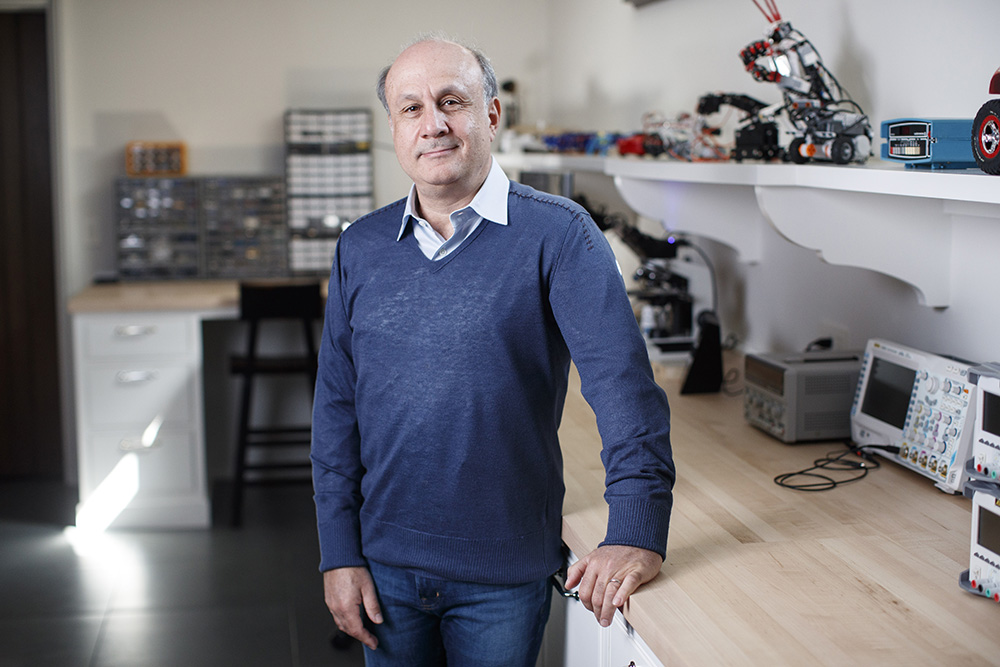
Professor Paris Smaragdis develops computers with superhuman hearing for applications like speech recognition, music understanding, and environmental monitoring.
Exploring how generative AI could make machine vision more accessible to businesses. The post GenEye in a Box: Making Machine Vision Something You Can Just Ask For appeared first on GPT-Lab.
Jennifer Neville did not want to go into computer science—but that’s exactly where she landed. Neville discusses the starts and stops that led to her professional sweet spot and her work identifying “surprising failures” making it hard for AI to handle complexity. The post What AI gets wrong and what failure teaches us appeared first on Microsoft Research.
Computer scientist, entrepreneur, and philanthropist will collaborate with the MIT Schwarzman College of Computing to advance AI and scientific discovery.
We use cookies to run the site and, with your consent, for analytics and to show ads.
See our Cookie Policy.