Dark commercial patterns and deceptive user interface (UI) designs (or DPs) trick consumers into actions that benefit the shareholders. The legal and ethical implications of DPs are shaped by the sociocultural context. Special types of DPs exist in Japan, but the impact of these DPs on consumer attitudes and behaviour...
Katie Seaborn, Jo Yukami, Tatsuya Itagaki et al.· 0 citations
Impaired driving, including distraction, fatigue, and intoxication, leads to thousands of fatalities annually. Impairment detection and related assistive technologies are rapidly advancing, but their full potential remains unrealized. The inconsistent maturity of impairment research and anomalies within individual doma...
Kayli Battel, John Gideon, Megan Applegate-Kenton et al.· Proceedings of the 18th Inte...· 0 citations
Multimodal chat analysis of social media stickers (MCAS) benefits from jointly modeling text and sticker semantics, yet it is inherently challenged by the interference between sentiment and intent recognition. Although existing multi-task approaches achieve competitive performance, they largely ignore this inter-task i...
Zixiang Ni, Yifei Xu, Haowen Yang et al.· 0 citations
(un)stable equilibrium is an ongoing series of works that is based on a practice of training generative neural networks without data. This paper introduces the second series of (un)stable equilibrium works, in which the process of training without data is visualised in a series of video pieces. These works show a gener...
Terence Broad· 0 citations
Reach audiences
Advertise in front of researchers, engineers, and readers.
This analysis reveals that besides the critical hardware constraints, the future of AI-XR for tech creation is dependent on addressing human cognitive limits, and succeeding in the new multimodal Human-AI experience paradigm requires moving past flat-screen metaphors to design new types of interactions that selectively...
Risks that may form on the user side during long and repeated interaction are examined to establish safety across a series of conversations, with the central claim that an acceptable response on its own does not establish safety across a series of conversations.
There have been numerous attempts to investigate the potential of social robots for education in the field of child-robot interaction (cHRI). However, empirically based models for the integration of robot technologies into aesthetic education in early childhood, especially in music education, are rare. Our approach is...
This systematic mapping review examines 54 gamified interventions aimed at combating misinformation and identifies systematic gaps in the identified games, suggesting a field dominated by web-based simulations and trivia formats.
Omed Abed, S. Hinterreiter, Si-Jia Guo et al.· 0 citations
picoRing dual, an ultra-low-power bimanual interface with a pair of ring-wristbands based on inductive coupling, has the potential to offer ubiquitous finger input for everyday AR interaction.
Hideaki Yamamoto, Yi-Fan Li, Yoshihiro Kawahara et al.· Proceedings of the 2026 ACM...· 0 citations
PAUSE (Patterns of AI Use: Self-Examination), a privacy-by-design web tool that occupies a different niche from these, is described, a lightweight, non-diagnostic reflection aid for private individual use.
It is argued that automation reshapes rather than replaces translation value, creating an interdependent configuration in which technological efficiency enables human communicative work.
Maria Isabel Rivas Ginel, Janiça Hackenbuchner, A. Secara et al.· arXiv.org· 1 citation
CALICO is presented, a human-centered, codebook-aligned annotation workflow that treats prompts as editable, versioned, and optimizable artifacts and integrates codebook parsing, prompt generation, result inspection, prompt versioning, natural language human feedback, and label-supervised prompt optimization through ex...
AI agents can generate code at a scale that’s hard for humans to review line-by-line. PDD Kit helps ensure the code is doing what the developer intended by creating formal specifications and testing against them. It converts developer intent into a Verus specification, proves AI-generated code meets it for every input, and uses tests where proofs aren't practical. Developers review intent, not every line. The post Formally verifying agent-written full-stack web apps with PDD Kit appeared first o…
Professor Paris Smaragdis develops computers with superhuman hearing for applications like speech recognition, music understanding, and environmental monitoring.
MIT News · Artificial Intelligence· news.mit.eduOct 23, 2026
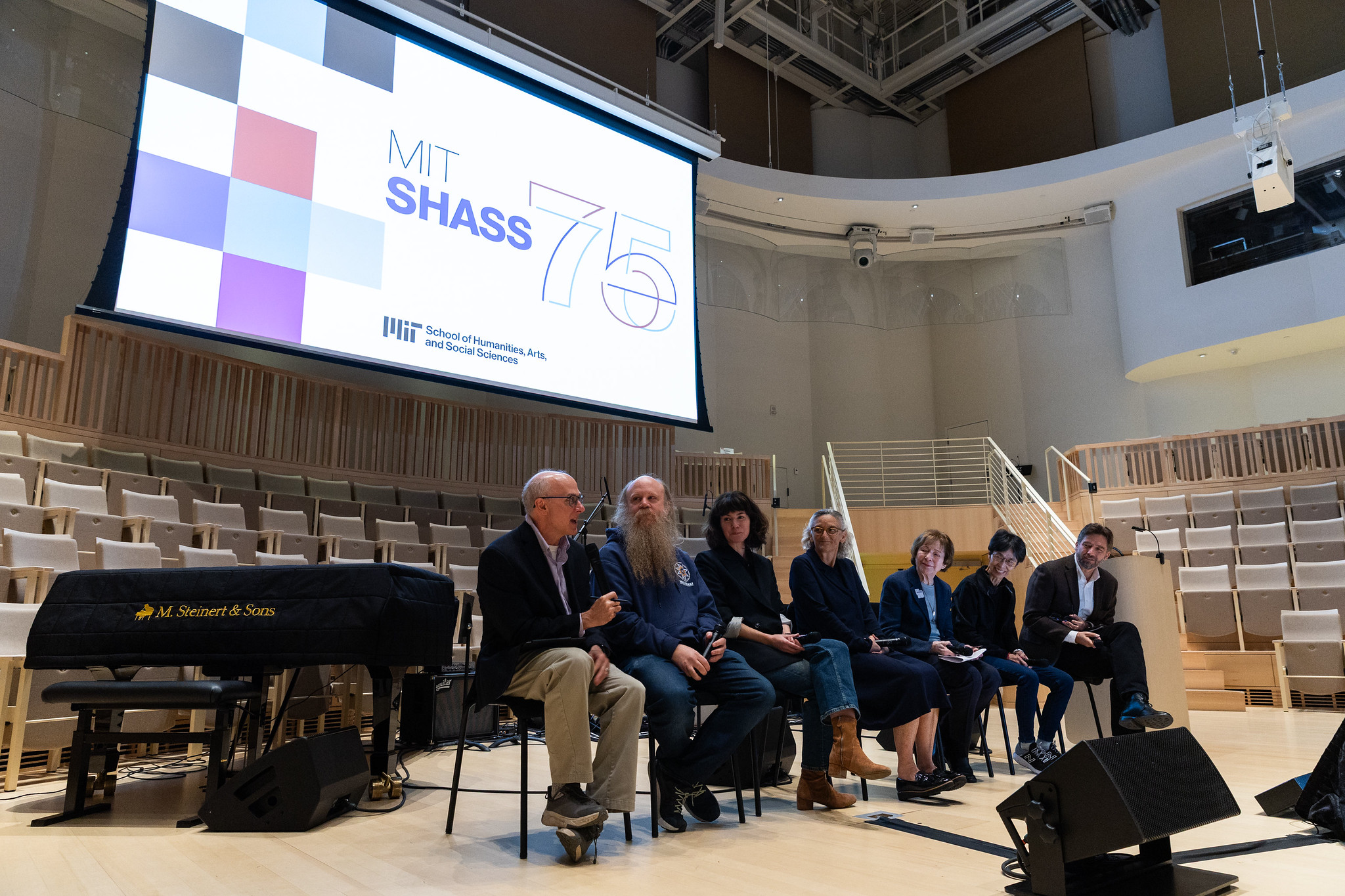
During the School of Humanities, Arts, and Social Sciences’ 75th Anniversary Symposium, President Sally Kornbluth said “MIT has never needed your particular insight and guidance more than we do now.”
MIT News · Artificial Intelligence· news.mit.eduOct 23, 2026
Assistant Professor Benjamin Lindquist studies how engineers deliberately injected randomness into early AI, giving rise to deep-learning models that sometimes hallucinate.
MIT News · Artificial Intelligence· news.mit.eduOct 22, 2026
“X-Hinges” helps design and 3D print items like lamps and gloves with an interactive twist: automatically embedded sensors that perceive and adaptively respond to human contact.
We use cookies to run the site and, with your consent, for analytics and to show ads.
See our Cookie Policy.