This position paper draws on AAC as a setting where speech AI failures are most visible and their stakes highest, alongside other underserved speakers - people who stutter, multilingual speakers, and non-binary and transgender users.
Maria Teleki, Kimi Wenzel, Anna Seo Gyeong Choi et al.· 0 citations
Data-to-text driver coaching is often presented as a generic pipeline from telematics events to advice. This paper argues that its content requires localisation because usefulness and credibility depend on drivers'knowledge, prevalent risks, regulation, infrastructure, and available data. Two independently developed sy...
Iniakpokeikiye Peter Thompson, Jawwad Baig, Ehud Reiter et al.· 0 citations
We present a new nonlinear dimensionality reduction method, MAPLE, that enhances UMAP by improving manifold modeling. MAPLE employs a self-supervised learning approach to more efficiently encode low-dimensional manifold geometry. Central to this approach are maximum manifold capacity representations (MMCRs), which help...
Zeyang Huang, Takanori Fujiwara, Angelos Chatzimparmpas et al.· 0 citations
This work presents a robust, multimodal OVR framework fusing user gaze and natural language to identify Points of Interest (POIs), and developed a VR-based pipeline synchronizing 360-degree transit videos with vehicle GNSS telemetry to address the scarcity of dynamic vehicular data.
Alireza Parchami, Artin Saberpour Abadian, Robin Connor Schramm et al.· Proceedings of the 18th Inte...· 0 citations
Reach audiences
Advertise in front of researchers, engineers, and readers.
Three robotic art installations which explore the aesthetics of adaptive behavior use learning and evolutionary processes not as a means to optimize a specific solution, but as an aesthetic experience on its own, suggesting new modes of interdisciplinary art-science research.
The synchronisation problem for one common movement, the rotation of an open hand about its long axis, is taken, and it is shown that it admits an exact solution needing no classifier, no training data and no calibration.
Large language models are increasingly deployed as synthetic consumer panels, promising $97\%$ cost reductions over traditional surveys. Yet aggregate validation metrics conceal systematic failures: variance compression, coefficient sign-flips, subgroup error balloons of 10--30 percentage points, and global corrections...
Reading a social situation often depends on behavior, not words alone. We introduce FriendBench, a benchmark for inferring whether two people are already familiar or are meeting as strangers, from a 20-second clip of a dyadic ice-breaker conversation. Every pair answers the same type of prompt, so only the manner of in...
Jeffrey M. Girard, Jason Z. Zheng, Jacqueline R. Vertino et al.· 0 citations
LEXIC, a compact recurrent model that predicts response correctness from fixation sequences, word frequency, and character length, has 41.6K parameters and requires no language-model inference, supporting lightweight on-device inference.
Sumin Lee, Kyeonghun Kim, Subeen Lee et al.· 0 citations
Two state-of-the-art systems, Claude Code (Anthropic) and Codex (OpenAI), were tasked with autonomously executing the same simple end-to-end pipeline on Einstein Telescope simulated data, on a shared computing infrastructure and without human intervention, but the agents exhibited substantially different behaviors and...
Forking Garden is presented, a branching game generation system that uses narrative archetype as a persistent semantic signal across the generation pipeline, and suggests that propagated Rise/Fall distinctions can remain meaningful during play, while also supporting narrative understanding and creator-oriented interpre...
Yun-Ge Wen, Chen-Liang Huang, Hang-Yu Zhou et al.· 0 citations
A sample-efficient personalization method that uses a few pairwise judgments to weight prior users' preferences rather than relying on a fixed rubric of UI attributes, which outperforms a pretrained UI evaluator and a larger multimodal model offline.
Yihang Peng, Samarth Das, Jeffrey P. Bigham et al.· arXiv.org· 2 citations
AI agents can generate code at a scale that’s hard for humans to review line-by-line. PDD Kit helps ensure the code is doing what the developer intended by creating formal specifications and testing against them. It converts developer intent into a Verus specification, proves AI-generated code meets it for every input, and uses tests where proofs aren't practical. Developers review intent, not every line. The post Formally verifying agent-written full-stack web apps with PDD Kit appeared first o…
Professor Paris Smaragdis develops computers with superhuman hearing for applications like speech recognition, music understanding, and environmental monitoring.
MIT News · Artificial Intelligence· news.mit.eduOct 23, 2026
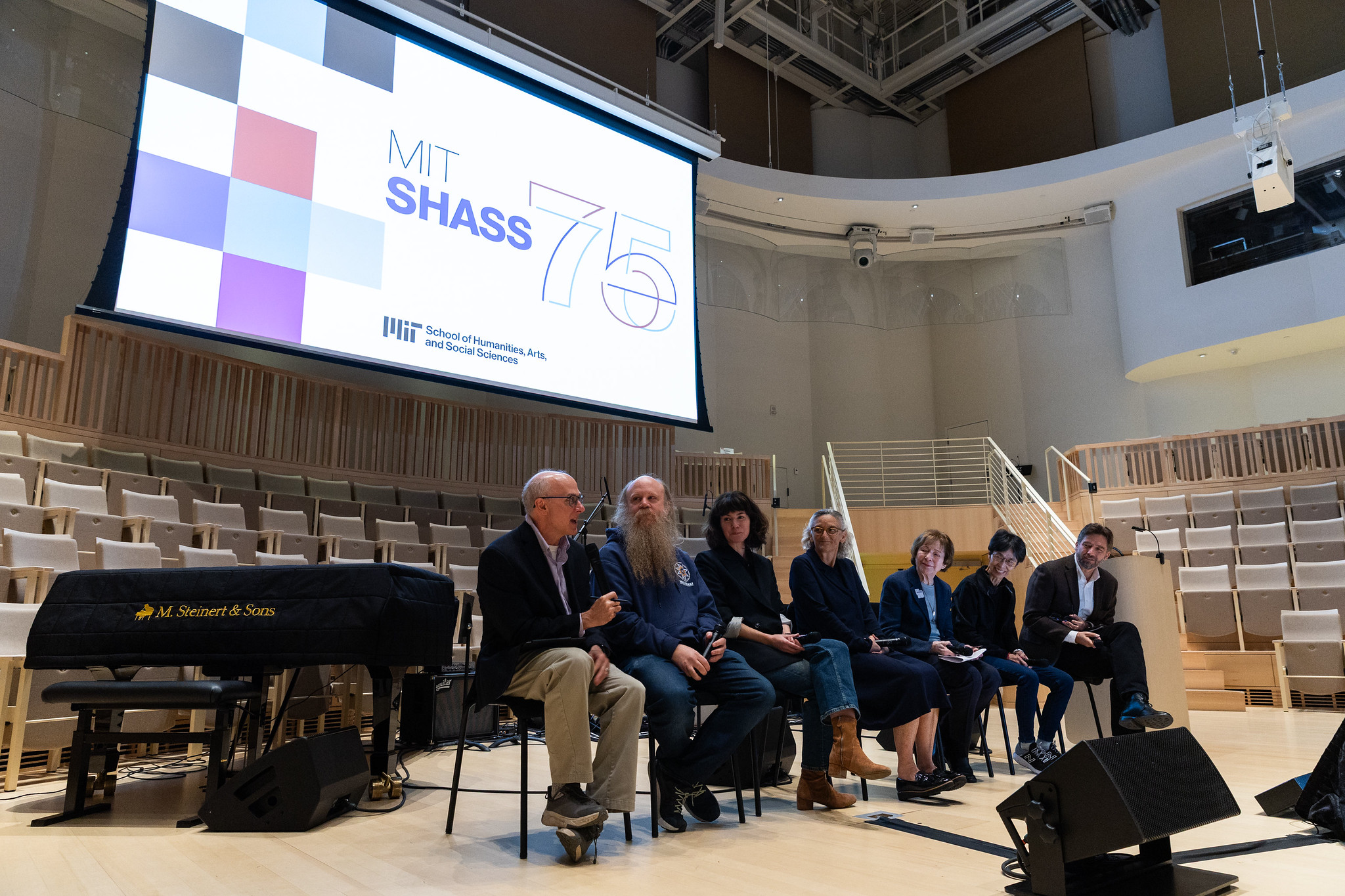
During the School of Humanities, Arts, and Social Sciences’ 75th Anniversary Symposium, President Sally Kornbluth said “MIT has never needed your particular insight and guidance more than we do now.”
MIT News · Artificial Intelligence· news.mit.eduOct 23, 2026
Assistant Professor Benjamin Lindquist studies how engineers deliberately injected randomness into early AI, giving rise to deep-learning models that sometimes hallucinate.
MIT News · Artificial Intelligence· news.mit.eduOct 22, 2026
“X-Hinges” helps design and 3D print items like lamps and gloves with an interactive twist: automatically embedded sensors that perceive and adaptively respond to human contact.
We use cookies to run the site and, with your consent, for analytics and to show ads.
See our Cookie Policy.