Browser-based webcam gaze trackers are increasingly used for crowd-scale data collection and in clinical settings where lab eye trackers are impractical, but the reported latency numbers may not represent real world functionality. The common practice of timestamping each gaze sample when it is emitted, rather than when...
Ollie is introduced, a gaze-informed proactive artificial intelligence (AI) assistant that offers short narrative descriptions based on where a child is looking that shows the feasibility of using gaze as an implicit input for proactive AI assistance for children and provides design implications for future child-center...
Ze-Kun Wu, Man Su, Huiyong Li et al.· arXiv.org· 0 citations
Building on critical feedback and concerns, Fabula is used as a cultural probe in adversarial design, and potentials for writing feedback and for interactive storytelling are identified.
P. Mirowski, Benjamin D. Wedin, Reinald Kim Amplayo et al.· arXiv.org· 1 citation
People passively interact with ambient surfaces such as tables, chair backs, and armrests throughout daily life, making them natural candidates for ubiquitous tactile interfaces. However, transforming these everyday surfaces into practical haptic interfaces remains challenging. Existing solutions typically rely on dens...
Shubham Rohal (University of California, Merced), Dong Yoon Lee (University of California et al.· 0 citations
Reach audiences
Advertise in front of researchers, engineers, and readers.
Sign Parameter-Infused (SPI) prompting is introduced, which integrates standard SL parameters, like hand shape, motion, and orientation, directly into the textual prompts, which makes the instructions more structured and reproducible than free-form natural text from vanilla prompting.
Recent advances in large language models (LLMs) have shown great potential in automating the process of visualization authoring through simple natural language utterances. However, instructing LLMs using natural language is limited in precision and expressiveness for conveying visualization intent, leading to misinterp...
Zhen Wen, Luoxuan Weng, Yinghao Tang et al.· 0 citations
This work proposes Caption-once, Frames-onDemand (CFD), a budget-aware edge-cloud agentic framework that turns visual access into a first-class, query-conditioned cost, capping per-query frame consumption regardless of video length.
Wei-Tong Cai, Hang Zhang, Yu-Kai Huang et al.· 2 citations
It is proved that the population gap is zero when the partner's choices convey nothing beyond their literal content, given a fair shuffle and a player who uses only what was said and seen, and argued for reporting the convention gap on human-partnered play, not only AI-AI performance, when evaluating agents intended fo...
Makoto Fukushima, Hua-Dong Xiong, E. M. Pari· 1 citation· ⚡1
By decoupling haptic control loops from network bottlenecks, CARLAverse enables scalable, cross-institutional HITL experiments without compromising physical immersion.
P. Rebling, Philipp Nenninger, Reiner Kriesten· 0 citations
Clinical education must prepare medical students to conduct safe and coherent patient interviews under conditions of uncertainty. Traditional standardized patient (SP) training is resource-intensive and difficult to scale. We developed a scaffolding-oriented multi-agent Large Language Model (LLM) AI Standardized Patien...
Lu-Ming Yang, Hao-Xian Liu, Si-Qing Li et al.· 0 citations
A conceptual framework is proposed composed of three core components which are drawn on the synthesis of selected empirical studies on technologies embedded in built environments for social wellbeing that could help researchers, practitioners and policymakers to design and guide digital technology interventions that ta...
Gul Sher Ali, M. Giannakos, M. Lillefjell et al.· 0 citations
Five deployment dilemmas involving persistence, attention, role boundaries, state disclosure, and escalation that require stakeholder specification are derived, further informing technical implications for learning, situated evaluation, and embodied adaptation.
AI agents can generate code at a scale that’s hard for humans to review line-by-line. PDD Kit helps ensure the code is doing what the developer intended by creating formal specifications and testing against them. It converts developer intent into a Verus specification, proves AI-generated code meets it for every input, and uses tests where proofs aren't practical. Developers review intent, not every line. The post Formally verifying agent-written full-stack web apps with PDD Kit appeared first o…
Professor Paris Smaragdis develops computers with superhuman hearing for applications like speech recognition, music understanding, and environmental monitoring.
MIT News · Artificial Intelligence· news.mit.eduOct 23, 2026
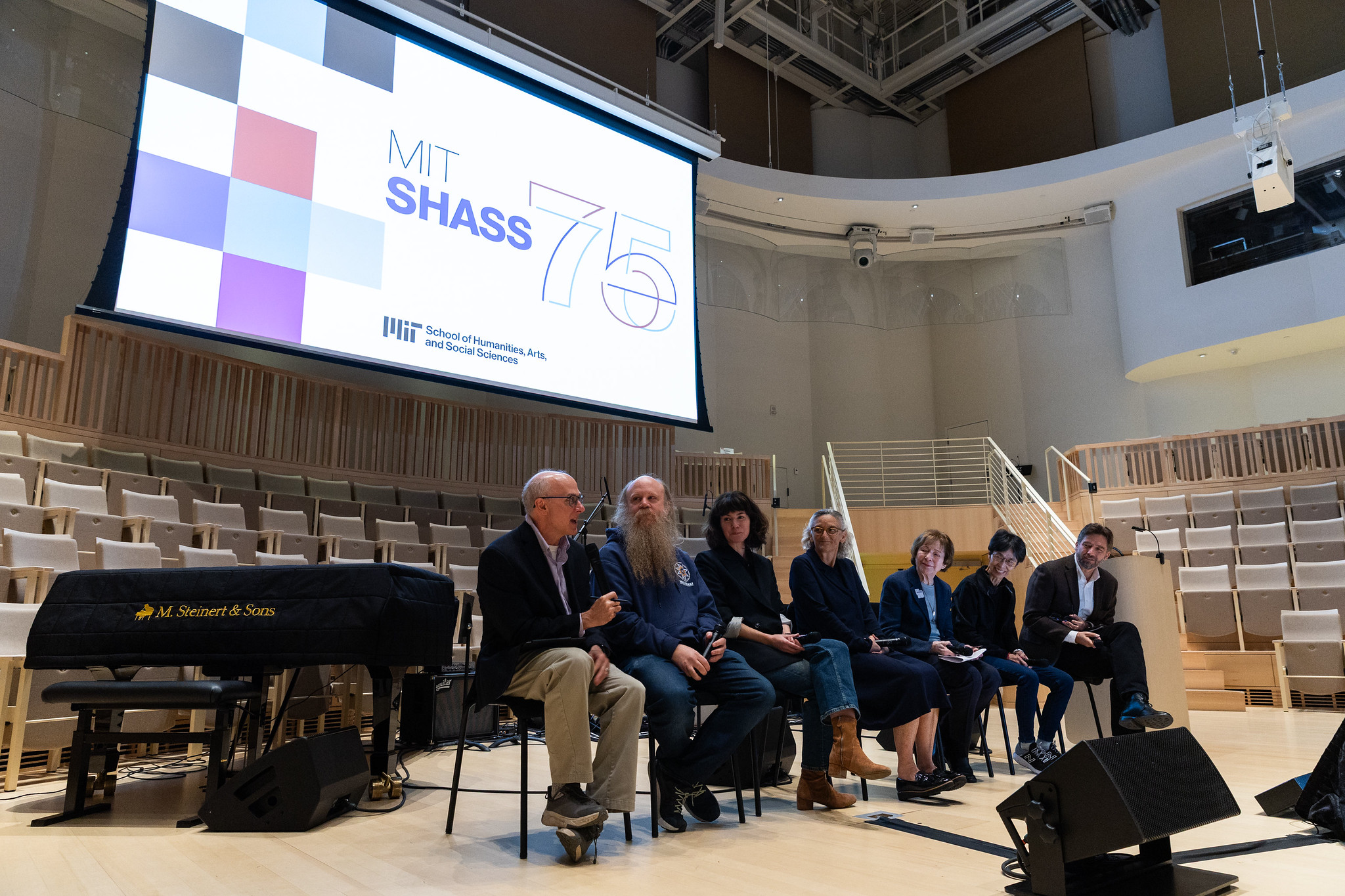
During the School of Humanities, Arts, and Social Sciences’ 75th Anniversary Symposium, President Sally Kornbluth said “MIT has never needed your particular insight and guidance more than we do now.”
MIT News · Artificial Intelligence· news.mit.eduOct 23, 2026
Assistant Professor Benjamin Lindquist studies how engineers deliberately injected randomness into early AI, giving rise to deep-learning models that sometimes hallucinate.
MIT News · Artificial Intelligence· news.mit.eduOct 22, 2026
“X-Hinges” helps design and 3D print items like lamps and gloves with an interactive twist: automatically embedded sensors that perceive and adaptively respond to human contact.
We use cookies to run the site and, with your consent, for analytics and to show ads.
See our Cookie Policy.