Results show that participants perceive differences across personalization levels and evaluate AI-generated advertising imagery most positively at a moderate level of personalization, and high personalization increases perceived personalization, which is positively associated with all three outcome measures, but also i...
Victor Kolominsky-Rabas, Leopold Müller, Claudius Budcke et al.· 0 citations
AdMan is proposed, a multi-agent pipeline that transforms customer data into personas, generates personalized advertisement images conditioned on product reference images, and applies an LLM-based judge agent for automated quality control, and shows that the pipeline can generate photorealistic and personalized adverti...
Victor Kolominsky-Rabas, Leopold Müller, Claudius Budcke et al.· 0 citations
In this work, insights from a German-based empirical study with eleven semi-structured interviews are reported on, contributing a grounded map of existing and potential use cases and identifies tentative practical implications for adoption.
Victor Kolominsky-Rabas, Leopold Müller, Felicia Perpina et al.· 0 citations
This work establishes a precise definition of AI augmentation comprising six conditions, spanning durable net value, meaningful human control, accountability and recovery, and long-term human development through learning, career pathways, and job purpose, and outlines how organisations, researchers, and government lead...
Civic-Ai Collaboration Jiaying Wu, Caleb Ziems, Raymond Chan et al.· 0 citations
Reach audiences
Advertise in front of researchers, engineers, and readers.
AgentGUI is introduced, a user-friendly, locally hosted GUI for seamlessly observing and steering AI agents amid multiple concurrent, long-running sessions and features rich agent trajectory visualizations, effective manual and automated steering, and integration with and coordination between open-source and frontier a...
Xuan Zhao, Jiwoong Sohn, Qinyue Zheng et al.· arXiv.org· 0 citations
Agentic artificial intelligence (AI) is shifting from decision support to autonomous coordination, challenging established assumptions about managerial authority. This qualitative conceptual paper synthesises recent literature in algorithmic management, organisational theory, and human-computer interaction to examine h...
Kwan Hong TAN· Zenodo (CERN European Organi...· 0 citations
SHRIMP is introduced, a system that allows users to automatically generate a hierarchical robot primitive plan using natural language and iteratively revise their plan through re-prompting and explicit correction, and once satisfied, execute it on the physical robot.
Mya Schroder, Yuna Hwang, Callie Y. Kim et al.· 0 citations
It is argued that preventing lasting harm to young adults'dvelopment is paramount, and implications for rethinking AI chatbot dependence grounded in this understanding are provided.
Ashlee Milton, L. Ajmani, Amy K. Heger et al.· 1 citation
Concept Bottleneck Models (CBMs) are interpretable-by-design neural networks that detect human-understandable concepts from the input and use them to generate predictions. By allowing users to inspect the concepts underlying a prediction and explore how predictions change under alternative concept configurations, CBMs...
A. Bogani, Nicola Debole, E. Marconato et al.· 0 citations
Tact, a browser-based pipeline that converts a spoken or typed story idea into printable braille with a matching raised tactile illustration, without an account or mandatory cost and with an offline-capable path is presented.
Iliano Fasolino· Zenodo (CERN European Organi...· 0 citations
In exploratory factor analysis (EFA), one aims to describe latent variables by constructing a factor model based on the relationships among manifest variables. For a model to be useful, it is not enough that it is grounded on data; it must also be meaningful. Hence, in practice, one attempts to interpret different fact...
Justin Philip Tuazon, Joemari Olea, Richelle Ann Juayong· 0 citations
AI agents can generate code at a scale that’s hard for humans to review line-by-line. PDD Kit helps ensure the code is doing what the developer intended by creating formal specifications and testing against them. It converts developer intent into a Verus specification, proves AI-generated code meets it for every input, and uses tests where proofs aren't practical. Developers review intent, not every line. The post Formally verifying agent-written full-stack web apps with PDD Kit appeared first o…
Professor Paris Smaragdis develops computers with superhuman hearing for applications like speech recognition, music understanding, and environmental monitoring.
MIT News · Artificial Intelligence· news.mit.eduOct 23, 2026
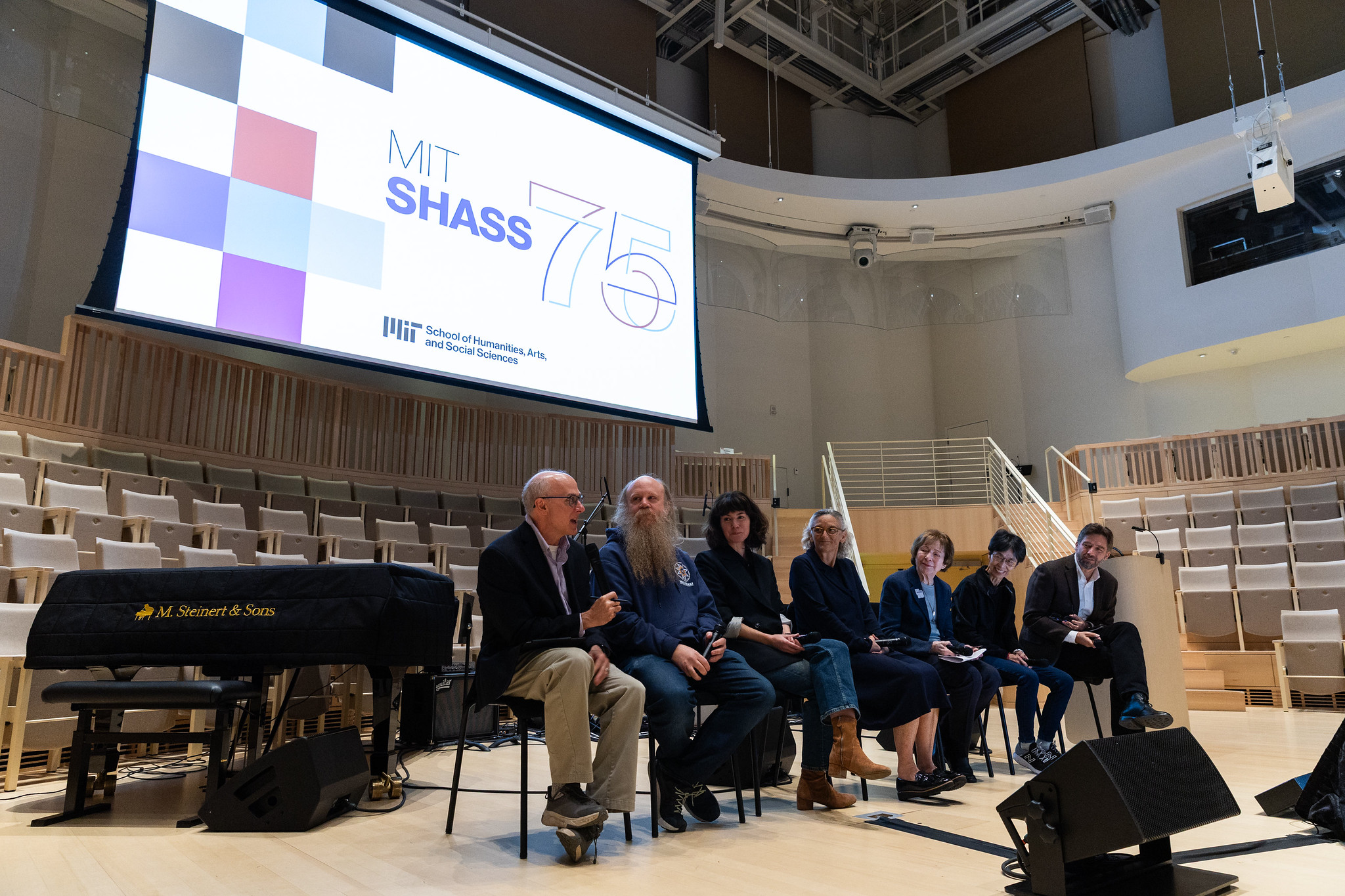
During the School of Humanities, Arts, and Social Sciences’ 75th Anniversary Symposium, President Sally Kornbluth said “MIT has never needed your particular insight and guidance more than we do now.”
MIT News · Artificial Intelligence· news.mit.eduOct 23, 2026
Assistant Professor Benjamin Lindquist studies how engineers deliberately injected randomness into early AI, giving rise to deep-learning models that sometimes hallucinate.
MIT News · Artificial Intelligence· news.mit.eduOct 22, 2026
“X-Hinges” helps design and 3D print items like lamps and gloves with an interactive twist: automatically embedded sensors that perceive and adaptively respond to human contact.
We use cookies to run the site and, with your consent, for analytics and to show ads.
See our Cookie Policy.