It is suggested that the pulling illusion depends on perceptual processing beyond basic vibration detection, through which asymmetric vibration is experienced as directional pulling.
Takeshi Tanabe, Satoshi Yamamoto, Toru Yamada et al.· 0 citations
Under a local linearization of the WiFi forward process, a common task-observability condition is derived under which a strict common linear representation is recoverable from every geometry-induced operator while preserving the gesture task.
Xiang Zhang, Huan Yan, Ge-Ying Yang et al.· 0 citations
Maritime Autonomous Surface Ships (MASS) and AI- supported decision assistants are expected to transform maritime operations, but their safe integration depends on how maritime professionals perceive and trust such systems. This paper presents a survey study on maritime stakeholders'attitudes toward an AI-supported ass...
Doreen Jirak, Armeen Saroukanoff, D. Van Rooy· 0 citations
Extended Reality (XR) technologies have received growing attention in accessibility research involving Deaf and Hard of Hearing (DHH) communities. Yet less attention has been given to the assumptions shaping this work. We present a theory-grounded review of an ACM-published corpus of XR research involving DHH users. Dr...
Shuxu Huffman, Michaela Okosi, Jose Merino et al.· Proceedings of the 2026 28th...· 0 citations
Reach audiences
Advertise in front of researchers, engineers, and readers.
Ethics Training Agents is proposed, a group discussion system that leverages multiple LLM participants embodying distinct ethical orientations, along with a moderator agent, to enable structured human-AI group ethical discussions for collaborative reflection.
Youngseok Seo, Sueun Jang, Hyesoo Park et al.· 0 citations
This study examines data visualization design evolution over 12.5 years, reflecting on the impact of Large Language Models over the last 3.75 years and identifies how LLMs have aided design-space exploration: reducing coding effort, enabling new design opportunities, shock, excitement, accomplishments, and shifts to th...
Live captions on TV often contain errors and timing issues, making it hard for deaf and hard-of-hearing (DHH) viewers to follow dialog. It is essential that caption quality metrics reflect the lived DHH TV viewing experience. To this end, we describe a U.S.-based large-scale online survey with 216 validated participant...
Bernard Thompson, James Waller, Luz Fanny Calderon Torres et al.· 0 citations
These findings position stage-aware human-AI collaboration as a practical approach for producing inspectable, revisable, and verifiable analyses while retaining domain-expert involvement in consequential decisions.
Providing guidance is frequently referenced as a key capability of digital health interventions targeting physical activity, yet the term remains poorly defined and inconsistently applied. Existing work often conflates guidance with related constructs such as personalisation, feedback, or persuasion, limiting both theo...
Faith Young, Markus Tatzgern, Alexander Meschtscherjakov et al.· 0 citations
This work developed a literature-informed baseline pipeline that enables AI agents to independently code, debate, and reconcile disagreements, and revealed that coding accuracy depends on factors such as codebook length, qualitative data similarity, and agent disagreement.
Multi-display signage (MDS), now ubiquitous in urban environments, has the potential to influence human behavior and experience in public spaces. However, despite its unique capability to present spatially distributed dynamic visual stimuli, its current use is mainly limited to advertising. In this study, we propose a...
Yuri Mikawa, Taiki Fukiage, Yuki Kubota et al.· 0 citations
We present X-Hinges, a design and fabrication method for self-sensing compliant mechanisms based on multi-material FDM 3D printing. By co-printing two conductive filaments of different conductivities within a compliant body, we embed resistive sensing elements directly during fabrication without post-assembly, enabling...
Xiang Chang, Hai-Yang Yan, Stefanie Mueller et al.· 0 citations
AI agents can generate code at a scale that’s hard for humans to review line-by-line. PDD Kit helps ensure the code is doing what the developer intended by creating formal specifications and testing against them. It converts developer intent into a Verus specification, proves AI-generated code meets it for every input, and uses tests where proofs aren't practical. Developers review intent, not every line. The post Formally verifying agent-written full-stack web apps with PDD Kit appeared first o…
Professor Paris Smaragdis develops computers with superhuman hearing for applications like speech recognition, music understanding, and environmental monitoring.
MIT News · Artificial Intelligence· news.mit.eduOct 23, 2026
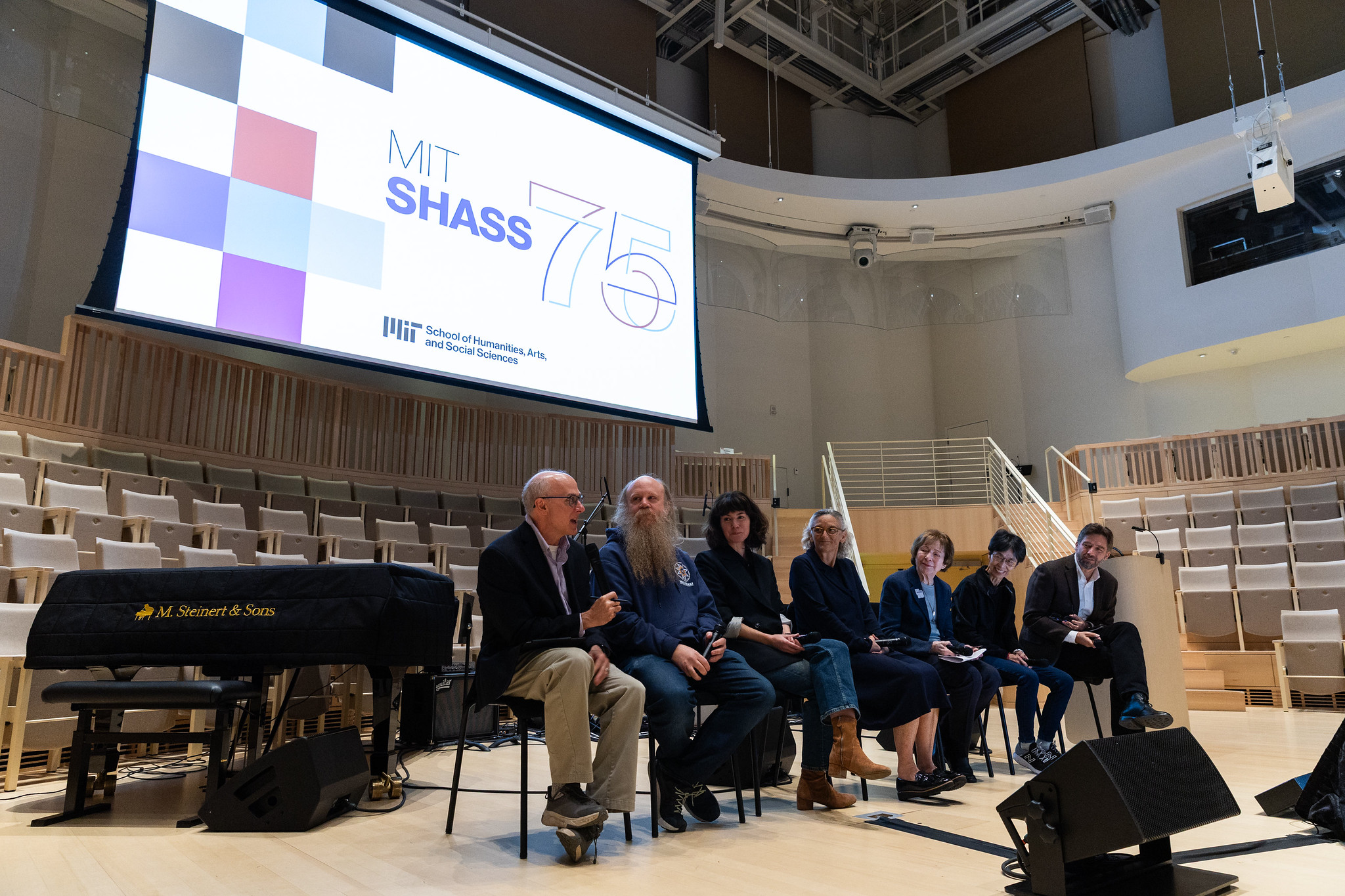
During the School of Humanities, Arts, and Social Sciences’ 75th Anniversary Symposium, President Sally Kornbluth said “MIT has never needed your particular insight and guidance more than we do now.”
MIT News · Artificial Intelligence· news.mit.eduOct 23, 2026
Assistant Professor Benjamin Lindquist studies how engineers deliberately injected randomness into early AI, giving rise to deep-learning models that sometimes hallucinate.
MIT News · Artificial Intelligence· news.mit.eduOct 22, 2026
“X-Hinges” helps design and 3D print items like lamps and gloves with an interactive twist: automatically embedded sensors that perceive and adaptively respond to human contact.
We use cookies to run the site and, with your consent, for analytics and to show ads.
See our Cookie Policy.