Live programming provides visibility to programmers by running and tracing programs as they are edited. However, for programs with potentially harmful side effects, liveness can turn mistakes into disasters. We propose enabling live programming in environments with side effects via sandboxing: confining effects to a si...
It is argued that the college transition is a critical point for analysis and technological intervention, and further, that Intersecting Liminality provides a useful lens for HCI scholars to unpack the compounding challenges that prevent some BLV students from completing computing degrees.
Isabela Figueira, Josahandi M. Cisneros, S. Branham· 0 citations
The paper proposes dynamic-reflexive tracking (DRT), which requires that a creator's evolving reasons undergo reflective uptake, exert genuine influence on the subsequent trajectory of creation, and remain capable of rejecting and redirecting the system's default direction.
This paper presents SurgicalRoomAgent, a voice-interactive multi-agent system for smart operating rooms based on large language models (LLMs), which achieves natural language understanding, device control, intraoperative recording, and surgical report generation through a layered architecture comprising a voice interac...
Tian Zhou· 0 citations
Reach audiences
Advertise in front of researchers, engineers, and readers.
Generative AI and the practice of"vibe coding"are changing how archaeologists carry out computational research, but their effects on the discipline's range of methods is still understudied. In this paper, we evaluate whether large language models (LLMs) are narrowing the variety of methods archaeologists use. We first...
An ANC system for open-ear wearables that suppresses environmental noise using only microphones and miniaturized open-ear speakers embedded within the frame of the wearables, removing the need for an in-ear error microphone is presented.
This work proposes a cross-device user authentication system based on inductive transfer learning, where keystroke dynamics learned on one device are adapted to a secondary device, which is used to robustly train a binary classifier.
Nuwan Kaluarachchi, Sevvandi Kandanaarachchi, K. Moore et al.· 0 citations
The first systematic security study of NES systems is conducted, finding that NES retrieves a significantly expanded context, including inputs from imperceptible user actions and global codebase retrieval, which increases the attack surfaces.
AID, Automated IPI Detection, a data-driven system that continuously logs unauthorized access and suspicious behaviors on smartphones is presented, demonstrating AID's potential as an evidence-support tool that complements current clinic-based interpretation and safety-planning.
Wei-Si Yang, Shi-Nan Liu, Feng Xiao et al.· Proceedings of the ACM on In...· 2 citations
Preliminary findings on breakdowns are presented as a design principle for creativity support, prioritising human creative agency and meaningful reflection over automated content generation.
Marianne Bossema, S. Ben Allouch, Rob Saunders· arXiv.org· 0 citations
A confidence-aware multimodal fusion framework (CAMF) is proposed to realize reliable human intention prediction for industrial human-robot collaboration and outperforms existing multimodal fusion approaches in overall performance and stability.
Xin-Yu Liu, Qing-Qing Dong, Bo Jia et al.· 0 citations
This feasibility study investigates the impact of applying plain language (Einfache Sprache) to cookie banners within the IAB Transparency&Consent Framework and demonstrates that the comprehension barrier can be lowered from a college-graduate level to a 7th-grade level.
Minela Bećirović, Ha Dao, Mannat Kaur et al.· 0 citations
AI agents can generate code at a scale that’s hard for humans to review line-by-line. PDD Kit helps ensure the code is doing what the developer intended by creating formal specifications and testing against them. It converts developer intent into a Verus specification, proves AI-generated code meets it for every input, and uses tests where proofs aren't practical. Developers review intent, not every line. The post Formally verifying agent-written full-stack web apps with PDD Kit appeared first o…
Professor Paris Smaragdis develops computers with superhuman hearing for applications like speech recognition, music understanding, and environmental monitoring.
MIT News · Artificial Intelligence· news.mit.eduOct 23, 2026
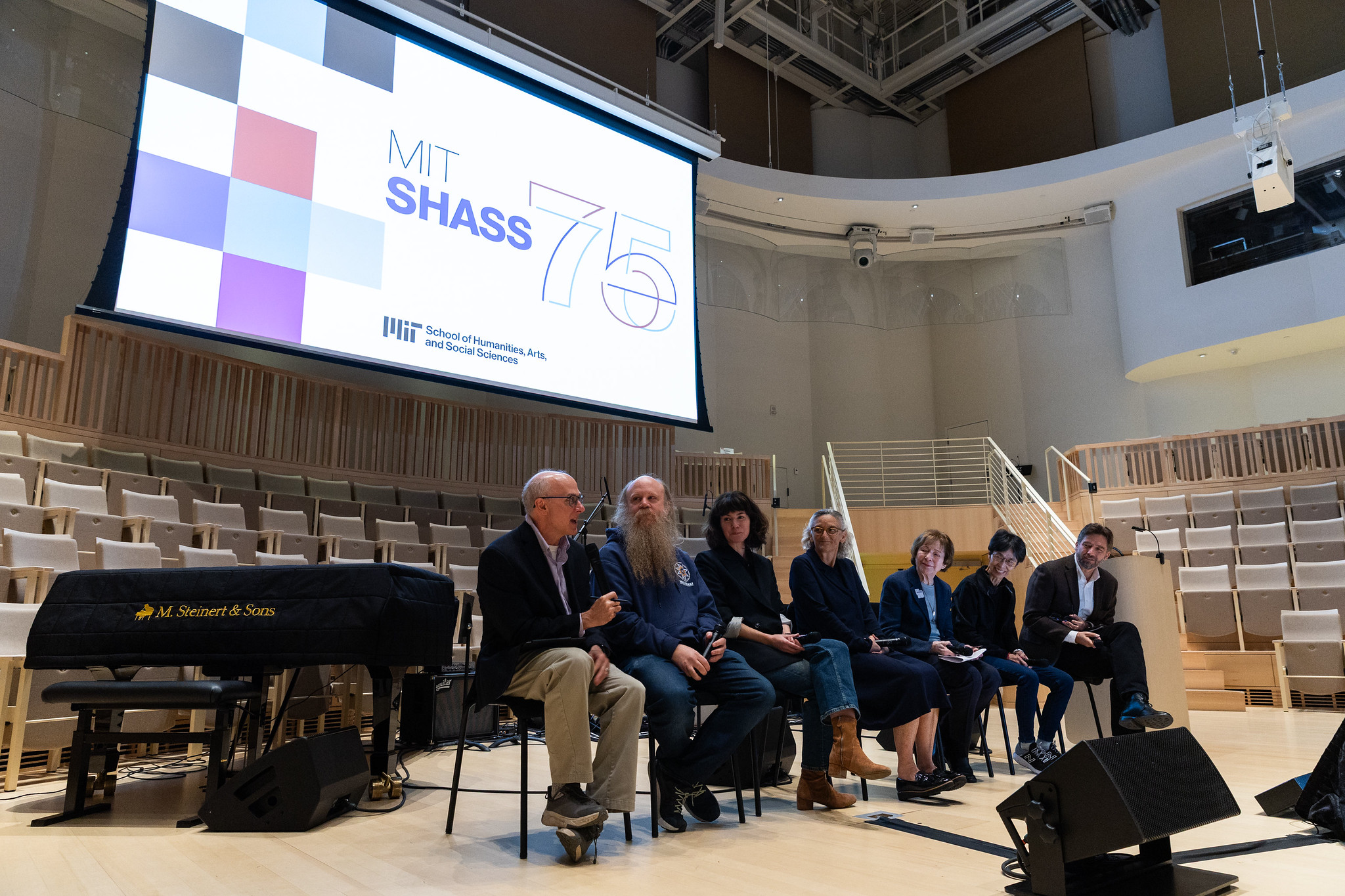
During the School of Humanities, Arts, and Social Sciences’ 75th Anniversary Symposium, President Sally Kornbluth said “MIT has never needed your particular insight and guidance more than we do now.”
MIT News · Artificial Intelligence· news.mit.eduOct 23, 2026
Assistant Professor Benjamin Lindquist studies how engineers deliberately injected randomness into early AI, giving rise to deep-learning models that sometimes hallucinate.
MIT News · Artificial Intelligence· news.mit.eduOct 22, 2026
“X-Hinges” helps design and 3D print items like lamps and gloves with an interactive twist: automatically embedded sensors that perceive and adaptively respond to human contact.
We use cookies to run the site and, with your consent, for analytics and to show ads.
See our Cookie Policy.