Tactile Search, an approach that uses modulation of frequency and amplitude of vibrations to the hands for guiding attention to the location of objects in 3D space, is introduced and it is found that vibrotactile feedback significantly improved performance and increased user confidence.
Amber Maimon, I. Wald, J. Keppel et al.· 0 citations
Personal LLM assistants (health companions, elder-care agents, accessibility aides) are judged by what they remember about a person: a medication or an allergy mentioned in passing and needed days later, so an eviction policy must decide what the cache forgets.
Li-Chen Zhu, Yueqian Lin, Yi-Heng Wang et al.· Proceedings of the 4th Inter...· 0 citations
Digital Twins for educational buildings can support sustainability-oriented learning, but their use in schools remains limited. This paper presents a GenAI-based chatbot built on top of an existing Digital Twin for two school buildings in Greece, using real IoT data from environmental sensors and energy meters. The cha...
Themistoklis Sarantakos, Dimitrios Amaxilatis, Michail Giannakos et al.· 0 citations
Human users are interacting with chatbots and companion AI technologies as if they were human. A growing array of AI-systems are now trained to recognise, interpret and simulate feeling in user interactions. Ethical considerations such as fairness, accountability, transparency and explainability (FATE) are paramount in...
Alicia Vidler, Belinda Middleweek· 0 citations
Reach audiences
Advertise in front of researchers, engineers, and readers.
EviMap is an interactive system providing researchers and practitioners with an auditable thematic overview of heterogeneous corpora spanning 2,108 to 101,699 documents, with a comparison against flat and hierarchical LLM baselines.
FrankenReport, an interface for long-form knowledge-seeking report generation that supports adaptive early exiting per section, is presented, an interface for long-form knowledge-seeking report generation that evaluates intermediate outputs during generation and predicts whether further targeted computation will yield...
Zheng-Ping Jiang, Gonzalo Ramos, Ji-Na Suh et al.· 0 citations
This paper derives a heuristic baseline built from severity-weighted usability signals, normalized layout metrics, and pixel-ratio complexity measures calibrated to real user sentiment from the complete RICO dataset of 66,261 real-world mobile application screens.
M. Sadi, Golam Mostofa Naeem, Toufiqur Rahman Tasin et al.· 0 citations
Demographic synthetic survey panels are often validated by matching aggregate answers to published surveys. We test what that certificate establishes across six multiselect batteries from four survey organisations in three countries. The headline analysis is restricted to three instruments whose synthetic cohort and hu...
This work presents InsightChain, a four-stage visualization prompting pipeline that emulates expert analytical workflows, together with VG-COPRO, a vision-guided automatic prompt optimization (APO) method adapted to jointly optimize such multi-stage, executable pipelines.
Han-Ya Sun, Chen Zhang, Sheng Liang et al.· 0 citations
A counterfactual condition (MIX) is test with a counterfactual condition (MIX) in which each document combines segments drawn from different systems, preserving document-level presentation while breaking cross-segment consistency.
Ahrii Kim, Vilém Zouhar, Chanjun Park et al.· 0 citations
This work conducts a controlled human study of six reasoning formats across tasks of varying complexity, supported by a web-based framework that randomizes task domains, problem instances, and representation order.
This interpretation presents the 1948 game as a human-approximates-machine game and suggests that the imitation game framework can be used not only to ask whether machines imitate humans, but also to examine when human intelligence becomes machine-like under specific task constraints.
AI agents can generate code at a scale that’s hard for humans to review line-by-line. PDD Kit helps ensure the code is doing what the developer intended by creating formal specifications and testing against them. It converts developer intent into a Verus specification, proves AI-generated code meets it for every input, and uses tests where proofs aren't practical. Developers review intent, not every line. The post Formally verifying agent-written full-stack web apps with PDD Kit appeared first o…
Professor Paris Smaragdis develops computers with superhuman hearing for applications like speech recognition, music understanding, and environmental monitoring.
MIT News · Artificial Intelligence· news.mit.eduOct 23, 2026
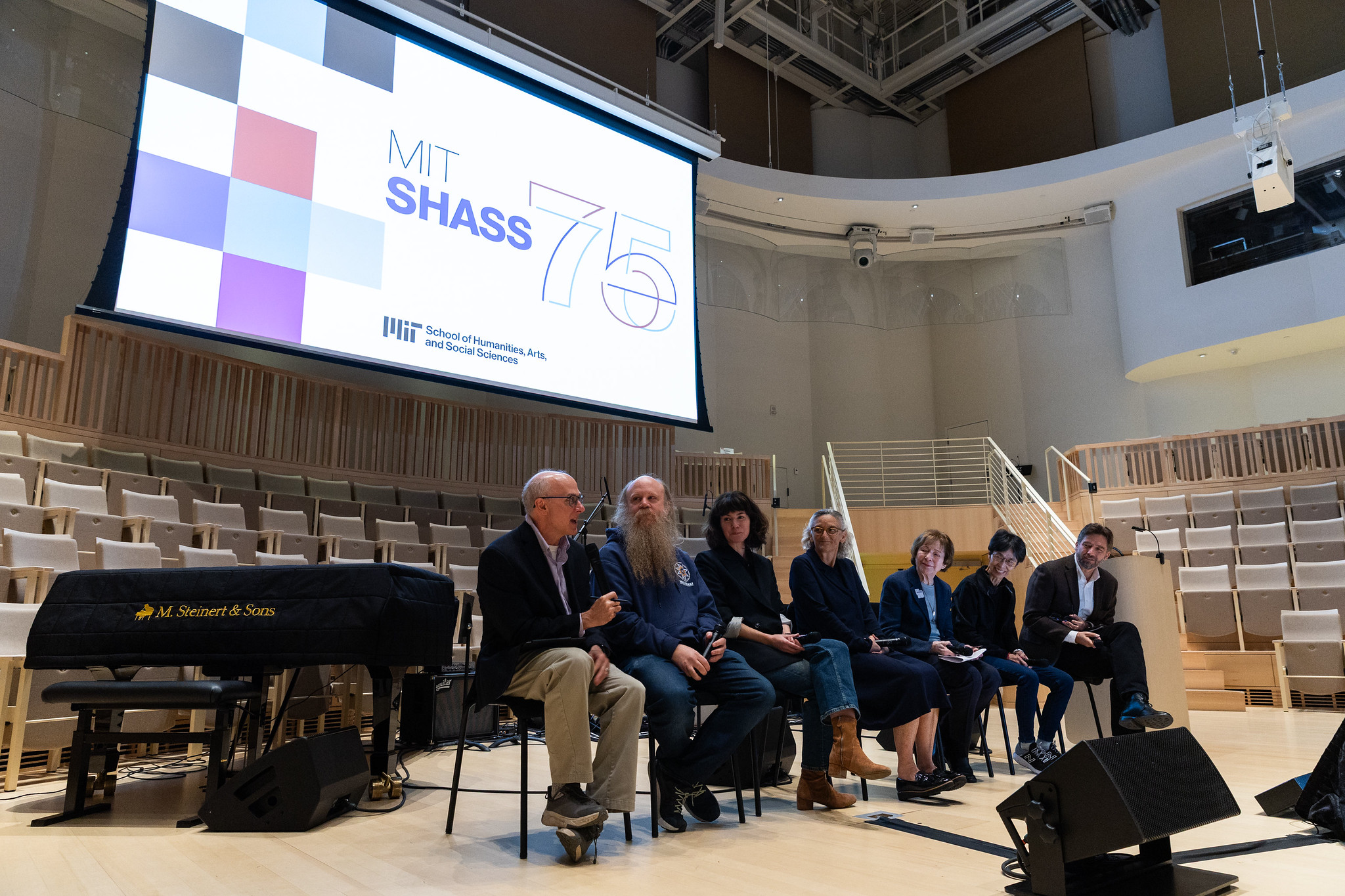
During the School of Humanities, Arts, and Social Sciences’ 75th Anniversary Symposium, President Sally Kornbluth said “MIT has never needed your particular insight and guidance more than we do now.”
MIT News · Artificial Intelligence· news.mit.eduOct 23, 2026
Assistant Professor Benjamin Lindquist studies how engineers deliberately injected randomness into early AI, giving rise to deep-learning models that sometimes hallucinate.
MIT News · Artificial Intelligence· news.mit.eduOct 22, 2026
“X-Hinges” helps design and 3D print items like lamps and gloves with an interactive twist: automatically embedded sensors that perceive and adaptively respond to human contact.
We use cookies to run the site and, with your consent, for analytics and to show ads.
See our Cookie Policy.