This research WIP paper presents DBWorkout, a web-based platform that supports formative SQL learning through sandbox-based execution, automated result-based feedback, and session-based gamification. Learning Structured Query Language (SQL) remains challenging for undergraduate students due to limited opportunities for...
S. Nizamani, D. Devaraj, T. Nguyen et al.· 0 citations
This research full paper examines how undergraduate students use large language models (LLMs) across computer science subfields. As LLMs become increasingly integrated into computing education, understanding how their use varies across technical and pedagogical contexts is essential for designing effective, subfield-aw...
S. Nizamani, Yoonjeong Lee, Nikitha Donekal Chandrashekar et al.· 0 citations
We present a teleoperation system that enables a single operator to perform construction tasks on a Unitree G1 humanoid, combining extended reality (XR) based upper body control with pedal-based locomotion to enable simultaneous manipulation and locomotion. Motivated by persistent labor shortages, hazardous working con...
Parastoo Ali Pour, David R. Martin, Chang Min Hur et al.· 0 citations
Companies and brands increasingly use dynamic pricing, including targeting social media ads to users based on their income. In this work we audit TikTok's feed using 56 automated accounts, which collect data on over 80,000 videos, across two studies. We test the impact of device price on ad load and ad types, using 12...
Nazanin Sabri, Cat Mai, Haodi Zou et al.· 0 citations
Reach audiences
Advertise in front of researchers, engineers, and readers.
This technical report presents TeamLens, an optional Critsly interface for voluntarily sharing a self-reported MBTI type with a particular board, an implemented disclosure-to-aggregation workflow and an auditable technical account of its correctness boundaries, privacy limitations and scaling cost.
Although not exhaustive, the findings indicate that the card-sorting approach can organise and streamline the design of the evaluation process, encouraging a more comprehensive and multidisciplinary assessment of XAI systems in research and development.
K. Kacafírková, Ivania Donoso-Guzmán, Denis Parra et al.· 0 citations
Generative AI can support writing, but frictionless access may cause cognitive offloading before users develop their own ideas. We introduce Engage-to-Unlock, a productive-friction mechanism that unlocks generative capabilities after users meaningfully engage with the task. In a controlled experiment (N = 398), partici...
Xiao-Tian Su, Laura Rimell, Jiazheng Li et al.· 0 citations
Assessing learning in large classrooms presents a significant challenge for individual instructors, who may have limited capacity to evaluate the understanding, participation, and assessment behaviour of every student. Peer assessments have been a way of distributing this responsibility among learners, allowing them to...
Jinal Gupta, Pavani Ayinampudi, Aditya B. M. V. et al.· 0 citations
Large language models are increasingly used as collaborators on deductive-reasoning tasks, but their outputs can hallucinate or pull users away from intended reasoning. Formal proof assistants provide machine-checked verification, but have a steep learning curve and require more granular reasoning than human written pr...
Chen-Jun Guo, Manooshree Patel, Arnav Mehta et al.· 0 citations
Multimodal large language models (LLMs) increasingly integrate vision and text, yet how people use them in natural settings remains underexplored. We seek to answer the question: when users upload images, what tasks are they trying to accomplish? Analyzing over 40,000 de-identified image-upload conversations from Micro...
Jin-Yi Ye, Scott Counts, Gaurav Verma et al.· 0 citations
Users experience different balance challenges while standing, walking, and turning in virtual reality (VR), yet most locomotion techniques apply the same visual behavior regardless of movement state. We present a real-time movement-smoothing design framework in this paper that organizes visual adaptations according to...
We present three locomotion adaptation approaches: Motion Acceleration, Turn Acceleration, and Motion Deceleration to improve postural stability during body-state transitions in virtual reality (VR). The system detects standing-to-walking, turning, and walking-to-stopping transitions and applies adaptive locomotion smo...
AI agents can generate code at a scale that’s hard for humans to review line-by-line. PDD Kit helps ensure the code is doing what the developer intended by creating formal specifications and testing against them. It converts developer intent into a Verus specification, proves AI-generated code meets it for every input, and uses tests where proofs aren't practical. Developers review intent, not every line. The post Formally verifying agent-written full-stack web apps with PDD Kit appeared first o…
Professor Paris Smaragdis develops computers with superhuman hearing for applications like speech recognition, music understanding, and environmental monitoring.
MIT News · Artificial Intelligence· news.mit.eduOct 23, 2026
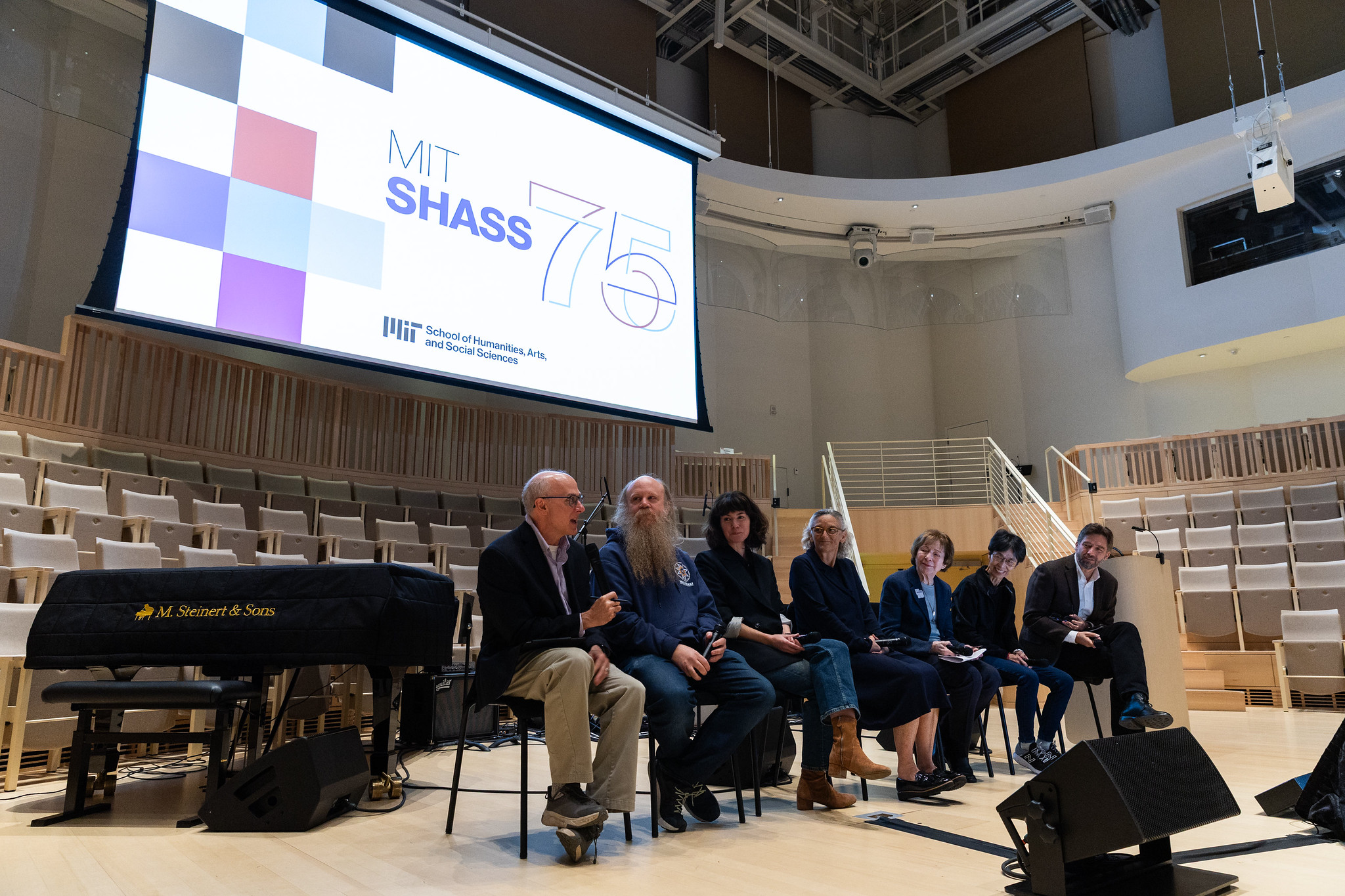
During the School of Humanities, Arts, and Social Sciences’ 75th Anniversary Symposium, President Sally Kornbluth said “MIT has never needed your particular insight and guidance more than we do now.”
MIT News · Artificial Intelligence· news.mit.eduOct 23, 2026
Assistant Professor Benjamin Lindquist studies how engineers deliberately injected randomness into early AI, giving rise to deep-learning models that sometimes hallucinate.
MIT News · Artificial Intelligence· news.mit.eduOct 22, 2026
“X-Hinges” helps design and 3D print items like lamps and gloves with an interactive twist: automatically embedded sensors that perceive and adaptively respond to human contact.
We use cookies to run the site and, with your consent, for analytics and to show ads.
See our Cookie Policy.