This conceptual paper theorizes agentic workflows systems, where an AI agent or agents proactively perceive, plan, act and reflect throughout the entire software development lifecycle (SDLC); its implications for end to end software engineering automation are discussed.
Harsh Verma· World Journal of Advanced Re...· 1 citation
AI-driven cybersecurity in the software engineering field is discussed, where machine learning, deep learning, natural language processing, and reinforcement learning can be applied throughout the software development lifecycle to provide increased security.
Harsh Verma· World Journal of Advanced Re...· 0 citations
Intent-Based Security (IBS), a structured approach built on foundational ideas from access control, zero-trust models, and principal-agent dynamics, shows why trusting identities fails against invisible threats.
Harsh Verma· International Journal of Sci...· 0 citations
This study offers new means to design a resilient multi-agent system that is able to resist emergent threats by formalizing trust as a dynamic security vector and introduces an Agentic Trust Dynamics Theory as a conceptual theory to model the evolution, loss, and impact of trust on emerging security vulnerabilities in...
Harsh Verma· International Journal of Sci...· 0 citations
Reach audiences
Advertise in front of researchers, engineers, and readers.
Explainability in Large Language Model (LLM)–assisted PLC programming is essential for industrial adoption, where engineers must understand, validate, and maintain generated control logic under strict safety and standardization constraints. Existing explainability-oriented prompting approaches such as Chain of Note (Co...
Ketut Adnyana, A. Schwung· International Conference on...· 0 citations
Generating PLC programs with Large Language Models (LLMs) that are directly deployable in industrial toolchains remains challenging because outputs must satisfy IEC 61131-3 semantics and vendor-specific compilation constraints. Verification-centric prompting such as Chain-of-Verification (CoVe) can reduce reasoning err...
Ketut Adnyana, A. Schwung· International Conference on...· 0 citations
This study develops a rule-based parts of speech tagging tool specifically for those people who want to learn or research on Bengali grammar and proposes and endeavor to implement this tool with an intent to achieve higher accuracy by optimizing memory overhead.
Shadikun Nahar Sakiba, Md Nasir Uddin Shuvo, Najia Hossain et al.· Lecture Notes in Networks an...· 7 citations
Interstellar communication is not merely slow. It is strategically stale. A message received across distance reports a sender that may no longer occupy the same strategic state, while replies and irreversible actions are chosen on different local clocks. This paper develops a delayed Bayesian interaction game in which...
Kwan Hong TAN· Zenodo (CERN European Organi...· 0 citations
Dark Forest arguments commonly reduce interstellar strategy to a bilateral encounter between two persistent civilisations. A galaxy, however, is an open population in which civilisations enter, disappear, form selective relationships and occupy a spatially constrained network. This paper develops a continuous-time Gala...
Kwan Hong TAN· Zenodo (CERN European Organi...· 0 citations
AI agents can generate code at a scale that’s hard for humans to review line-by-line. PDD Kit helps ensure the code is doing what the developer intended by creating formal specifications and testing against them. It converts developer intent into a Verus specification, proves AI-generated code meets it for every input, and uses tests where proofs aren't practical. Developers review intent, not every line. The post Formally verifying agent-written full-stack web apps with PDD Kit appeared first o…
Professor Paris Smaragdis develops computers with superhuman hearing for applications like speech recognition, music understanding, and environmental monitoring.
MIT News · Artificial Intelligence· news.mit.eduOct 23, 2026
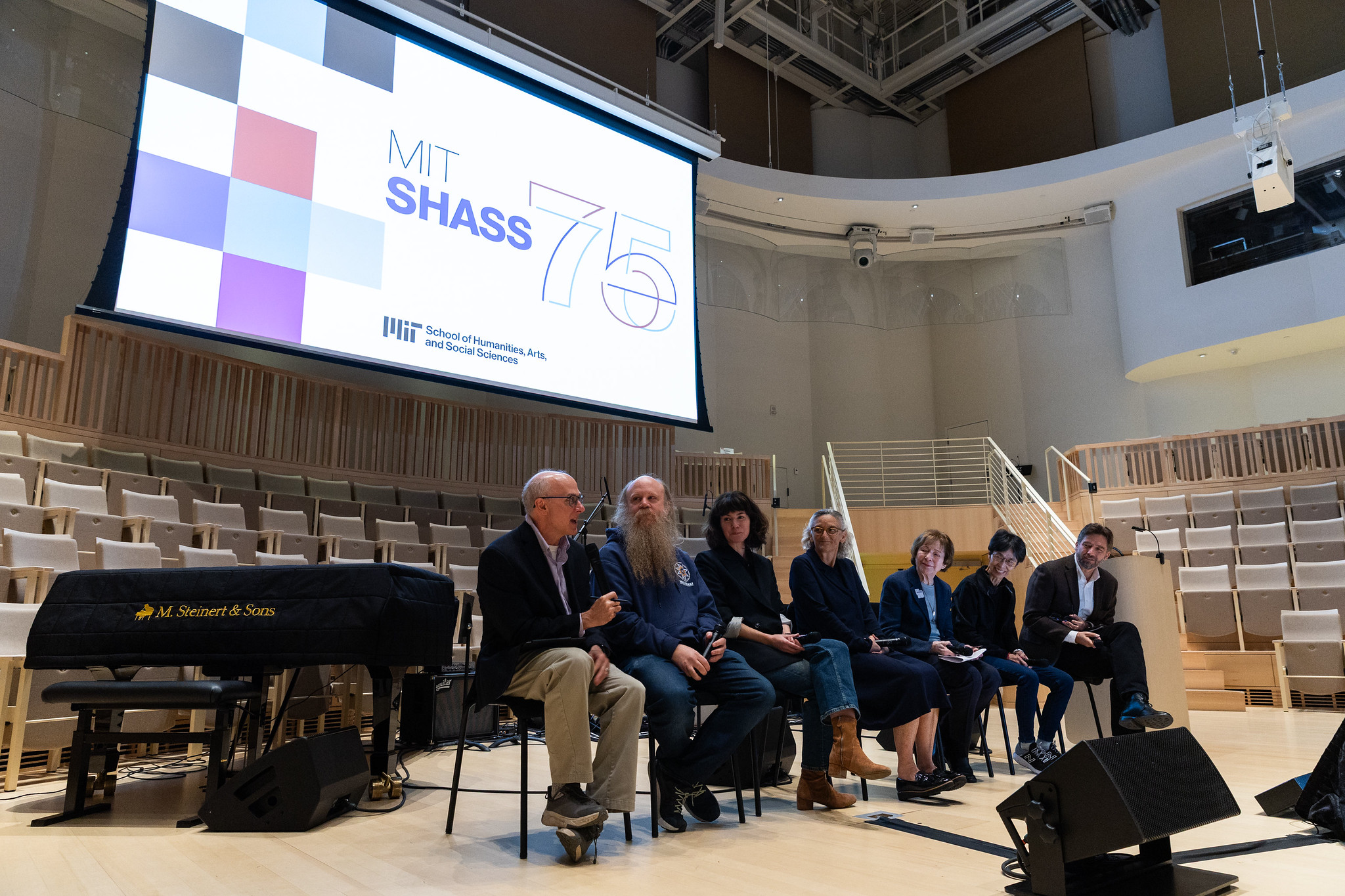
During the School of Humanities, Arts, and Social Sciences’ 75th Anniversary Symposium, President Sally Kornbluth said “MIT has never needed your particular insight and guidance more than we do now.”
MIT News · Artificial Intelligence· news.mit.eduOct 23, 2026
Assistant Professor Benjamin Lindquist studies how engineers deliberately injected randomness into early AI, giving rise to deep-learning models that sometimes hallucinate.
MIT News · Artificial Intelligence· news.mit.eduOct 22, 2026
“X-Hinges” helps design and 3D print items like lamps and gloves with an interactive twist: automatically embedded sensors that perceive and adaptively respond to human contact.
We use cookies to run the site and, with your consent, for analytics and to show ads.
See our Cookie Policy.