A serious behavioural failure may be uncommon within a person’s history yet become the principal basis for judgments of character and future risk. This conceptual article develops the conjunctive misfortune problem: adverse conditions, culpable action, stochastic harm, categorical institutional responses, and persisten...
Kwan Hong TAN· Zenodo (CERN European Organi...· 0 citations
This conceptual article develops a formal theory of atypical human failure in which severe life-course consequences can emerge from a conjunction of adverse conditions, a low-frequency behavioural lapse, stochastic outcome mechanics, categorical legal or institutional thresholds, and dynamically propagating collateral...
Kwan Hong TAN· PhilPapers (PhilPapers Found...· 0 citations
Reach audiences
Advertise in front of researchers, engineers, and readers.
Artificial intelligence is usually analysed as a productivity technology, a labour-market shock, or a governance problem. This article argues that its deeper political significance may arise from a fourth channel: ontological displacement. Ontological displacement occurs when a technology weakens the socially recognise...
Kwan Hong TAN· Zenodo (CERN European Organi...· 0 citations
A person-centred framework of hermeneutic sovereignty for generative AI is developed and concludes that trustworthy AI must preserve not only a human role in decisions, but a meaningful human standing in the production of the interpretations on which decisions depend.
Kwan-Hong Tan· International Journal of Law...· 0 citations
This paper critically examines the foundational assumptions of rational decision-making models and finds them to be systematically and comprehensively flawed. Through a rigorous analysis of empirical evidence from behavioral economics and neuroscience, we demonstrate that traditional models, such as Expected Utility Th...
Kwan Hong TAN· Zenodo (CERN European Organi...· 0 citations
This paper critically examines the foundational assumptions of rational decision-making models and finds them to be systematically and comprehensively flawed. Through a rigorous analysis of empirical evidence from behavioral economics and neuroscience, we demonstrate that traditional models, such as Expected Utility Th...
Kwan Hong TAN· PhilPapers (PhilPapers Found...· 0 citations
This thesis investigates the complex and often contentious question of whether predictive models are epistemically superior to causal models. It challenges the simplistic dichotomy that often frames this debate, arguing that the epistemic superiority of a model is not an intrinsic property but is contingent upon the sp...
Kwan Hong TAN· Zenodo (CERN European Organi...· 0 citations
This paper develops a novel account of truth grounded in fluctuational epistemology, a framework that situates knowledge within the ontological instability of reality. Traditional theories—correspondence, coherence, pragmatic, and deflationary—assume varying degrees of stability in the relation between propositions and...
Kwan Hong TAN· Zenodo (CERN European Organi...· 0 citations
AI agents can generate code at a scale that’s hard for humans to review line-by-line. PDD Kit helps ensure the code is doing what the developer intended by creating formal specifications and testing against them. It converts developer intent into a Verus specification, proves AI-generated code meets it for every input, and uses tests where proofs aren't practical. Developers review intent, not every line. The post Formally verifying agent-written full-stack web apps with PDD Kit appeared first o…
Professor Paris Smaragdis develops computers with superhuman hearing for applications like speech recognition, music understanding, and environmental monitoring.
MIT News · Artificial Intelligence· news.mit.eduOct 23, 2026
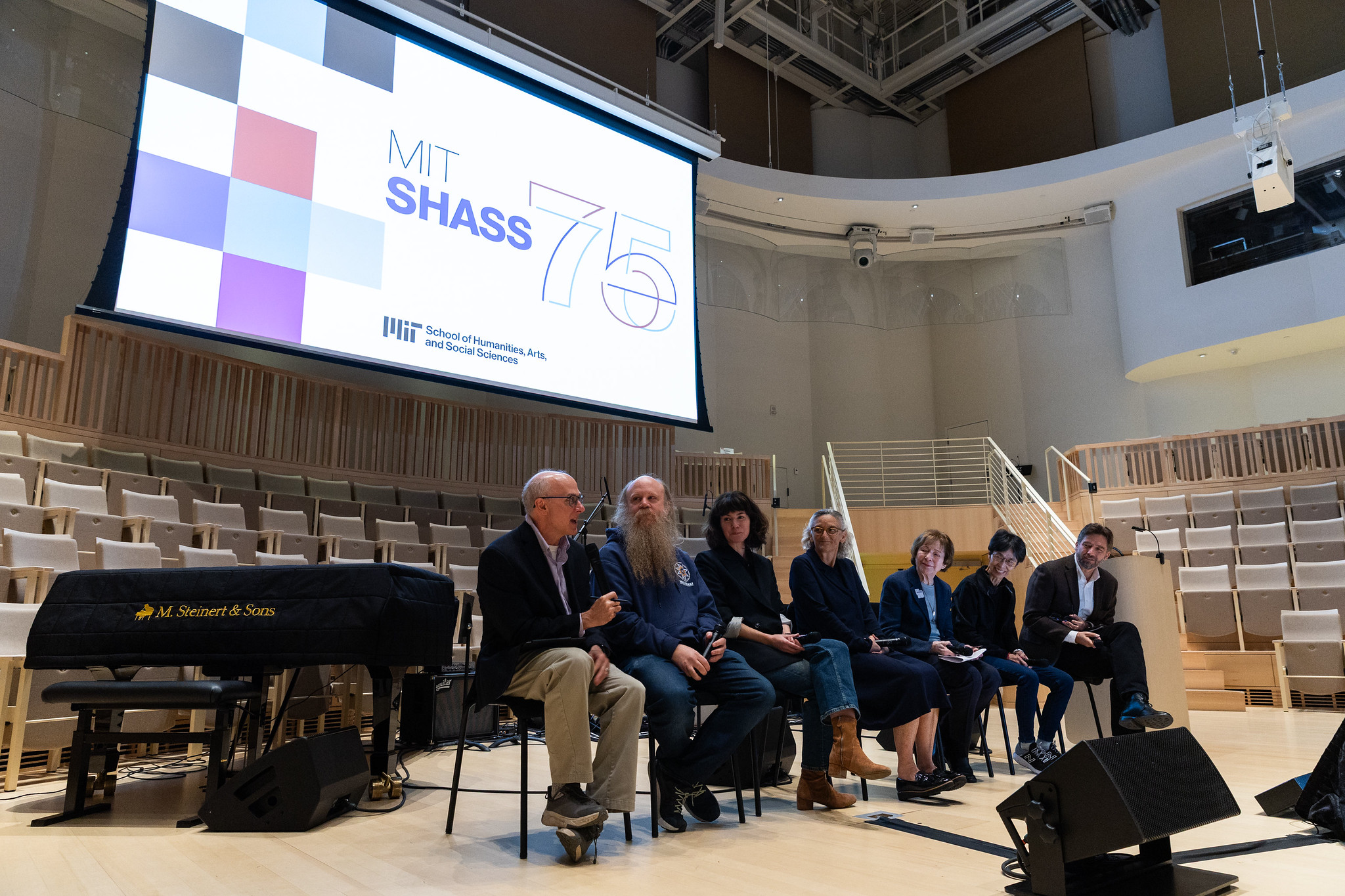
During the School of Humanities, Arts, and Social Sciences’ 75th Anniversary Symposium, President Sally Kornbluth said “MIT has never needed your particular insight and guidance more than we do now.”
MIT News · Artificial Intelligence· news.mit.eduOct 23, 2026
Assistant Professor Benjamin Lindquist studies how engineers deliberately injected randomness into early AI, giving rise to deep-learning models that sometimes hallucinate.
MIT News · Artificial Intelligence· news.mit.eduOct 22, 2026
“X-Hinges” helps design and 3D print items like lamps and gloves with an interactive twist: automatically embedded sensors that perceive and adaptively respond to human contact.
We use cookies to run the site and, with your consent, for analytics and to show ads.
See our Cookie Policy.