This work reformulates the output projection followed by top-k token selection as a maximum inner product search over token embeddings and replaces the dense vocabulary projection with an HNSW-based vector index, suggesting approximate retrieval is a practical alternative to dense output projections in latency-sensitive small-batch decoding.
We propose QGPINNs, a physics-informed neural network framework developed in PyTorch for the numerical solution of nonlocal differential equations on quantum graphs. The framework is designed as a general computational implementation in which the solution on each edge of the graph is approximated by a neural network, while a unified graph-based loss function enforces the governing equations together with initial, boundary, and vertex transmission conditions. In particular, the formulation incorporates standard continuity and Kirchhoff-Neumann vertex conditions and Dirichlet boundary conditions into the learning process to couple the local edge-wise neural approximations into a global solution on the graph. The framework is developed for two representative classes of nonlinear models: multi-order fractional elliptic problems and time-fractional evolution equations on quantum graphs. To improve accuracy and training stability, QGPINNs integrates several graph-adapted learning strategies, including soft and hard constraint enforcement, dynamic loss balancing, Fourier feature embeddings, and a learnable singularity-capturing feature for weakly singular solutions arising in the considered problems. The framework also extends naturally to inverse problems, including the identification of the orders of fractional operators and physical parameters from noisy observational data. We validate the accuracy, computational efficiency, and physical consistency of the proposed framework through numerical experiments on benchmark graph structures and real-world networks, including the IEEE 14-bus system and an open-channel agricultural drainage network.
As a precursor to high-dimensional biomedical data modeling, reliable feature selection can reduce computational expense, improve modeling performance, and yield simpler, more interpretable models. However, most filter-based feature selection methods struggle to detect feature interactions, while wrapper or embedded feature selection methods are computationally expensive. Relief-based algorithms (RBAs) are filter methods that are sensitive to feature interactions while mitigating these other limitations. This study (1) refactors, optimizes, and expands the scikit-rebate Python package with existing and newly proposed RBA variants and (2) conducts rigorous RBA benchmark comparisons across diverse genomic simulations. We expand scikit-rebate to include SWRF*, mu-Relief, and 5 novel RBA variants implementing alternative strategies for neighbor selection and feature scoring. All RBAs were evaluated to compare predictive feature ranking and runtime across simulated genomic datasets varying in sample size, number of features, heritability, and underlying association type (e.g. main effects and interactions). All RBAs, except mu-Relief, were proficient in detecting 2-way interactions in noisy data. RBAs utilizing 'far' scoring were best at detecting 2-way interactions - with MultiSWRFDB* top-performing - but were far less sensitive to main effects. SWRF, MultiSWRF, MultiSURF, and MultiSWRFDB yielded top performance across main effect and 2-way interaction datasets with MultiSWRFDB performing best when also considering 3-way interactions. Refactoring of scikit-rebate resulted in 10 to 35-fold reductions in RBA runtimes. The newly introduced RBAs were among the strongest performing, and by robustly retaining both main effects and 2-way epistatic interactions, these algorithms preserve predictive signals for downstream modeling.
Kia Kazemi-Nia, Harsh Bandhey, Philip J. Freda et al.· 0 citations
Model merging combines multiple task-specific fine-tuned LLMs into a single multi-task model without additional training. However, merged models are known to suffer from representation bias: systematic drift between the merged model's hidden states and those of each individual source model. Prior work (Yang et al., 2024a) study and mitigate this bias for encoder-based vision models using a lightweight correction module trained with L1 loss. However, such bias is not studied for decoder models due to their autoregressive nature. We analyze the problem of representation bias in decoder models, and show two challenges absent in encoders: (1) the causal attention mask causes bias to accumulate across token positions, requiring position-dependent correction; and (2) not all token positions are equally important, i.e., high-entropy (decision-critical) positions matter far more than low-entropy ones. To address these challenges, we propose Decoder-Aware Representation Tuning via Surgery (DARTS). DARTS employs a novel entropy-weighted L1 loss to upweight correction at high-entropy positions where errors most affect generation quality, and a per-position additive bias that captures position-dependent error without overparameterization. We perform extensive evaluation on three domains: code generation (HumanEval), mathematical reasoning (GSM8K), and instruction following (AlpacaEval) on Llama-2-7B models, and show DARTS achieves significant improvement over the standard surgery approach while adding negligible parameters ($0.1\%$ of total parameters).
Aaryan Ajay Sharma, Sai Nishanth Padala, Seganrasan Subramanian· 0 citations
Reach audiences
Advertise in front of researchers, engineers, and readers.
To determine the real-world effectiveness of machine learning based malware detection, it is vital to evaluate its robustness against highly capable adversaries. However, state-of-the-art attacks do not effectively model realistic adversaries, as they often assume access to privileged information such as the training data, feature space, or confidence scores of the target. In this work, we present Replicant, a deep reinforcement learning framework that learns the realistic task of evasion under a strict label-only black-box threat model. Replicant learns a reusable policy on how to modify a malware sample and when to query the target, which transfers across samples, detectors, and feature spaces. Across seven Android malware detectors and three feature spaces, Replicant is the strongest and most query-efficient approach achieving a mean attack success rate of 78.8%, a relative improvement of 20.9%-39.2% over the state-of-the-art. Furthermore, when used for adversarial training, Replicant also outperforms the state-of-the art by producing detectors with more generalizable robustness. With Replicant we demonstrate that learning the task of evasion not only results in stronger attack performance but, crucially, provides a better signal for hardening malware detectors.
Shae McFadden, Ilias Tsingenopoulos, Mario D'Onghia et al.· 0 citations
This work proposes a curvature-conditioned multiscale momentum method with sphere constraints, which significantly accelerates Muon across diverse architectures (dense, MoE) and model sizes (0.12B--2.3B parameters).
Shu-Chen Zhu, Yu-Xin Fang, Ming-Ze Wang et al.· 0 citations
Euclidean Fourier neural operators (EFNOs) are proposed as a domain-independent alternative to FNOs and can learn operators that act consistently across periodic domains of varying shape and size by parameterizing the spectral kernel as a continuous function of the physical wavevector.
Nathanael Bosch, N. Schmitz, M. Herbst· 0 citations
Tabular data, as a core data format in machine learning, often lacks the discriminative power needed for high-performance modeling due to insufficient feature informativeness. Automated Feature Engineering (AutoFE) overcomes this by automating feature generation and selection, ensuring both model performance and operational efficiency. However, traditional AutoFE often yield features with poor interpretability because they rely on blind mathematical transformations, while large language models (LLM)-based AutoFE faces challenges in requiring costly multi-round iterations to generate high-utility features to effectively enhance model performance, compounded by inherent risks of bias and hallucination. In this paper, we combine symbolic regression with LLMs for feature engineering (SymboLLM-FE) to solve these challenges. We extract mathematically expressive formulas strongly correlated with the target via symbolic regression, which can enhance model performance, then refine them by LLMs with rich prior knowledge to ensure interpretability. Empirical results on six real-world datasets and four Kaggle competitions demonstrate that SymboLLM-FE outperforms existing AutoFE. SymboLLM-FE also addresses the dual challenges of poor interpretability and numerous iterations by employing a statistical prior-grounded LLM refinement mechanism and single-digit LLM calls.
Zi-Jian Cheng, Zi-Yi Jia, Zhi Zhou et al.· 0 citations
Structured generation underpins large language model (LLM) agents that produce JSON, SQL, and function calls, where a single wrong field can cause the downstream action to fail. Constrained decoding already tracks parser transitions to enforce formal validity, and these transitions expose how generated tokens participate in schema-critical decisions such as required fields, arguments, and structural boundaries under the active grammar. Existing KV compression largely leaves this task-relevant structural signal unused. We introduce PASK (Parser-Aware Structural KV Persistence), which turns parser-derived structure into layer-group-specific KV persistence decisions. PASK addresses the mismatch between model-side KV sensitivity and task-level structured risk by using task-error sensitivity to set minimum protection floors and attention-output distortion to allocate residual KV capacity. An offline calibration stage compiles these signals into a persistence policy, leaving only lightweight structure-conditioned lookup online. At a targe total KV budget of 0.33, PASK outperforms the strongest compressed baseline by 17.39 percentage points on average across eight BFCL non-live and Live subcategories on Qwen3-4B. In end-to-end serving, PASK achieves up to 2.2x higher throughput and 3.3x lower TPOT, while using 0.53x the peak GPU memory of Full KV.
Let $n\ge2$ be even, let $\lambda=(\lambda_1,\ldots,\lambda_n)\in\mathbb{R}^n$ have pairwise distinct coordinates, and define the difference-power matrix \[ A_d(\lambda) := \bigl[(\lambda_r-\lambda_s)^d\bigr]_{r,s=1}^n, \qquad d\in\mathbb{N}. \] In 1928, Colombo proved that $\det A_{n-1}(\lambda)\ne0$---and hence $\det A_{n-1}(\lambda)>0$---and that $\operatorname{rank} A_d(\lambda)=d+1$ for $0\le d<n-1$. He conjectured that \[ \det A_d(\lambda)\ne0 \qquad\text{for every } d\ge n-1. \] For even $d$, the conjectured nonsingularity follows from previously published results on distance-power matrices. The remaining open cases were therefore the supercritical odd exponents $d\ge n+1$. We prove nonsingularity for all these odd exponents, thereby completing Colombo's conjecture. Consequently, \[ \operatorname{rank} A_d(\lambda)=\min\{n,d+1\} \qquad(d\in\mathbb{N}). \] Our proof converts a hypothetical kernel vector into a real binary form having more projective real linear factors, counted with multiplicity, than its real Waring length permits.
TransMod constructs a shared zone-level spatial representation that aligns mobility systems with different spatial granularities into a common space, thereby reducing structural mismatch and distributional shift and provides robust forecasting performance under limited target data.
Randomized neural networks enable fast and analytically tractable training by fixing the input to hidden layer parameters at random and learning the output weights in closed form; however, their performance critically depends on a single uninformed draw of hidden units. This one shot and task uninformed feature construction often leads to redundant representations and suboptimal utilization of model capacity. To address this limitation, we propose a simple and broadly applicable residual guided procedure that greedily constructs the hidden layer using a closed form residual decrease criterion. At each stage, we (i) generate a pool of random candidate units, (ii) score each candidate by the exact reduction it induces in the ridge regularized objective, (iii) select the top k units, and (iv) refit the readout in closed form using the standard design with direct input links. This procedure yields a progressive training process with a guaranteed monotonic decrease of the training objective. The method is model agnostic: only the candidate generation is architecture specific, while the scoring selection refitting loop is shared across models. Extensive experiments on 71 benchmark datasets from the UCI repository, covering both binary and multiclass classification tasks, demonstrate that the proposed residual-guided models consistently outperform their baseline counterparts in terms of accuracy, stability, and overall ranking performance.
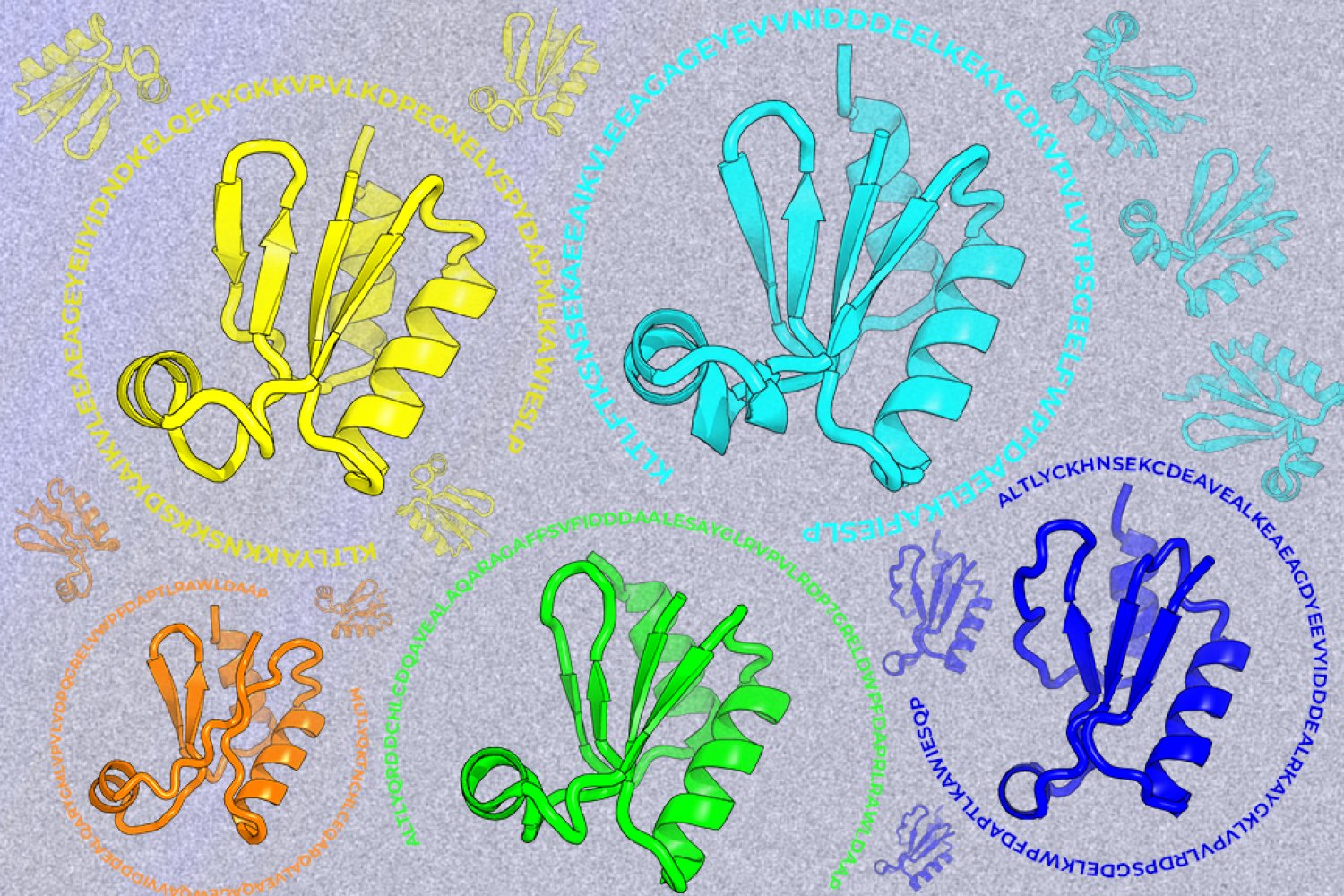
A new machine-learning framework aims to improve the success rate of computational protein design while moving away from results that reproduce sequences found in nature.
MIT News · Artificial Intelligence· news.mit.eduAug 24, 2026
A new method for surgically removing training examples from a model reveals that as datasets grow, the link between what a model learns and what it produces dissolves.