Powered two-wheeler riders face critical safety challenges in low- and middle-income countries, yet limited studies exist on how cognitive stressors such as Time Pressure influence collision risk. We address this gap by introducing a comprehensive dataset consisting of over 129,000 labeled multivariate time-series samples, gathered across 153 simulator rides from 51 participants under No, Low, and High TP scenarios. Across each sequence, we capture 64 distinct attributes covering vehicle motion, rider control actions, spatial proximity, and rule compliance indicators. Using this dataset, we introduce MotoSafety, a new edge-AI framework built on the Learned Temporal Importance (LTI) concept. MotoSafety achieves 94.97% accuracy and 99.33% ROC AUC, outperforming ten baselines, including TimesNet and LLM4TS, and achieves 0.039 MSE and 0.094 MAE for forecasting (4.4x lower error than Time-LLM and iTransformer). With only 1.15M parameters and 0.135 ms latency, it is suitable for edge deployment on low-cost CPU hardware. Using ground truth TP as an inductive bias improves accuracy from 94.09% to 94.97%, while predicted TP achieves 94.82%. Using only 21 IMU+GPS features, it achieves 93.91% accuracy, indicating practical deployment. Beyond PTW safety, the architecture shows better transferability to human activity (97.66%) and clinical (99.65%) domains. This lightweight framework advances PTW collision risk assessment, supporting the Safe System Approach for Intelligent Transportation Systems.
Sumit S. Shevtekar, Chandresh K. Maurya, Gourab Sil et al.· 0 citations
This work introduces Co-RL, a framework in which multiple decoupled models, sharing no parameters, are simultaneously optimized through RL using rewards derived from their peers, and shows that unsupervised reasoning can emerge through cooperative multi-agent training.
Yunhao Yang, Yuexin Bian, Yunjie Tian et al.· 0 citations
Approximate Speculative Decoding (ASD) is introduced, a training-free verifier that replaces binary first-mismatch truncation with budgeted longest-prefix selection and reuses the contiguous target-greedy suffix without additional approximate decisions or target-model forward passes.
Yuannuo Feng, Zegang Peng, Yu-Xin Xie et al.· 0 citations
Physical learning rules such as equilibrium propagation (EP), coupled learning (CL), and adjoint coupled learning (AL) train resistive networks through local measurements. The learned function is decided by where on the solution manifold training lands. Two properties could decide it, and they have not been separated: the circuit's invariance under rescaling every conductance, and the rule's conservation of the mass K = (1/2) sum_e kappa_e^2. We separate them. When every element is trainable, all three vector fields are homogeneous in the conductances, so the initialization scale is provably inert. An element the rule does not adjust breaks that homogeneity whatever its constitutive law. Across twenty topologies the learned function moves with the initialization scale by a median of twelve percent with fixed rectifiers and eight with fixed linear resistors, against 3e-8 when every element is trainable; a single fixed rectifier produces the whole effect. The conservation law is not what protects the function: AL, which we prove dissipates the mass at exactly twice its own loss, remembers its initialization as strongly as the rules that conserve it, and the memory survives in runs where K is conserved to 1e-4. Raising the fixed-element count from one to eight multiplies the conservation drift by five thousand and leaves the memory unchanged, while the all-trainable circuit under AL drifts comparably and remembers nothing. What the rule's conservation structure does control is solution quality: at matched training loss AL is worse than EP and CL in four of six small circuits, by a median of three to seven percent, though the ordering is not stable across checkpoints and does not reproduce at fifty nodes. Physical learning therefore carries two independent inductive biases, one belonging to the circuit and one to the rule, and only the first is a memory of how the device was built.
Bijaya Dangol· 0 citations
Reach audiences
Advertise in front of researchers, engineers, and readers.
Objective. We tested whether frozen representations from five EEG foundation models support decoding of long-range temporal correlations, measured as the detrended-fluctuation-analysis (DFA) exponent of the alpha-band amplitude envelope. Approach. REVE, LaBraM, BENDR, CBraMod, and BIOT were evaluated in CAUEEG and BrainLat. A common 240 s estimator used 8-13 Hz filtering, DFA over 2-23.8 s, artifact masking, and quality control. One fixed nested-cross-validation readout predicted DFA and a fixed-mode aperiodic exponent. Controls tested pre-pool order sensitivity and aperiodic residualization. Results. CAUEEG included 764 recordings and BrainLat 79. BIOT decoded DFA in CAUEEG (R-squared = 0.232; conditional subject-bootstrap 95 percent interval, 0.121-0.310), and CBraMod was positive but imprecise (R-squared = 0.121; 0.003-0.214). Neither replicated in BrainLat, where all five point estimates were negative. In contrast, CBraMod and BIOT decoded the aperiodic exponent in both cohorts (R-squared = 0.459-0.757). BIOT remained positive after removal of the measured linear aperiodic association in matched CAUEEG data (R-squared = 0.240). The post-hoc order control was batch- and configuration-sensitive. Because chronological EEG epochs are not exchangeable, it was descriptive, not an LRTC-specific test. No revised DFA transfer direction passed source-label permutation testing. Cohort membership was near-ceiling decodable from all five embeddings, but this is not a pure site effect. Significance. CBraMod and BIOT show a replicated, model-specific spectral-temporal dissociation: aperiodic decoding is present in both cohorts, whereas alpha-envelope DFA decoding is cohort-dependent. These findings bound the evaluated readouts; they do not establish representational absence or an architectural cause. Transfer and clinical associations remain exploratory.
Equipping a classifier two-sample test with a gradient-boosted discriminator and decomposing it by controlled permutation into marginal, dependency, and numerical-categorical cross components, each read against a fully factorized reference that destroys all dependency while leaving every marginal intact, and against a real-data oracle.
Existing patching and multi-scale methods advance multivariate time series forecasting but treat learned representations as transient byproducts of prediction, lacking explicit mechanisms that enforce structural consistency across temporal scales. We propose M2Patch, a CNN-based architecture that organizes channel-independent observations into a structured latent space via two complementary differentiable penalties. Multi-scale patching decomposes the input into overlapping temporal granularities, depthwise separable CNN blocks with progressively growing dilation extracts scale-specific features at linear complexity, and per-scale learned projections compress these features into a compact latent representation. An intra-scale smoothness penalty enforces temporal continuity between adjacent patches, while an inter-scale alignment penalty restores cross-granularity interaction through learnable cross-scale mappings, so that all scales encode mutually consistent representations of the underlying dynamics. Extensive experiments on ten real-world benchmark datasets demonstrate that M2Patch significantly outperforms state-of-the-art baselines. Further analyses establish M2Patch as a structure-aware recognizer: it recovers channel functional groupings and remains robust under patch-level input corruption, confirming that the structured latent space captures the data's intrinsic dynamics.
This work proposes RouteCost, a production-inspired multi-stage framework that decomposes the problem into time-aware demand forecasting, fee-card-informed baseline pricing, Stage 2 residual correction, and proxy-based box-consolidation inference inference.
Xianling Zeng, Zihan Yu, Sichen Zhao et al.· 0 citations
A pipeline that is fully automatic and cross lingual, using large language models, GPT 5, GPT 4o and Claude Sonnate 4, to independently generate, evaluate, and refine neural network architectures for handwritten optical character recognition, opening the door to rapid and adaptable deployment of OCR technology across many languages and domains.
Results demonstrate that hierarchical modeling of 3D facial geometry enables interpretable, ontology-linked phenotype classification, though performance on rare leaf terms remains limited.
F. Hellmann, Alexander Hustinx, Benjamin D. Solomon et al.· 0 citations
Mask2Real-WM is presented, a two-stage action-conditioned world model for dexterous manipulation that decouples pixel prediction into a dynamics model and a rendering model that shows that mask conditioning and simulation pretraining are both required for per-DoF action controllability across all 23 degrees of freedom.
Riccardo Feingold, Davide Liconti, Chenyu Yang et al.· 1 citation
As AI labs approach a data ceiling where compute capacity outpaces the rate of new high-quality text generation, language model pretraining is shifting toward a data-constrained, compute-abundant regime that demands productive multi-epoch training on fixed corpora. Standard autoregressive (AR) pretraining overfits severely in this setting, reaching its optimum early and then continuously deteriorating. We investigate training-time data augmentation as a regularizer to mitigate this overfitting and enable productive training for hundreds of epochs on the same data. We introduce three orthogonal categories of augmentation for AR pretraining: token-level noise (masking, random replacement), sequence permutations (right-to-left prediction, Fill-in-the-Middle), and target offset prediction ($x_{t+i}$ for $i > 1$). Through systematic ablations, we find that individual augmentations delay overfitting and lower validation loss relative to the baseline, with random token replacement achieving the best minimum loss among individual methods. Combining augmentation categories further lowers the minimum validation loss. Our experiments demonstrate that data augmentations mitigate AR pretraining's data inefficiency and offer a promising solution to the data-constrained regime~\footnote{All code and data are available at https://github.com/ michaelchen-lab/ data-augmentations-for-pretraining.
Michael K. Chen, Xikun Zhang, Fan Bai et al.· 0 citations
A weeklong summer workshop brought higher education faculty to campus to explore how AI and machine learning materials can be adapted for their classrooms.
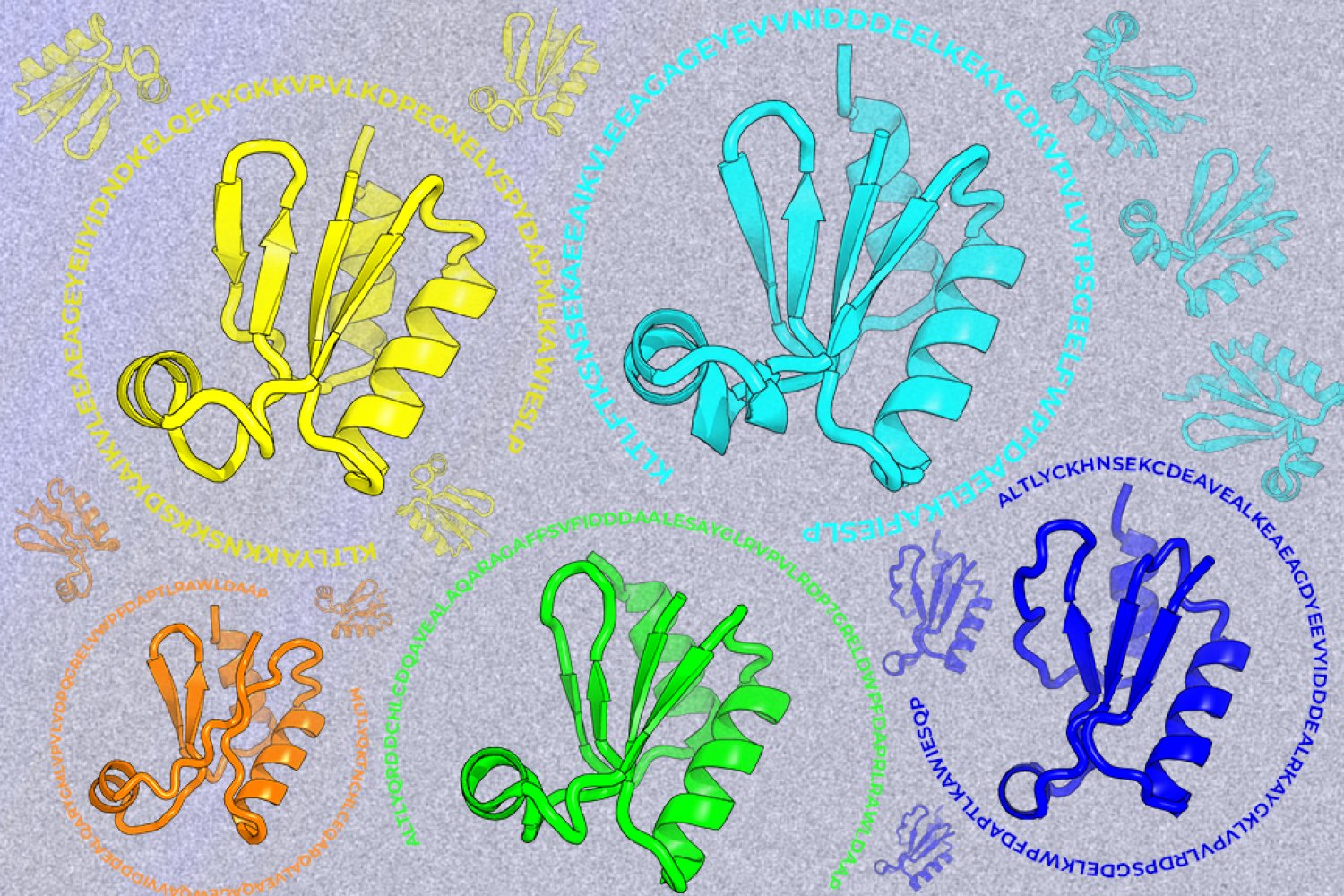
A new machine-learning framework aims to improve the success rate of computational protein design while moving away from results that reproduce sequences found in nature.
MIT News · Artificial Intelligence· news.mit.eduAug 24, 2026