Energy-aware LLM serving requires comparing configurations under realistic request shapes, yet exhaustive target-GPU profiling is costly and a cheap predictor can be dangerously confident outside its measured scope. We present TokenPowerSandbox, an evidence-gated workflow that combines an interpretable CPU-resident projector, short target-GPU probes, full-workload verification, and tamper-evident freeze-before-measurement provenance. On one NVIDIA H100 80GB serving Qwen2.5-7B-Instruct with vLLM, three anchor repeats and six development workloads calibrate workload transfer. The same frozen model is evaluated on a blind holdout and a separately predeclared no-refit confirmation totaling 51 post-freeze runs. Energy MAPE is 6.23% and 7.35%, with Spearman rank correlations of 0.976 and 0.933. However, a predeclared TTFT gate passes at concurrency four (9.27% MAPE) and triggers abstention below four (64.80%), showing why energy accuracy cannot certify latency.
The Entropy Constrained Adaptive Stochastic Quantization problem is formulated, which jointly selects adaptive quantization values to minimize MSE under an entropy budget and an unbiasedness constraint, and an iterative refinement procedure is provided for the approximation solution.
Ran Ben Basat, Y. Ben-Itzhak, Michael Mitzenmacher et al.· 0 citations
This paper treats hallucination as a temporally extended span and detects it by sequence labeling: each token is scored from a 33-dimensional feature stream that fuses text statistics, Natural Language Inference entailment, and language model surprisal, with no access to model internals.
The results show that non-invasive brain-to-text decoding starts to operate at a level of accuracy previously thought exclusive to surgical implants, opening a path toward safe and efficient brain-computer-interfaces.
Mingfang Zhang, Jarod Lévy, Cédric Rommel et al.· 0 citations
Reach audiences
Advertise in front of researchers, engineers, and readers.
This work defines a grouping metric, specify a harness, and shows how tracking a human-AI pair's grouping over time yields the compounding signal that Paper 1's field study requires.
An agent still learning its environment should be cautious while ignorant and bold once confident. The entropic value-at-risk captures this through a robust-optimization identity---a confidence level fixes the radius of a relative-entropy ball of alternative models---but that ball cannot reach catastrophes the nominal deems impossible, precisely what a safe agent must hedge. We instead use an optimal-transport ball and study the coherent risk measure it induces, the Wasserstein entropic value-at-risk. It has a variational dual mirroring the entropic formula (an inverse temperature becomes a transport price), occupies a definite place in the risk hierarchy, and provably accounts for the reachable catastrophes the entropic measure ignores; we verify both dualities numerically. Driving the transport radius by belief entropy then yields a closed-form robust dynamic-programming operator whose caution contracts as the belief sharpens, with a certified safety sandwich and a sharp safety switch.
Deep Kumar Ganguly, Jan K\v{r}et\'insk\'y· 0 citations
Analyzing a large corpus of publicly released post-training trajectories, it is found that across different tasks, the agent's training strategy is locked in at the very beginning, and the entire remaining budget is spent on local adjustments within the selected strategy.
J. Lim, Xinyuan Huang, Hao Peng et al.· 0 citations
To efficiently generate adversarial examples, a gradient-based attack method is proposed that performs optimization exclusively on the vision encoder of the VLM rather than on the entire multimodal architecture, which significantly reduces the computational cost and resource requirements of the attack while maintaining strong effectiveness.
Ilan Zini, B. Addad, Katarzyna Kapusta· 0 citations
It is argued that indeterminacy, rather than correctness alone, is a central challenge for AI reasoning, and that state-of-the-art language models systematically fail to distinguish between determined and undetermined instances, exhibiting miscalibrated reasoning even in verification settings.
Hadi Hosseini, Samarth Khanna, Xiyuan Wang· 0 citations
This work separates generation from selection: explanations are produced ahead of time as a frozen candidate pool (six prompt styles, two commodity LLMs), and a small CPU-resident selector picks one at request time, which needs no GPU and returns in under 100 ms.
T. Chowdhury, Saeideh Shahrokh Esfahani· 0 citations
HN-CLIP is introduced, which uses the text encoder's own text-text geometry to construct per-negative adaptive similarity margins, and improves all six tested fine-tuning frameworks on the in-domain benchmarks and reaches the strongest full-data baseline with only 20% of the training data.
Haoyue Liu, Yeheng Chen, Zhichao Wang et al.· 0 citations
A weeklong summer workshop brought higher education faculty to campus to explore how AI and machine learning materials can be adapted for their classrooms.
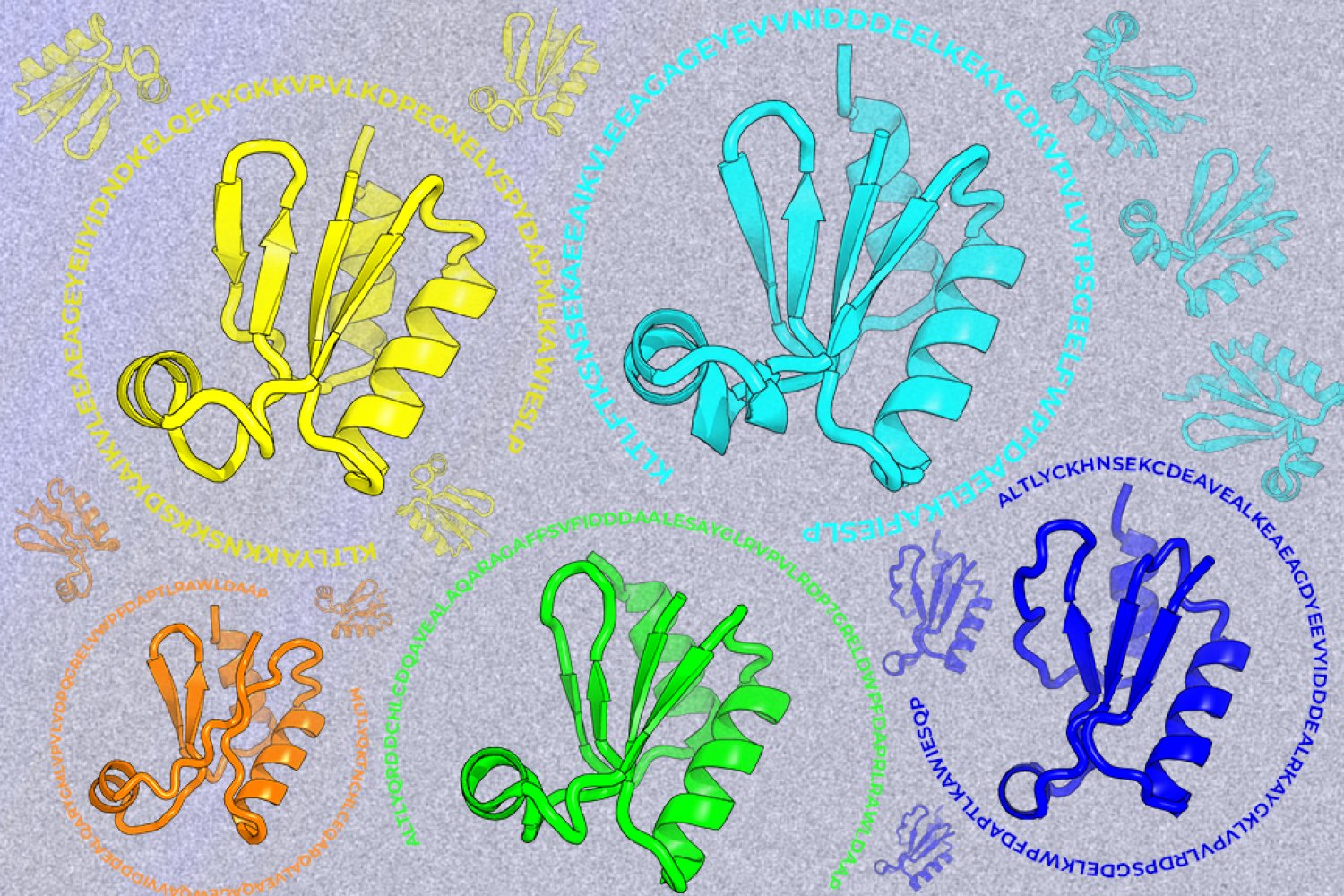
A new machine-learning framework aims to improve the success rate of computational protein design while moving away from results that reproduce sequences found in nature.
MIT News · Artificial Intelligence· news.mit.eduAug 24, 2026