E-commerce platforms increasingly personalize user experiences through machine learning, yet page layout decisions remain dominated by static rules and manual curation. We present a scalable bandit-based system that optimizes product page layouts in real time while preserving human control over design intent. A contextual bandit model dynamically selects the most effective layout for each session using user, item, and category-level features. The system leverages a LinUCB-based policy to balance exploration and exploitation as it learns from live user interactions. The architecture is designed for seamless integration into large-scale web serving stacks, supporting low-latency inference and continuous model updates. The system was first tested on entry product pages. In online A/B deployments on a major retail platform, our approach achieved positive lifts in session-level performance metrics over a strong heuristic baseline. Our results demonstrate that contextual bandits can effectively optimize visual and structural aspects of product discovery for user engagement, providing a scalable path toward learning-to-design the web.
Bhavtosh Rath, Harshith Narasimhamurthy, Bob Eisinger et al.· 0 citations
Neural Architecture Search (NAS) has so far rarely been applied to Mixture-of-Experts (MoE) models, and existing MoE designs leave the alignment between experts and the structure of the data to emerge on its own. We propose an architecture search framework that makes this alignment an explicit search variable: the assignment of data clusters to experts is optimised jointly with the per-expert architectures. We cast the joint problem as a cluster-aware likelihood maximisation, show that it coincides with the incomplete-data maximum likelihood of a latent-variable mixture, and solve it by a generalised Expectation-Maximisation procedure whose otherwise intractable expert-quality term is supplied by an adaptively refined surrogate. We prove that the iterates converge whenever the surrogate errors are summable, and that at every limit point no candidate the search produces improves the true objective. On a heterogeneous image-classification mixture the method recovers the underlying domain partition on 95% of clusters without ever observing domain labels, and on that benchmark and a four-domain time-series forecasting one alike it outperforms the MoE and NAS baselines that likewise use no label information.
Structured pruning uses surrogate objectives because direct task evaluation over every feasible mask is too expensive. Most evaluations report average surrogate error or rank correlation on broadly sampled masks. These summaries do not directly test the mask chosen by the surrogate. We introduce PruneShift, an evaluation framework that separates broad predictive fidelity, fidelity near selector outputs, and the quality of the selected pruning decision. We first prove that Spearman and Kendall agreement can approach one while normalized selection regret remains maximal. We then derive sufficient conditions based on uniform error, selector suboptimality, decision margin, density ratio, and comparison mass. The analysis also yields a finite pool certificate with an explicit excess cost bound. Four studies test different links in this argument. External TextbookQA confirmation is heterogeneous: 7 of 20 simultaneous intervals favor the surrogate-selected mask, 6 favor its fixed comparator, and 7 cross zero. On a fixed Natural Questions pool, strict improvement holds in one of four settings. A controlled QQP experiment supports the proposed coverage mechanism in all 16 prespecified endpoints, although the sufficient bounds are conservative. Finally, a restricted OSSCAR reconstruction study on OPT-125M shows better local than broad fidelity in 68 of 75 primary endpoints. Independent fixed-mask confirmation is inconclusive in 24 of 25 endpoints and favors the comparator in one. These results show why predictive fit, decision reliability, and pruning method quality require separate evidence.
Broad Learning System (BLS) is an efficient alternative to deep architectures due to its fast training, analytical learning, and strong generalization under limited data. However, existing BLS variants are confined to real-valued representations, restricting their ability to capture nonlinear interactions and second-order statistical dependencies inherent in real-world data. Notably, no prior BLS model fully exploits the complete second-order statistics that naturally emerge when data are embedded in the complex domain. To address this limitation, this paper introduces the first complex augmented Broad Learning System (CA-BLS), which transforms real-valued inputs into phase-encoded complex representations and adopts widely linear modeling to jointly leverage covariance and pseudo-covariance information via complex conjugate augmentation. This enables effective modeling of latent nonlinearities, coherence structures, and second-order dependencies inaccessible to conventional BLS formulations. To mitigate the additional computational cost of complex augmentation, an Efficient Complex Augmented BLS (ECA-BLS) is further developed, reformulating CA-BLS entirely in the real domain while preserving its exact decision function, achieving up to 75\% fewer multiplications and over 60\% fewer additions. A rigorous theoretical analysis proves the mathematical equivalence between CA-BLS and ECA-BLS, ensuring zero theoretical loss. Extensive experiments on 26 benchmark datasets from the UCI and KEEL repositories demonstrate that ECA-BLS consistently outperforms classical BLS and recent state-of-the-art randomized neural networks in accuracy, average rank, and statistical significance, establishing augmented second-order modeling as a critical and previously missing dimension of BLS research.
A. Rahaman, A. Quadir, M. Sajid et al.· 0 citations
Reach audiences
Advertise in front of researchers, engineers, and readers.
Electroencephalography (EEG) is a promising, non-invasive, and cost-effective modality for Alzheimer's disease (AD) detection, but deep learning methods are limited by small and imbalanced clinical datasets. Generative augmentation offers a solution, yet existing approaches rely on inefficient class-specific models or fail to capture complex spatial and temporal brain dynamics. To address this, we propose GraM-Diff, a unified classifier-guided Graph-Mamba diffusion framework for EEG synthesis. It embeds Graph Convolutional Networks within a diffusion U-Net to model inter-electrode connectivity and Bidirectional Mamba state-space blocks for linear-complexity long-range temporal modeling. Latent-space classifier guidance lets a single model generate both healthy and pathological EEG within a shared representation, avoiding fragmented per-cohort pipelines. Across four EEG-based AD benchmarks, synthetic augmentation improves classification, yields superior Context-FID and correlation scores over strong generative baselines, and enhances robustness in data-scarce settings.
M. Tanveer, Ayush Singh Rana, Sanskriti Jain et al.· 0 citations
Transformers rely on position embedding mechanisms in long context modeling in most cases. Rotary Position Embedding (RoPE) embeds positional information with independent 2D rotations, forming relative position terms in self-attention. However, its pairwise, block-based, and decoupled structure limits deep mixing and robustness across channels. We propose HD-RoPE, which extends RoPE from independent 2D rotations to higher-dimensional rotations and introduces a Paley-I orthogonal basis to obtain balanced, isotropic, and dense phase mixing within each rotation subspace. This significantly enhances channel coupling and rotational degrees of freedom while maintaining orthogonal stability and the relative position closure property. Furthermore, HD-RoPE is easily optimized for engineering efficiency without introducing additional trainable parameters. We have conducted extensive evaluation results demonstrating that HD-RoPE achieves significant performance improvements over standard RoPE across various popular benchmarks and in both long and short contexts.
Yixing Li, Ruobing Xie, Yudong Zhang et al.· 0 citations
Early failure prediction is important for long-horizon agents, as it enables timely intervention and can reduce inference and tool-use costs. Uncertainty quantification, such as verbal confidence and perplexity, offers a promising approach to detecting agent failures; however, it has not been explored whether these signals retain their discriminative power during the intermediate stages of long-horizon execution. We evaluate mainstream uncertainty signals on deep-research tasks and find that verbal confidence reliably distinguishes failures at trajectory completion, achieving a mean AUROC of 0.85, whereas all evaluated signals offer limited predictive value earlier in execution, with none exceeding a mean AUROC of 0.60 at 50% trajectory progress. We identify an underlying mechanism explaining this gap: path switching, where agents frequently abandon their current search direction in-trajectory, breaking the link between early signal and final outcome. These findings challenge the assumption that intermediate uncertainty can reliably guide early intervention. They also motivate a practical recommendation for agent harnesses in deep-research settings: use final-step confidence to decide whether to restart, an approach that our experiments find more effective than in-trajectory intervention.
Zongyue Li, Chengyue Yu, Lei Zang et al.· 0 citations
Sharing tabular data in high-stakes domains is constrained by privacy regulations. Synthetic data offer a promising alternative, but deep generative models are costly to train and difficult to audit, while LLM-based methods often serialize records as text, obscuring tabular structure and exposing sensitive data. We introduce Tabular Synthesis Strategy Designer (TabSSD), which uses an LLM to design synthesis procedures rather than directly generate records. TabSSD provides the LLM with tree-derived summaries of variable dependence rather than raw records, which produces Python programs for local execution and evaluation. Across twelve datasets, TabSSD strikes a favourable balance among statistical fidelity, predictive utility, and empirical privacy risk, achieving the best average rank across six metrics among ten methods. Moreover, it substantially reduces local computation and token consumption relative to the compared methods. By enabling human-guided refinement and eliminating user-side model tuning, TabSSD lowers the expertise and infrastructure barriers to transparent tabular data synthesis.
Jinmeng Li, Quan Zhang, Hangting Ye et al.· 0 citations
The rapid development of LLMs incurs prohibitive memory footprints and intensive computational demands. Quantization-Aware Training (QAT) techniques have emerged as a promising solution to address these challenges by explicitly simulating quantization effects during model training, yielding low-bit models that achieve accuracy comparable to their full-precision counterparts. In this work, we provide a target-centric survey of QAT, aimed at clarifying both its theoretical foundations and its evolving implementation landscape. We systematically review existing QAT methods through a target-centric taxonomy and synthesize cross-target differences in error characteristics, numerical formats, and strategy transferability. We further summarize QAT evaluation paradigms and discuss challenges in optimization and deployment, outlining potential directions for future research.
Jiamin Song, Mengjie Zhao, Zijing Wang et al.· 0 citations
To mitigate the time complexity of generative models, one-step generative models have recently emerged through direct mapping from noise to data in a single forward pass. However, the reward-guided fine-tuning method of one-step generative models remains largely unexplored. To address this, we consider one-step generators from an optimal transport view, investigating Wasserstein Gradient Flow (WGF) for modeling smooth and controlled distributional evolution in probability space. We then propose a novel reward-guided fine-tuning of a one-step generative model via WGF. We derive a practical training method that requires no reward gradients, thereby handling both non-differentiable and differentiable rewards. Moreover, our method provides smooth and stable reward-guided distributional updates while mitigating reward hacking and mode collapse. Experiments on 2D synthetic data, CIFAR-10, and ImageNet 256$\times$256 with diverse rewards, including JPEG (in)compressibility, class probability, Black-and-White and CLIP alignment, show that our method achieves better reward alignment compared to baselines.
Hoseong Hwang, Woorim Han, Joungin Chun et al.· 0 citations
Large language models (LLMs) have shown promise for spatio-temporal forecasting, but existing approaches often rely on regularly sampled token sequences and struggle with irregular observations because of temporal asynchrony, representation-space misalignment, and limited context windows. We propose LLMODE, a token-efficient framework for irregular spatio-temporal forecasting with a frozen LLM backbone. LLMODE first uses a graph-aware ODE encoder to reconstruct irregular graph observations as a continuous-time latent trajectory. A Fixed-Budget Perceiver Resampler then compresses this variable-length trajectory into a fixed number of dynamic memory tokens. In parallel, compact statistical descriptors are encoded and resampled into context memory tokens. A dual-source gated cross-attention module injects both memories into the frozen LLM, enabling controlled utilization of external spatio-temporal evidence. Experiments on three real-world urban datasets and two physical-dynamics benchmarks show competitive overall performance, with clearer advantages under sparse or dynamically complex irregular sampling. Additional evaluations on unseen urban regions further demonstrate strong zero-shot generalization without adaptation.
Di Zhang, Jingyang Zhang, Ziqian Wang et al.· 0 citations
We study unsupervised hypergraph alignment, where the goal is to infer node correspondences between two hypergraphs using only structural information, without node features, labels, seed matches, or side information. Direct higher-order formulations can represent hyperedge interactions faithfully, but they can be computationally demanding and cumbersome for non-uniform hypergraphs. Graph-reduction approaches introduce a different challenge: clique expansions keep the alignment problem on the original node set but collapse all hyperedge evidence into one pairwise graph, whereas bipartite expansions preserve incidence structure but enlarge the problem from nodes to nodes plus hyperedges. We introduce FALCON (Filtration-based hypergrAph aLignment via Cross-scale Optimal traNsport), an unsupervised optimal-transport framework for hypergraph alignment. Instead of representing each hypergraph by a single collapsed clique graph, FALCON constructs a filtration-induced sequence of clique-based co-occurrence dissimilarity matrices and jointly aligns all levels through one shared multi-scale Gromov--Wasserstein (GW) objective. The shared transport plan enforces a globally consistent node correspondence across filtration levels while avoiding the auxiliary hyperedge nodes introduced by bipartite expansion. Experiments on perturbation benchmarks derived from real-world hypergraphs show that FALCON is robust to structural noise and in almost all cases outperforms strong graph- and hypergraph-alignment baselines.
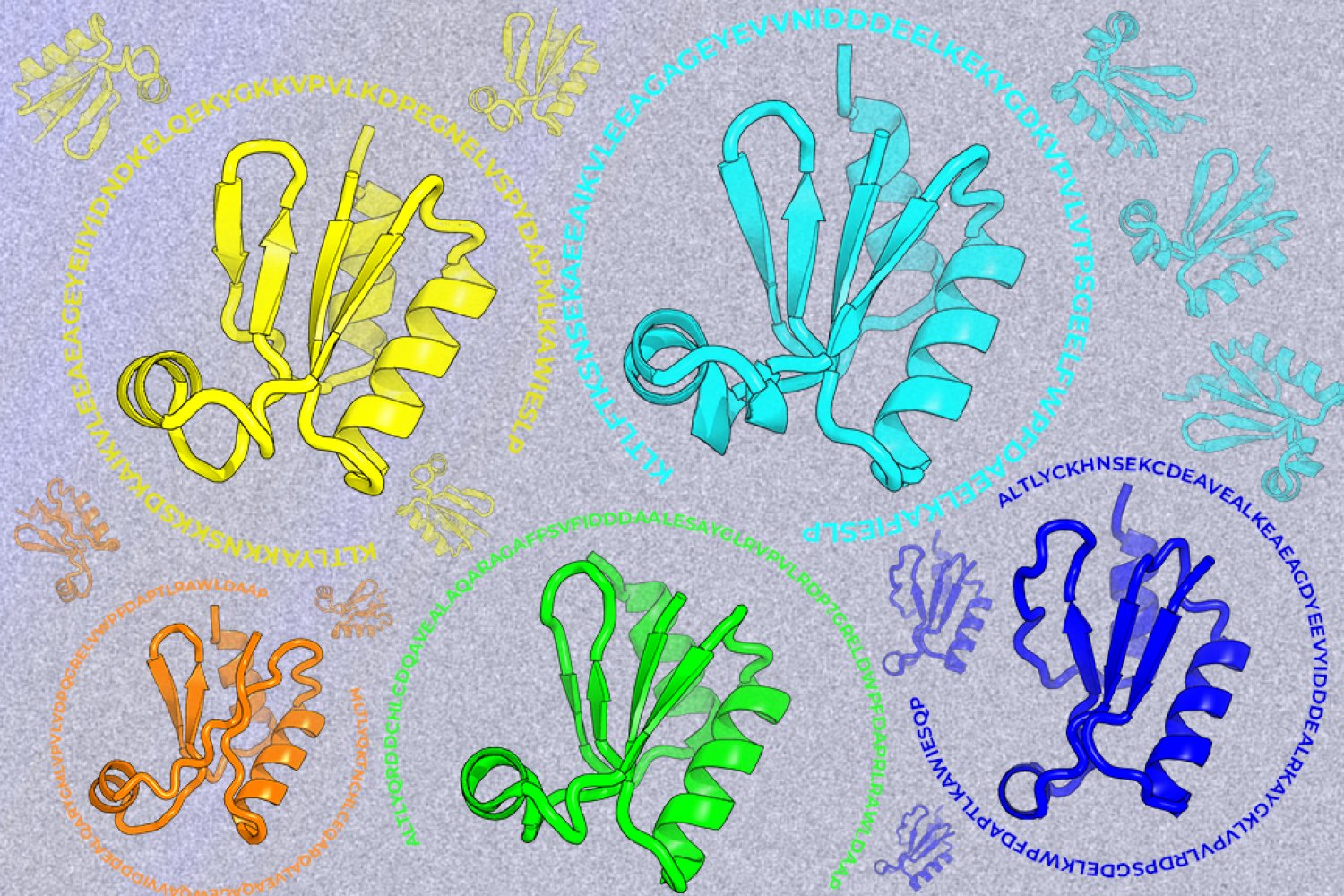
A new machine-learning framework aims to improve the success rate of computational protein design while moving away from results that reproduce sequences found in nature.
MIT News · Artificial Intelligence· news.mit.eduAug 24, 2026
A new method for surgically removing training examples from a model reveals that as datasets grow, the link between what a model learns and what it produces dissolves.