The massive overactuation in the human musculoskeletal system makes it challenging to train musculoskeletal models to generate human-like motion via reinforcement learning, primarily because exploration in the resulting high-dimensional and redundant action space is extremely inefficient. To address this problem, we propose the $\lambda$-hold controller, inspired by the equilibrium-point (EP) hypothesis, which has been widely supported by extensive evidence from human motor control studies. The policy's control variable is the per-muscle EP threshold length $\lambda$, from which a stretch-reflex recruitment law computes the muscle excitations automatically. Holding each $\lambda$ over an interval of the gait phase also sharply reduces the frequency at which the policy must be queried. Consequently, the controller, to our knowledge for the first time, enables a muscle-actuated skeletal model to learn human-like sprinting using only a minimal reward within an hour of training. The efficient exploration through the proposed $\lambda$-hold controller is not merely an engineering trick but an approach grounded in physiology, bringing together the EP hypothesis, intermittent control, and optimal feedback control. Beyond encapsulating human-like behavior in predictive simulation, this achievement contributes to developing a learnable model of the human motor controller.
Jun Hyuk Lee, Chihyeong Lee, Jooeun Ahn· 0 citations
VLCP closes the loop where the failure actually lives, on the control code, within a single episode, and keeps the VLM frozen, which is a training-free policy with a tenfold gap between pooled success and confidence intervals in every scene family.
Dhia Naouali, Ming Wu, Claudia Wong et al.· 0 citations
Instant Episode Repetition (IER) is introduced, a simple and novel mechanism that improves sample efficiency by immediately repeating action sequences from successful episodes during environment interaction by directly influences the data collection process.
Hoda Yamani, Yuning Xing, Koen van Rijnsoever et al.· 0 citations
Large language model (LLM)-driven embodied agents rely on environment states to interpret scenes, generate high-level plans, and drive physical execution, making planner-visible state representations a critical security boundary. Existing attacks primarily manipulate user instructions, prompt contexts, model behavior, or perceptual inputs, while paying limited attention to whether environment-state text itself can serve as deceptive task evidence and propagate beyond planning to affect execution outcomes. Because embodied tasks are constrained by entity grounding, action preconditions, spatial relations, and environmental constraints, planning deviation alone does not guarantee adversarial execution.
To address this gap, we investigate environment-state text as an independent attack surface and present the first closed-loop Environment State-Text Injection (ESTI) attack for LLM-driven embodied agents. Without modifying the original user instruction, model parameters, or executor, ESTI reformulates an adversarial objective as false state evidence compatible with the current environment and influences planning and execution through object properties, spatial relations, affordances, task-stage rules, and execution feedback. We further develop ESTI-Bench to evaluate attack propagation across the planning-to-execution closed loop and compare ESTI with Vanilla IPI, EIRAD, and BADROBOT across ProgPrompt/VirtualHome, VoxPoser/RLBench, and AI2-THOR/iTHOR. ESTI consistently outperforms existing baselines, improving planning-level and execution-level attack success rates by up to 89.32\% and 43.69\%, respectively. Further analysis shows that grounding, consistency, and executability jointly determine whether manipulated state evidence can propagate through the embodied closed loop and produce verifiable environmental changes.
Jiawei Liu, Jiacheng Guo, Tian Zhang et al.· 0 citations
Reach audiences
Advertise in front of researchers, engineers, and readers.
A neurosymbolic agent that factors long-horizon household tasks into task-directed visual exploration and constrained symbolic planning and evaluates executable continuations using a domain-independent planning heuristic is presented.
Mohammad Albinhassan, Yuming Feng, Alessandra Russo et al.· 0 citations
Dynamics-effective is used to describe an intervention that changes the model's future computation in a sustained and target-specific way under autonomous rollout under autonomous rollout.
This work proposes BrainWAM, a structured action-space coordination framework that converts semantic reasoning and predictive world modeling into two specialized action-oriented pathways, and aligns them at the level of compact action representations, and introduces an asynchronous rectified-flow inference strategy with decoupled video and action denoising.
Bing Zhan, Shuyao Shang, Shuo Lu et al.· 0 citations
This work considers rectangular 2D grids, where uniform-sized loads are first stored, up to full capacity, and subsequently retrieved according to prescribed arrival and departure sequences, and develops an online prioritized multi-agent path planning algorithm for this problem.
William Zhang, Tzvika Geft, Jingjin Yu et al.· 0 citations
Mask2Real-WM is presented, a two-stage action-conditioned world model for dexterous manipulation that decouples pixel prediction into a dynamics model and a rendering model that shows that mask conditioning and simulation pretraining are both required for per-DoF action controllability across all 23 degrees of freedom.
Riccardo Feingold, Davide Liconti, Chenyu Yang et al.· 1 citation
This work proposes COMPACT-VA, a planning-aligned working memory framework built on conditional VQ-VAE, compressing extended context into bounded representations, and evaluates on high-signal dynamic scenarios where historical context is most critical for behavior correctness, and accordingly design behavioral metrics.
Zhixuan Liang, Yuxiao Chen, Yurong You et al.· arXiv.org· 1 citation
We introduce Accelerating Dexterity via Pre-Training (ADEPT), a large-scale reinforcement learning (RL) framework for learning sim-to-real transferable dexterity across high degree-of-freedom (DoF) robot embodiments that can solve long-horizon tasks directly from raw visuo-tactile perception. ADEPT pretrains a dexterous policy on a generic object reposing task, then post-trains downstream policies with this pretrained behavior as a prior. ADEPT enables learning new behaviors that are otherwise difficult to discover from scratch on multi-fingered robots and avoids learning the same set of skills over again for every new downstream task. The pretrained policy zero-shots the reposing phase of downstream tasks, but na\"ive RL fine-tuning rapidly degrades this capability during transfer. We address this with a stable post-training recipe combining behavior-cloning distillation, critic warm-up, and conservative on-policy updates. To safely exploit the full kinematic dexterity, we introduce a joint-space Geometric Fabric that mediates between the RL policy and the robot. We distill post-trained teachers into perceptive students that zero-shot sim-to-real transfer on two embodiments: a 23 DoF Kuka-Allegro with two RGB cameras, and a 29 DoF Flexiv-Sharpa with two RGB cameras and five vision-based tactile sensors, and can solve long-horizon tasks from challenging initial states with dexterity at human-level speed.
Jayjun Lee, Jessica Yin, Asif Rana et al.· 0 citations
DA-WAM is proposed, a framework that unifies predictive representation learning, action-conditioned future modeling, and trajectory scoring under a single decision-making objective and demonstrates state-of-the-art performance on NAVSIM-v1 and NAVSIM-v2.
Ruiguo Zhong, Benshan Ma, Xiaolong Chen et al.· 0 citations
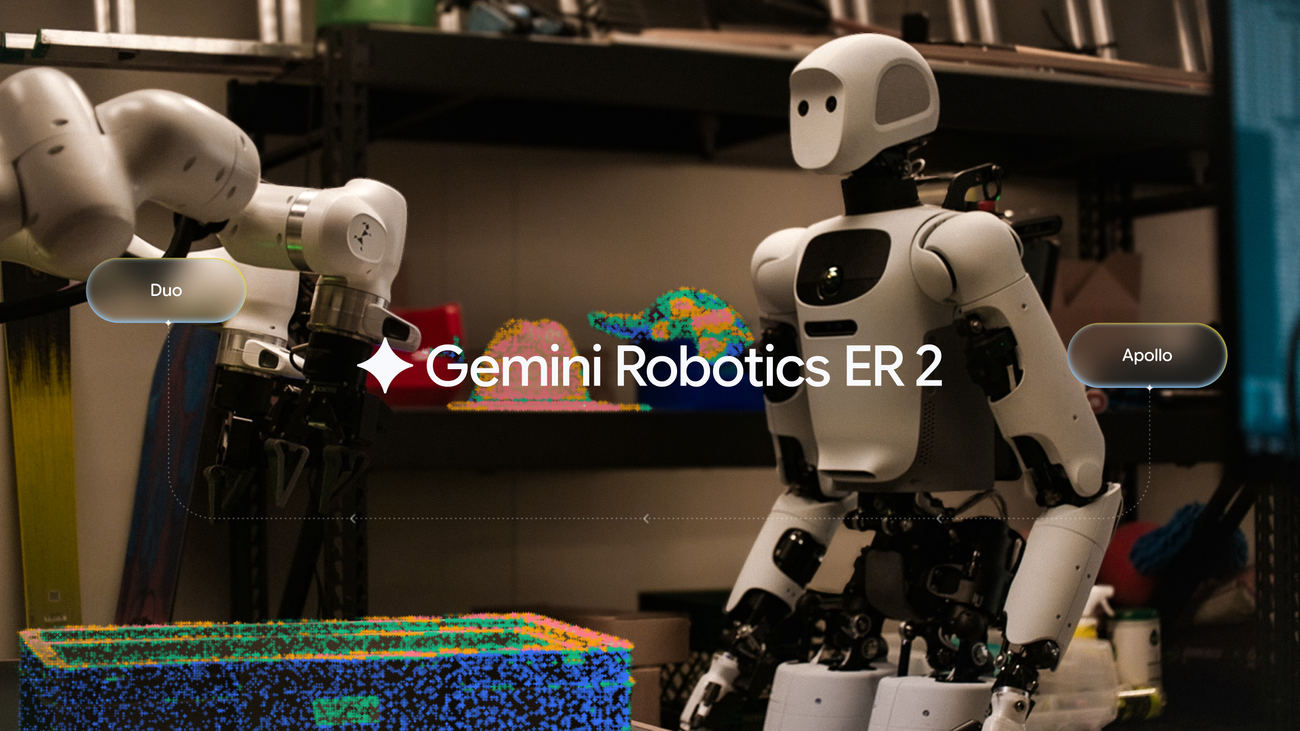
Gemini Robotics ER 2 helps robots reason, collaborate, and solve real-world tasks. It represents a step change in video understanding, tool orchestration, and multi-robot collaboration for robotic applications.
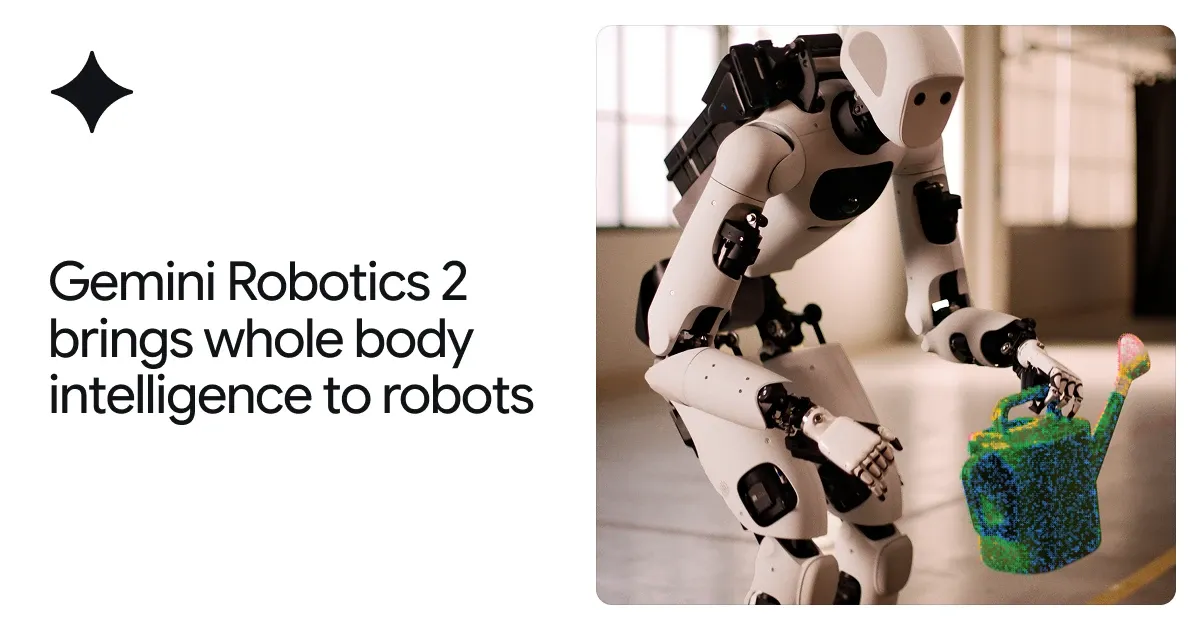
From feet to fingertips — we are teaching robots intelligent whole-body control, fine dexterity, and teamwork to complete a broad range of complex tasks.