We present a real-time semantic navigation framework for Unmanned Aerial Vehicles (UAVs) focused on improving time efficiency in the Object Goal Navigation (ObjectNav) task. Central to our approach is a Large Language Model (LLM) that interprets user-provided natural language instructions and performs semantic reasoning over detected objects and spatial context to prioritize high-probability search regions. The system combines real-time object detection, 3D spatial mapping, and polynomial spline interpolation for smooth and feasible UAV trajectory planning. Unlike prior methods that rely on offline reasoning or simulator-constrained action spaces, our framework can operate in real time, continuously updating semantic relevance based on new observations. Experiments in both simulated and real-world settings demonstrate reductions in mission duration while maintaining high search accuracy, underscoring the effectiveness of LLM-guided reasoning for time- efficient UAV-based ObjectNav.
Marin Maletic, Marijana Peti, Tamara Petrovic et al.· 0 citations
Robotic sorting of recyclable waste is challenging due to the deformable and geometrically inconsistent nature of target objects. We present a training-free suction grasping system for sorting deformed aseptic beverage cartons, decoupling target identification from grasp-point selection. An open-vocabulary vision-language model detects cartons from a text prompt, SAM2 refines each detection into an instance mask, and a geometric scoring method selects the suction point by combining surface flatness with normal alignment. Three geometric methods are compared: k-nearest-neighbour PCA, Sobel cross-product, and RANSAC plane fitting. Evaluated on a real robot across three deformation levels and 35 cluttered scenes, single-object grasp success reaches 88.2% and end-to-end retrieval in clutter is 72.6%.
Cardiovascular risk prediction remains limited by incomplete clinical data and imaging biomarkers that reduce computed tomography (CT) to a small number of handcrafted features. We developed CARDINAL (Cardiovascular Assessment via Representation learning from Deep Imaging with Nested Anatomical Latent embeddings), a clinically grounded framework that learns compact representations from routine non-contrast cardiac CT for major adverse cardiovascular event (MACE) prediction. In 17,659 patients, CARDINAL was evaluated for 1-, 3-, 5-, and 10-year MACE prediction against American Heart Association (AHA) pooled cohort equations (PCE), AHA predicting risk of cardiovascular disease events (PREVENT), coronary artery calcium (CAC), segmentation-derived CT biomarkers, and 70-feature structural radiomics. Gains were largest at longer horizons. At 10 years, CARDINAL (joint) achieved an area under the receiver operating characteristic curve (AUROC) of 0.866 $\pm$ 0.020 and an area under the precision-recall curve (AUPRC) of 0.890 $\pm$ 0.015, compared with an AUROC of 0.826 $\pm$ 0.023 and an AUPRC of 0.826 $\pm$ 0.022 for structural radiomics, the strongest baseline. CARDINAL also achieved the highest survival concordance index (C-index), 0.753 $\pm$ 0.015, and high-versus-low risk-tertile hazard ratio, 10.78 $\pm$ 3.16, with favorable reclassification and exploratory calibration. These findings suggest that non-contrast cardiac CT contains prognostic information beyond conventional risk equations, CAC scoring, and engineered imaging biomarkers.
Roy Gabriel, Nattakorn Kittisut, Jamshid Hassanpour et al.· 0 citations
Vision-language-action models (VLAs) have shown strong promise for general-purpose robotic manipulation by mapping language instructions and vision observations directly to actions. However, most VLAs primarily condition action prediction on current observations and lack an explicit mechanism for reasoning over future task dynamics, which is particularly important for fine-grained, contact-rich manipulation. We present PHR-VLA, a framework that enables planning-horizon reasoning in VLAs through privileged latent representations of future dynamics. PHR-VLA introduces a lightweight auxiliary future head that, during training, aligns the VLA's internal representations with latent dynamics extracted from future observations. Evaluation results demonstrate that local, contact-centric, patch-level latent dynamics supervision from the wrist camera improves success rate on LIBERO from 84.1% to 88.4% and on real-world disassembly tasks from 63.3% to 82.5%. Patch-level supervision from a third-person camera also improves performance on Meta-World from 56.70% to 57.8%. These results demonstrate that privileged latent dynamics alignment provides an effective training signal for improving anticipatory reasoning in VLA policies. Project website: \href{https://davoodsz.github.io/PHR-VLA.github.io/}{https://davoodsz.github.io/PHR-VLA.github.io/}
Davood Soleymanzadeh, Kaidi Zhang, Zhiyuan Zhang et al.· 0 citations
Reach audiences
Advertise in front of researchers, engineers, and readers.
We investigate whether automatic speech recognition (ASR) errors in user input can lead to unsafe outputs from Embodied AI (EAI) models. We find that ASR errors can lead to harmful instructions being accepted and executed by EAI models, thereby reducing safety. We simulate ASR errors and combine them with existing safety benchmarks (SafeAgentBench and POEX) to evaluate how different errors affect embodied AI safety. We find that some of them preserve semantic structure but increase harmful ambiguity, while others weaken the model refusal behaviour and allow unsafe plans to be generated and executed. We show that in some cases automatic correction of ASR errors can reduce the risk, but this is not always effective. Overall, we show that ASR errors lead to significant safety risks for embodied AI.
Predicting robot videos requires both precise motion reasoning and preservation of high-frequency appearance, yet monolithic pixel models entangle these objectives and often conceal their progress behind a strong last-frame baseline. We present AcrossVAM1.0, a lightweight, text-assisted video action model that factorizes future prediction into object-centric motion and dense appearance. A frozen SAM3-DLP codec decomposes four context frames into semantic particles for the robot, arm, and gripper, together with a background latent. A 0.28M-parameter spatio-temporal Transformer aligns particle identities, rolls their states forward, and is modulated by a frozen OpenCLIP instruction embedding through FiLM. A causal dual-stream decoder combines particle-rendered motion with appearance encoded exclusively from the last observed frame; a residual refiner and learned delivery mask produce five future frames without access to future appearance. On our VRS benchmark constructed from diverse real-robot trajectories, particle dynamics reduce trajectory error by 21.0\% over persistence. Across three delivery-mask seeds, AcrossVAM1.0 improves future-frame PSNR/SSIM from 19.97/0.796 to 20.573/0.8004, while raw particle generation improves motion-region PSNR from 11.89 to 13.23. The delivered model does not yet beat persistence in LPIPS, and correct-versus- shuffled language changes trajectory error by only 2.8--3.1%. We report these limitations alongside oracle, negative-control, multi-seed, and per-robot analyses. The results show that explicit particle dynamics are a promising low-dimensional interface for robot video prediction, while robust language grounding and appearance delivery remain the principal open challenges.
Shielding has emerged as a promising approach for ensuring safety of AI-controlled autonomous systems. The algorithmic goal is to compute a shield, which is a runtime safety enforcement tool that needs to monitor and intervene the AI controller's actions if safety could be compromised otherwise. Traditional shields are designed statically for a specific safety requirement. Therefore, if the safety requirement changes at runtime due to changing operating conditions, the shield needs to be recomputed from scratch, causing delays that could be fatal. We introduce dynamic shields for parametric safety specifications, which are succinctly represented sets of all possible safety specifications that may be encountered at runtime. Our dynamic shields are statically designed for a given safety parameter set, and are able to dynamically adapt as the true safety specification (permissible by the parameters) is revealed at runtime. The main algorithmic novelty lies in the dynamic adaptation procedure, which is a simple and fast algorithm that utilizes known features of standard safety shields, like maximal permissiveness. We report experimental results for a robot navigation problem in unknown territories, where the safety specification evolves as new obstacles are discovered at runtime. In our experiments, the dynamic shields took a few minutes for their offline design, and took between a fraction of a second and a few seconds for online adaptation at each step, whereas the brute-force online recomputation approach was up to 5 times slower.
Davide Corsi, Kaushik Mallik, Andoni Rodriguez et al.· 0 citations
Take three frontier mixture-of-experts models (Alibaba, OpenAI, NVIDIA; 3.6-4.0B active parameters each) and fine-tune them to reason in a low-resource language. On accuracy benchmarks almost nothing happens, and the benchmark itself is noise at this scale: changing only the random seed moves the score by 7.7 points, more than every data and recipe effect we measured. That null is our first result. The real changes live where accuracy cannot see. Base models never think in Greek: 0 of 1,000 reasoning traces, even when the question is Greek, so the model answers correctly while reasoning in a form its user cannot read, audit, or correct. After supervised fine-tuning (SFT), every released checkpoint reasons in the language of the question on ~98% of items, one family at 3x fewer tokens, with judged grammaticality improving on all four models and general ability within a few points of each base: nothing was forgotten, and fluency was gained. We propose six behavioural dimensions that make such changes measurable, each gated to reject any metric that correlates with output length, and we report how our own instruments lied: six failures, each caught by a control. What SFT cannot do is fix its own defects: a quarter of answers skip the requested format, answers leak into the reasoning channel, and an explicit"think in English"is obeyed under half the time. Reinforcement learning with verifiable rewards, pre-registered before training, fixes the first two outright (fallback 24% to 2.5%, leak 3.5% to 0.0%, both against a flat random-reward control) and moves the third (+9.1pp), while the Greek reasoning habit survives an accuracy-only gradient untouched. We release five checkpoints. The instruments, the controls and the pre-registration travel to any low-resource language; Greek is the case that let us measure them.
A reinforcement learning-based framework for robotic grasp refinement, integrating keypoint-based object representations with a Deep Q-Network (DQN), is proposed, offering a scalable and adaptable solution for contact-rich manipulation tasks.
Amir Arsalan Nematollahi, Shayan Ahmadi, M. T. Masouleh et al.· 0 citations
This work employs encoder-decoder networks built around long-short term memory (LSTM) cells in a distributed optimization algorithm that allows unprecedented reconstruction accuracy or the usage of different prediction-horizon lengths without the necessity to retrain.
Torben Schiz, P. H. Nardelli, Henrik Ebel· 0 citations
Across four RoboTwin tasks spanning different horizons and coordination patterns, Prism-GRPO improves success and quality at matched rollout budgets and reaches target success rates with up to 56% fewer rollouts.
Zeyun Deng, Yuzhe Lu, Ya-Wei Wang et al.· 0 citations
End-to-end vision-language-action (VLA) and world-action models offer an elegant route to general-purpose robotics, but their reliability is bounded by validated physical coverage. When an unfamiliar object, sensor, embodiment, or contact falls outside that coverage and no validated fallback exists, correcting the failure requires new robot data, a policy update, and regression testing. This recurring burden is the retraining tax. Unlike text, embodied data must often be created by operating machines. We present Teach-and-Grow Learning (TGL), an agent-centered architecture for general robot learning. In its general form, a multimodal agent turns a few successful demonstrations into reusable Skill Blocks: closed-loop behaviors for meaningful subgoals. In a new scene, the agent grounds and composes these blocks, selects learned or geometric tools, observes the physical outcome, and revises the route when execution departs from intent. A Skill Library stores executable behavior, while structured Experience Memory carries forward success, failure, and repair. New tasks are acquired without task-specific policy retraining. Our LIBERO evaluation attains state-of-the-art performance; controlled studies expose skill induction, persistent reuse, and agent-directed adaptation. Finally, we propose the Teach-and-Grow scaling-law hypothesis: if X denotes effective reusable experience, future-task error and teaching demand should approach irreducible floors as power laws in X. The architecture therefore treats deployment as a period of continued learning, in which one task can make the next easier.
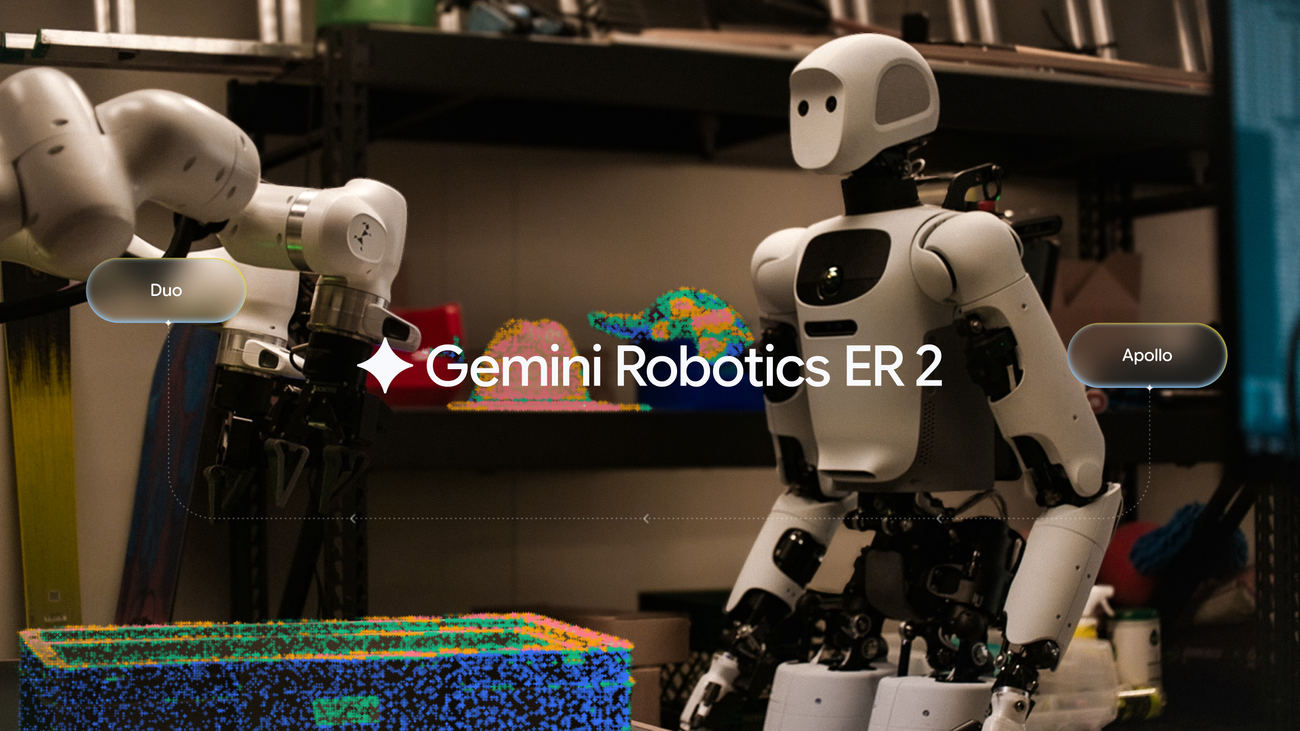
Gemini Robotics ER 2 helps robots reason, collaborate, and solve real-world tasks. It represents a step change in video understanding, tool orchestration, and multi-robot collaboration for robotic applications.
From feet to fingertips — we are teaching robots intelligent whole-body control, fine dexterity, and teamwork to complete a broad range of complex tasks.