A common operator viewpoint is developed connecting generator-based partial differential equations, variational principles, Markov state models, dynamical Galerkin approximation, and neural networks with an emphasis on self-supervised methods that learn solutions of their defining dynamical equations rather than relying on labeled shooting data.
Abstract
Most molecular transitions occur on time scales far beyond direct molecular dynamics simulations. The committor, the probability that a configuration reaches a product state before a reactant state, is a central kinetic statistic, providing a mechanism-independent reaction coordinate and a foundation for transition path theory and the calculation of rates. This review surveys modern approaches for estimating the committor and related kinetic statistics from molecular simulations, with an emphasis on self-supervised methods that learn solutions of their defining dynamical equations rather than relying on labeled shooting data. We develop a common operator viewpoint connecting generator-based partial differential equations, variational principles, Markov state models, dynamical Galerkin approximation, and neural networks. Empirical and theoretical evidence points to the efficiency of these methods. We provide theoretical and practical guidance for realizing their full potential in applications, including strategies for treating non-Markovian effects and for sampling. We conclude by identifying opportunities for further research, including connections to reinforcement learning and generative modeling.
The long-time dynamics of complex molecular systems often involves rare transitions across networks of metastable states. Building on transition-path theory, which provides a rigorous framework for describing rare transitions between two metastable states, we introduce the variational multistate committor network (VMCN...
Chen-Yu Tang, Cheng Giuseppe Chen, Benoit Roux et al.· 0 citations
A framework for constructing a continuous-time Markov chain (CTMC) from a static, Boltzmann-weighted ensemble is presented, enabling the generation of physically plausible kinetic trajectories without requiring extensive molecular dynamics simulation.
Krishna Praneet Mulukutla, Marimuthu Krishnan· Journal of Chemical Informat...· 0 citations
This work exploits the affine state update to obtain the exact one-step conditional-mean sensitivity by differentiating normalized reaction propensities, and defines the propensity straight-through (PST) estimator, a temperature- and Gumbel-free path to scalable gradient-based learning through exact stochastic trajecto...
BICePs-reweighted Reversible DeepMSMs are introduced, combining Bayesian Inference of Conformational Populations (BICePs), variational learning of Markov processes, and maximum entropy (MaxEnt)/maximum caliber (MaxCal) principles to infer consistent thermodynamics and minimally perturbed kinetics.
Gen-COMPAS is introduced, a generative committor-guided path-sampling framework that reconstructs rare biomolecular transition pathways and reveals the underlying thermodynamics and kinetics without using predefined collective variables or brute-force sampling, at an acceptable computational cost.
Chen-Yu Tang, M. P. Pandey, Cheng Giuseppe Chen et al.· Nature· 7 citations· ⚡1
The method identified sparse, closed-form kinetic representations while reducing reliance on a single predefined kinetic model, and demonstrates the potential of this approach to accelerate kinetic characterization across polymer, food, and biomolecular processing applications, where accurate kinetic models are essenti...
Paulina Portales Picazo, Navid Zobeiry· Journal of Chemical Informat...· 0 citations
Related blog posts
MIT News · Artificial Intelligence· news.mit.eduNov 17, 2026
By studying the computational foundations of language learning, Associate Professor Jacob Andreas builds intelligent systems that can communicate effectively with humans.
Microsoft Research Blog· microsoft.comNov 16, 2026
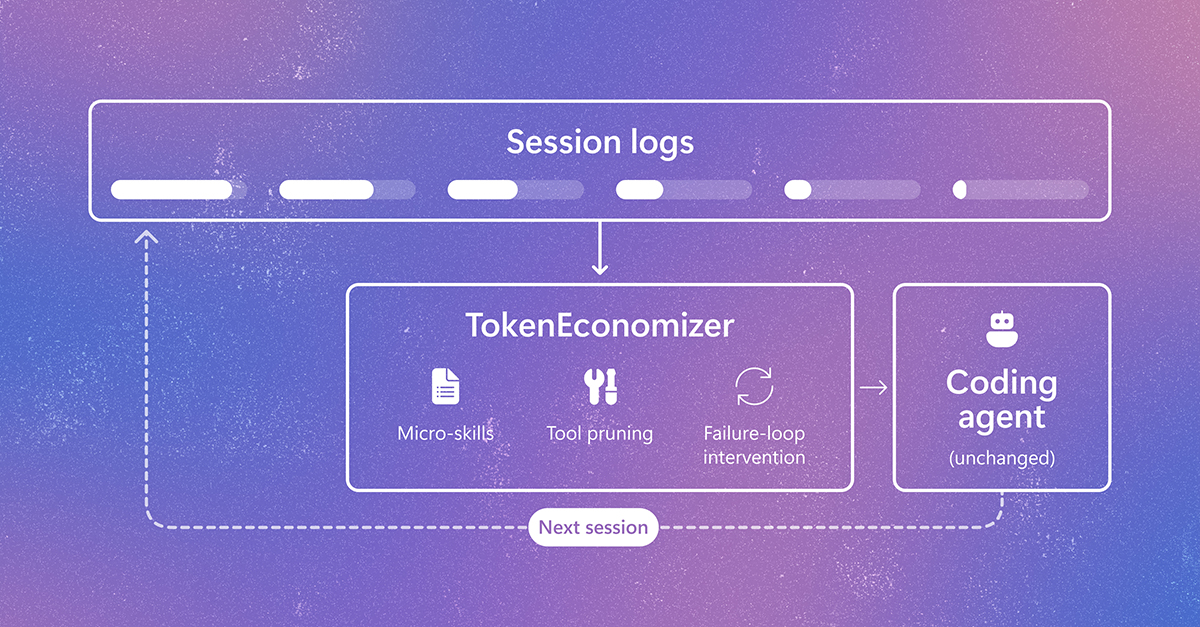
AI coding agents are increasingly help developers fix bugs and build features largely on their own, but every interaction with their models consumes tokens. In each session, an agent sends instructions, tool descriptions, and session history to its model. Most efforts to reduce this cost focus on individual tasks. Yet developers return to the same […] The post TokenEconomizer: Learning from Experience to Make AI Coding Agents More Efficient appeared first on Microsoft Research.
MIT News · Artificial Intelligence· news.mit.eduNov 13, 2026