Similar papers
Silk fibroin-loaded Fe-curcumin nanoparticles on antimicrobial peptide-functionalized TiO2 nanotube surfaces: Microenvironment-modulated synergy for antibacterial and osteogenic enhancement.
This study constructed a pH-responsive P-TN/SF@Fe-Cur composite coating that demonstrated significant anti-infective, anti-inflammatory, antioxidant, pro-angiogenic, and pro-osteogenic effects in rat subcutaneous infection and femoral defect models.
Alternative splicing expands and remodels the breast cancer proteoform landscape
The results show that alternative transcript diversity extensively enters translation-supported proteoform space and establish a systematic link between transcript variation and protein functional diversification.
Performance analysis of microalgae-based eco-extracts as new biostimulants for sustainable improvement of wheat crop.
Due to its importance and wide adoption, wheat cultivation is promptly required to shift towards sustainable practices, reducing the dependency on chemical components. Among bio-based solutions aimed at securing the sustainability of wheat cultivation, biostimulants offer a versatile platform of eco-friendly tools assuring sustainability and profitability. Microalgae present a concrete example of a biostimulant source due to their richness in metabolites and high value products. Therefore, this study evaluated the biostimulant potential of eleven eco-extracts prepared from soil-isolated microalgae strains. Eco-extracts applied via soil drench at low dose (0.1 g/L) were investigated for their biostimulant effects on wheat growth, physiology, yield, and quality under controlled conditions. Results demonstrated significant ameliorations in treated plants as compared to the control, with no phytoinhibitory effects. Remarkable enhancements were notable in growth parameters such as shoot and root lengths (+40-70%), physiological traits such as total chlorophyll and stomatal conductance (+7-52%), yield components in the example of grain number per spike and thousand grain weight (+17-103%), and grain quality namely protein and polyphenol content (+2-fold to 4-fold). Similarly, phosphorus accumulation and uptake were significantly improved, while soil physicochemical status was ameliorated, indicating enhanced fertility. Multivariate analysis and composite index ranking marked Chlorella sp. GA18, Chlorella sp. GA65, Scenedesmus sp. GA69, and Chlorococcum sp. GA63 as eco-extracts with consistent performances across all plant traits. These findings highlighted the promising potential of integrating microalgae-based eco-friendly extracts in sustainable wheat cultivation.
Modality-chain reasoning enables multimodal protein modelling and design
ProteinReasoner is developed, a multimodal generative protein foundation model that sequentially connects amino acid sequence, evolutionary constraints and three-dimensional structure within a shared autoregressive architecture and suggests a general route towards reasoning across interdependent representations in other scientific domains.
The HydroGym reinforcement learning platform for fluid dynamics.
HydroGym is introduced, a solver-independent reinforcement learning platform providing more than 60 validated, openly available flow control environments spanning from canonical laminar flows to complex turbulent flows, with systematic progression in the Reynolds number up to Re = 4 × 10⁵, and Mach number variations in two and three dimensions.
Machine learned designs of functional colloidal foldamers
A protein's function follows from the structure it adopts, and which structure that is depends on the pathway taken. In programmable matter the target is fixed before assembly, and whatever else forms is treated as error. Here we show that pathways themselves form a design space. Using reinforcement learning, we fold model DNA-coated droplet chains into rigid two-dimensional geometries, uncovering two classes of pathways: downhill, in which bonds are only added, and detour, in which bonds are broken and remade before the target is reached: for some the only route that exists. Coarse-graining pathways by interactions gives experimentally realizable protocols. Some produce one geometry, others several: structures sharing a detour route can be cycled between, while those that coexist assemble into superstructures inaccessible to a uniform product. Function emerges from the pathways rather than being designed. Designing the process instead of the components could give colloidal materials that reconfigure and repair themselves on demand.
Related blog posts
Looking beyond natural sequences
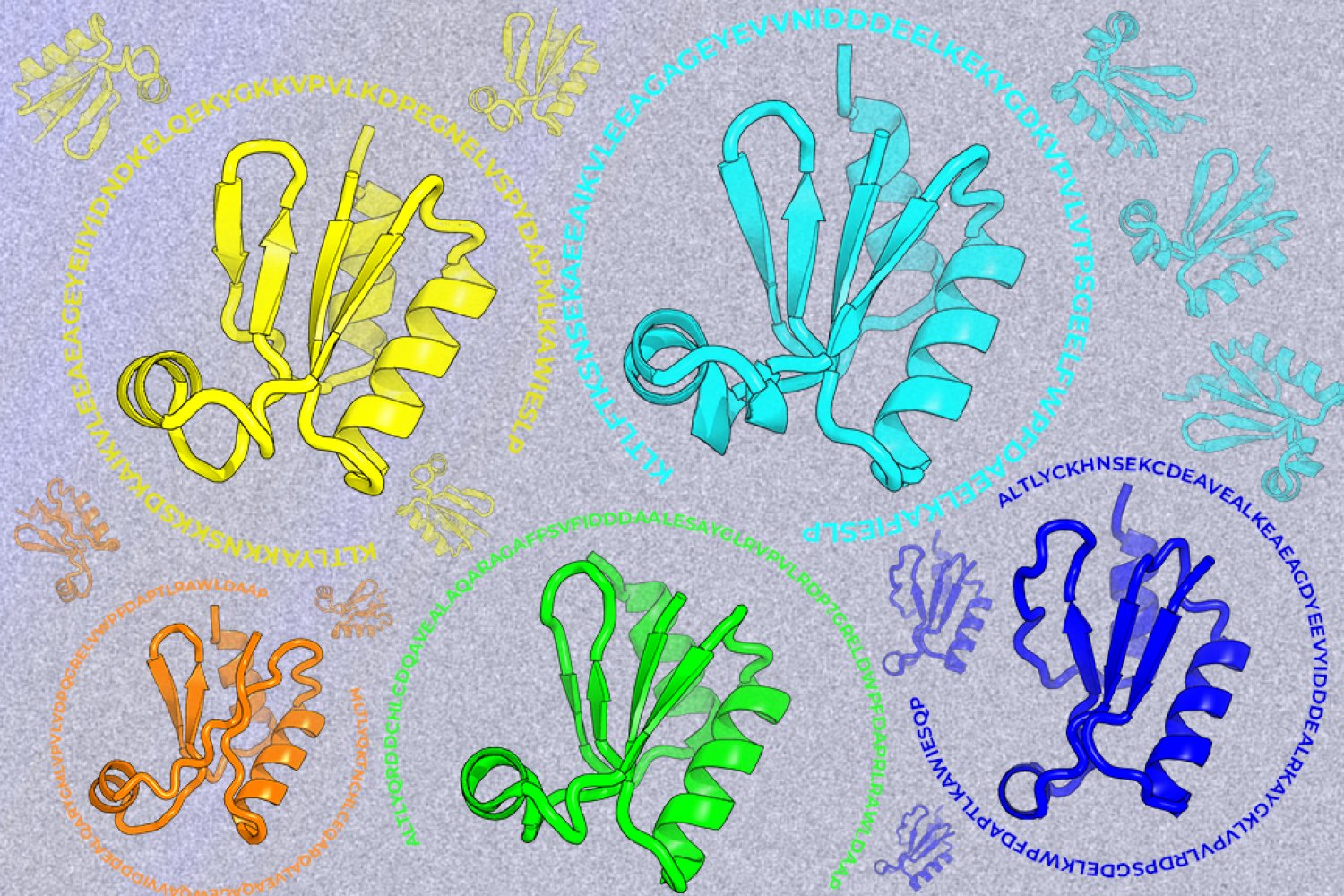
A new machine-learning framework aims to improve the success rate of computational protein design while moving away from results that reproduce sequences found in nature.
Harness, Scaffold, and the AI Agent Terms Worth Getting Right
Engineering more resilient crops for a warming climate
Scientists are using AlphaFold to strengthen a photosynthesis enzyme for resilient, heat-tolerant crops.
AlphaFold: Five years of impact
Explore how AlphaFold has accelerated science and fueled a global wave of biological discovery.