Jan 2026· Machine Learning: Science and Technology· Vol 7· 0 citations· 53 references
Computer SciencePhysics
TL;DR
This work builds Generative AdS, an approach to generative flow matching in which the dynamics are represented by the evolution of fields in AdS, together with a residual correction learned by a neural network.
Abstract
Holography, in the form of the anti-de Sitter/conformal field theory correspondence, offers a natural setting for generative modelling. Data on a boundary manifold lifts into a higher-dimensional bulk through a propagator, and this extra dimension plays the role of a flow parameter. We exploit this structure to build Generative AdS (GenAdS), an approach to generative flow matching in which the dynamics are represented by the evolution of fields in AdS, together with a residual correction learned by a neural network. Boundary samples are encoded as scalar sources, transported into the bulk along the flow, and decoded after numerical integration. Our paradigm combines a Fourier-space encoding scheme for the data as AdS sources, a normalised radial phase space in which to stage the flow-matching dynamics, and a Klein–Gordon backbone to guide the flow. On a two-dimensional checkerboard benchmark, our experiments show that most of the benefit of GenAdS comes from the Fourier representation and convolutional architecture. However, when we remove momentum-channel regularisation, our most physics-informed GenAdS variant rivals the strongest physics-free control on boundary violation. On modified National Institute of Standards and Technology, GenAdS models remain close to a convolutional baseline on fidelity while achieving significantly higher recall at comparable precision, suggesting a fidelity-coverage trade-off. Our findings establish GenAdS as a physically interpretable and experimentally controllable framework for generative modelling, with many avenues for future extension.
It is found that Llama 3 delivers comparable quality to leading language models such as GPT-4 on a plethora of tasks, and performs competitively with the state-of-the-art on image, video, and speech recognition tasks.
This paper investigates developing real-world perception for active agents, proposes Gibson Environment for this purpose, and showcases a set of perceptual tasks learned therein.
F. Xia, Amir Zamir, Zhi-Yang He et al.· 2018 IEEE/CVF Conference on...· 1,069 citations· ⚡112
The results indicate that software engineering work practices are chosen opportunistically, adapted and configured to provide value under the constrains imposed by the startup context.
Nicolò Paternoster, Carmine Giardino, M. Unterkalmsteiner et al.· Information and Software Tec...· 394 citations· ⚡54
The possibility of inferring high-dimensional data inference in a model that consists of a prior and an auxiliary differentiable constraint given some additional information is considered, thereby allowing a range of potential applications in adapting models to new domains and tasks.
Alexandros Graikos, Esmeralda S. Whitammer, N. Jojic et al.· Neural Information Processin...· 316 citations· ⚡15
It is proved that any global minimizer of the trajectory balance objective can define a policy that samples exactly from the target distribution, and empirically demonstrate the benefits of the trajectories balance objective for GFlowNet convergence, diversity of generated samples, and robustness to long action sequenc...
Esmeralda S. Whitammer, Moksh Jain, Emmanuel Bengio et al.· Neural Information Processin...· 302 citations· ⚡60
An algorithm is proposed which leverages disentangled semantic factors to generate adversarial perturbation by altering controlled semantic attributes to fool the learner towards various "adversarial" targets.
Haonan Qiu, Chaowei Xiao, Lei Yang et al.· arXiv.org· 208 citations· ⚡17
Related blog posts
MIT News · Artificial Intelligence· news.mit.eduNov 17, 2026
By studying the computational foundations of language learning, Associate Professor Jacob Andreas builds intelligent systems that can communicate effectively with humans.
Microsoft Research Blog· microsoft.comNov 16, 2026
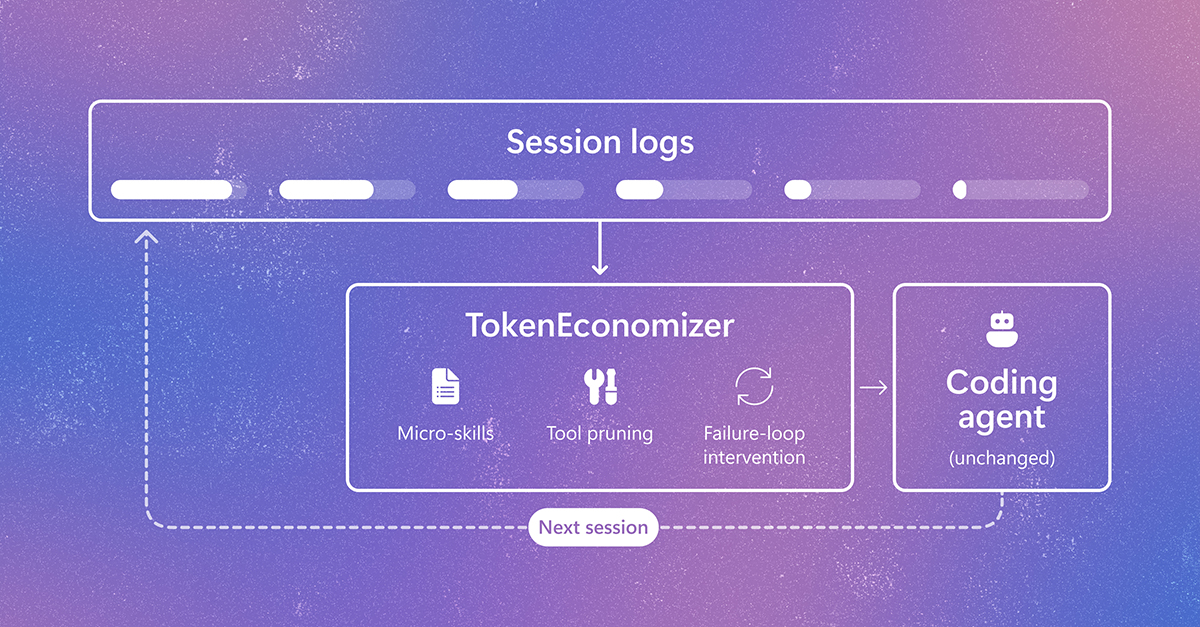
AI coding agents are increasingly help developers fix bugs and build features largely on their own, but every interaction with their models consumes tokens. In each session, an agent sends instructions, tool descriptions, and session history to its model. Most efforts to reduce this cost focus on individual tasks. Yet developers return to the same […] The post TokenEconomizer: Learning from Experience to Make AI Coding Agents More Efficient appeared first on Microsoft Research.
MIT News · Artificial Intelligence· news.mit.eduNov 13, 2026