Recommender systems on Web platforms tend to over-serve popular items and neglect the long tail. Item-side knowledge graphs (KGs), often available as linked data or RDF-style Web resources, can help by connecting sparse items through shared semantic attributes. Many competitive KG-aware recommenders rely on graph neural architectures, whereas strong shallow linear models such as EASE-R typically ignore side information and may become infeasible in their global closed-form version. We introduce TailSpec-EASE, a lightweight recommender that injects a relation-aware spectral KG prior into a local closed-form reconstruction objective. The prior strength adapts to item popularity, giving stronger semantic guidance to long-tail items. Across four public benchmarks and a broad set of classical, linear, graph-CF, KG-aware neural, and score-level KG baselines, TailSpec-EASE attains a favorable trade-off between overall accuracy, long-tail performance, and training cost. It improves NDCG@20 by up to 24% over its counterpart without KG information. All tail-metric improvements over the no-KG counterpart are statistically significant under a paired bootstrap, and overall NDCG improves significantly on three of the four datasets. In a representative Amazon-book timing study, TailSpec-EASE trains in 37 seconds on CPU, compared with 2,584 seconds for a GPU-trained KGAT run and 15,800 seconds for CPU LightGCN, while attaining higher NDCG@20 and Tail Recall@20 on that dataset. It also remains feasible on catalogs where the global closed-form model runs out of memory.

It is found that Llama 3 delivers comparable quality to leading language models such as GPT-4 on a plethora of tasks, and performs competitively with the state-of-the-art on image, video, and speech recognition tasks.
This paper investigates developing real-world perception for active agents, proposes Gibson Environment for this purpose, and showcases a set of perceptual tasks learned therein.
F. Xia, Amir Zamir, Zhi-Yang He et al.· 2018 IEEE/CVF Conference on...· 1,069 citations· ⚡112
The results indicate that software engineering work practices are chosen opportunistically, adapted and configured to provide value under the constrains imposed by the startup context.
Nicolò Paternoster, Carmine Giardino, M. Unterkalmsteiner et al.· Information and Software Tec...· 394 citations· ⚡54
The possibility of inferring high-dimensional data inference in a model that consists of a prior and an auxiliary differentiable constraint given some additional information is considered, thereby allowing a range of potential applications in adapting models to new domains and tasks.
Alexandros Graikos, Esmeralda S. Whitammer, N. Jojic et al.· Neural Information Processin...· 316 citations· ⚡15
It is proved that any global minimizer of the trajectory balance objective can define a policy that samples exactly from the target distribution, and empirically demonstrate the benefits of the trajectories balance objective for GFlowNet convergence, diversity of generated samples, and robustness to long action sequenc...
Esmeralda S. Whitammer, Moksh Jain, Emmanuel Bengio et al.· Neural Information Processin...· 302 citations· ⚡60
An algorithm is proposed which leverages disentangled semantic factors to generate adversarial perturbation by altering controlled semantic attributes to fool the learner towards various "adversarial" targets.
Haonan Qiu, Chaowei Xiao, Lei Yang et al.· arXiv.org· 208 citations· ⚡17
Related blog posts
MIT News · Artificial Intelligence· news.mit.eduNov 17, 2026
By studying the computational foundations of language learning, Associate Professor Jacob Andreas builds intelligent systems that can communicate effectively with humans.
Microsoft Research Blog· microsoft.comNov 16, 2026
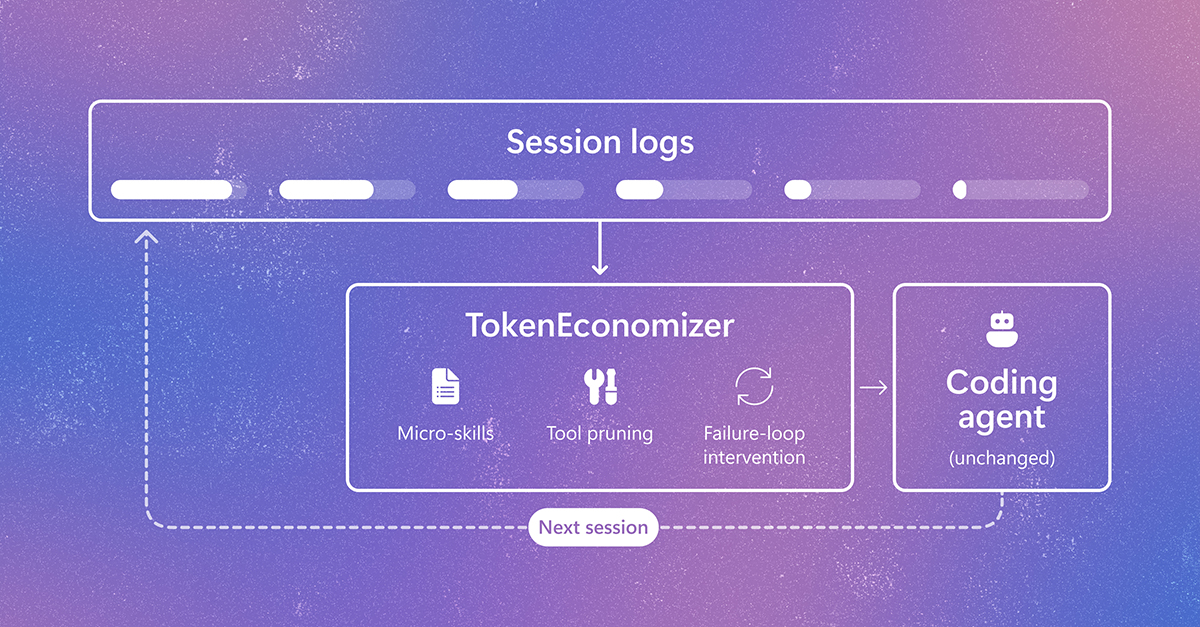
AI coding agents are increasingly help developers fix bugs and build features largely on their own, but every interaction with their models consumes tokens. In each session, an agent sends instructions, tool descriptions, and session history to its model. Most efforts to reduce this cost focus on individual tasks. Yet developers return to the same […] The post TokenEconomizer: Learning from Experience to Make AI Coding Agents More Efficient appeared first on Microsoft Research.
MIT News · Artificial Intelligence· news.mit.eduNov 13, 2026