Jan 2026· The European Physical Journal C· Vol 86· 0 citations· 23 references
Computer SciencePhysics
Abstract
Categorizing events using discriminant observables is central to many high-energy physics analyses. Yet, bin boundaries are often chosen manually. A simple, popular choice in multi-classification tasks is to assign events according to the largest per-class score (“argmax”) and to apply equidistant binning to the resulting one-dimensional discriminants. We propose a binning optimization for signal significance directly in multi-dimensional discriminants. We use a Gaussian Mixture Model (GMM) to define flexible regions in the score space, which can be interpreted either as bins or as analysis categories. While this GMM-based strategy is applicable in both one and multiple dimensions, we also study a direct bin-boundary optimization in one dimension as a simpler alternative for binary discriminants. On this binning model, we study two optimization strategies: a differentiable and a Bayesian optimization approach. We study two toy setups: a binary classification and a three-class problem with two signals and backgrounds. In the one-dimensional case, both approaches achieve similar gains in signal sensitivity compared to equidistant binning for a given number of bins, while in the multi-dimensional case the differentiable approach performs best. We show that the GMM-based optimization can outperform argmax classification even after optimized binning is applied to the one-dimensional projections. We further study the performance of our methods on the FAIR Universe H→ττ\documentclass[12pt]{minimal} \usepackage{amsmath} \usepackage{wasysym} \usepackage{amsfonts} \usepackage{amssymb} \usepackage{amsbsy} \usepackage{mathrsfs} \usepackage{upgreek} \setlength{\oddsidemargin}{-69pt} \begin{document}$$H\rightarrow \tau \tau $$\end{document} dataset, where the GMM-based optimization gives the highest signal significance. Both methods are released as lightweight Python plugins intended for straightforward integration into existing analyses.

It is found that Llama 3 delivers comparable quality to leading language models such as GPT-4 on a plethora of tasks, and performs competitively with the state-of-the-art on image, video, and speech recognition tasks.
This paper investigates developing real-world perception for active agents, proposes Gibson Environment for this purpose, and showcases a set of perceptual tasks learned therein.
F. Xia, Amir Zamir, Zhi-Yang He et al.· 2018 IEEE/CVF Conference on...· 1,069 citations· ⚡112
The results indicate that software engineering work practices are chosen opportunistically, adapted and configured to provide value under the constrains imposed by the startup context.
Nicolò Paternoster, Carmine Giardino, M. Unterkalmsteiner et al.· Information and Software Tec...· 394 citations· ⚡54
The possibility of inferring high-dimensional data inference in a model that consists of a prior and an auxiliary differentiable constraint given some additional information is considered, thereby allowing a range of potential applications in adapting models to new domains and tasks.
Alexandros Graikos, Esmeralda S. Whitammer, N. Jojic et al.· Neural Information Processin...· 316 citations· ⚡15
It is proved that any global minimizer of the trajectory balance objective can define a policy that samples exactly from the target distribution, and empirically demonstrate the benefits of the trajectories balance objective for GFlowNet convergence, diversity of generated samples, and robustness to long action sequenc...
Esmeralda S. Whitammer, Moksh Jain, Emmanuel Bengio et al.· Neural Information Processin...· 302 citations· ⚡60
An algorithm is proposed which leverages disentangled semantic factors to generate adversarial perturbation by altering controlled semantic attributes to fool the learner towards various "adversarial" targets.
Haonan Qiu, Chaowei Xiao, Lei Yang et al.· arXiv.org· 208 citations· ⚡17
Related blog posts
MIT News · Artificial Intelligence· news.mit.eduNov 17, 2026
By studying the computational foundations of language learning, Associate Professor Jacob Andreas builds intelligent systems that can communicate effectively with humans.
Microsoft Research Blog· microsoft.comNov 16, 2026
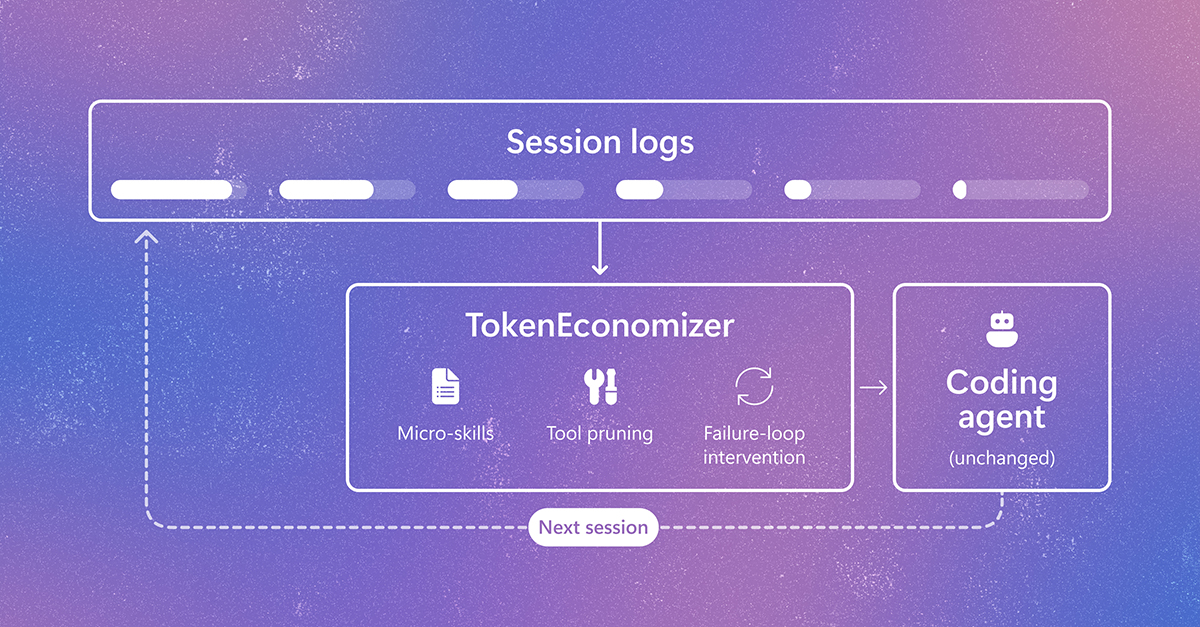
AI coding agents are increasingly help developers fix bugs and build features largely on their own, but every interaction with their models consumes tokens. In each session, an agent sends instructions, tool descriptions, and session history to its model. Most efforts to reduce this cost focus on individual tasks. Yet developers return to the same […] The post TokenEconomizer: Learning from Experience to Make AI Coding Agents More Efficient appeared first on Microsoft Research.
MIT News · Artificial Intelligence· news.mit.eduNov 13, 2026