This paper proposes FRESH, a Failure-aware Retrieval framework over Experience-Structured Heterogeneous graphs, which transforms historical successes and failures into structured external experience for tool-using agents and consistently improves task success and tool-use reliability over no-memory agents and representative memory-based baselines.

Abstract
Small and medium-sized language models offer cost-effective executors for tool-using agents, making them attractive for local and large-scale deployment. However, in long-horizon and stateful environments, they often make structural errors such as missing required observations, performing premature writes, repeating failed calls, and violating action preconditions. These errors can lead to incorrect state updates, policy violations, and costly or irreversible consequences, making reliable tool execution a critical deployment challenge. Existing fine-tuning approaches require substantial data and computation, while flat memory may retrieve failed actions without preserving their causal context or safety conditions. In this paper, we propose FRESH, a Failure-aware Retrieval framework over Experience-Structured Heterogeneous graphs, which transforms historical successes and failures into structured external experience for tool-using agents. By explicitly modeling the dependencies among tasks, actions, errors, repairs, and execution conditions, FRESH helps frozen language models reuse reliable strategies, avoid recurring failures, and make safer decisions in stateful tool interactions. Experiments on $\tau$-Bench and AppWorld with multiple open-source models show that FRESH consistently improves task success and tool-use reliability over no-memory agents and representative memory-based baselines.
Large language model agents can often make reasonable local decisions on short tasks, yet their performance degrades when success requires long sequences of dependent actions and tool calls. During execution, task requirements, historical evidence, and the current execution state may gradually become disconnected, so l...
This work studies insight-level memory maintenance for long-term language agents and proposes a failure-aware memory maintenance framework based on an editable insight graph and introduces a utility-aware retrieval mechanism and a graph controller that updates the memory graph after task execution.
Large language model agents increasingly rely on compound programs for retrieval, tool use, reasoning, and verification, yet their failures often arise from local procedural decisions. Existing reinforcement-learning and prompt-optimization approaches typically rely on scalar rewards or repeatedly modify entire prompts...
Xu Liu, Wen-Zhang Wei, Jun Cao et al.· 0 citations
Skill Runtime Intelligence is presented, a passive runtime-intelligence system that reconstructs supported Skill-lifecycle stages across heterogeneous harnesses while preserving unsupported stages as unknown and motivating executable adapter qualification.
KC-Bench is introduced, a controlled multi-turn benchmark for measuring model-level behavior across world-knowledge conflicts, input inconsistencies, and multi-source temporal conflicts, and provides a reproducible diagnostic for developing conflict-aware reasoning and execution safeguards.
Yaxing Lyu, Sheng-Jie Zhou, B. Toh et al.· 0 citations
Adaptive AI agents can help make BIM data more machine-readable by navigating IFC models, interpreting inconsistent information, and mapping it to defined standards. In this blog, Alok Rawat shares findings from a real-world pilot in construction workflows. The post Adaptive AI Agents in Construction Workflows appeared first on GPT-Lab.
What does it take to trust AI-driven HVAC optimization? Our AI Model Factory combines agents, machine learning, reinforcement learning and deterministic checks in a governed workflow designed for messy, real-world building data. The post We built an AI factory for HVAC control appeared first on GPT-Lab.
MIT News · Artificial Intelligence· news.mit.eduAug 18, 2026
A new method for surgically removing training examples from a model reveals that as datasets grow, the link between what a model learns and what it produces dissolves.
Microsoft Research Blog· microsoft.comJul 30, 2026
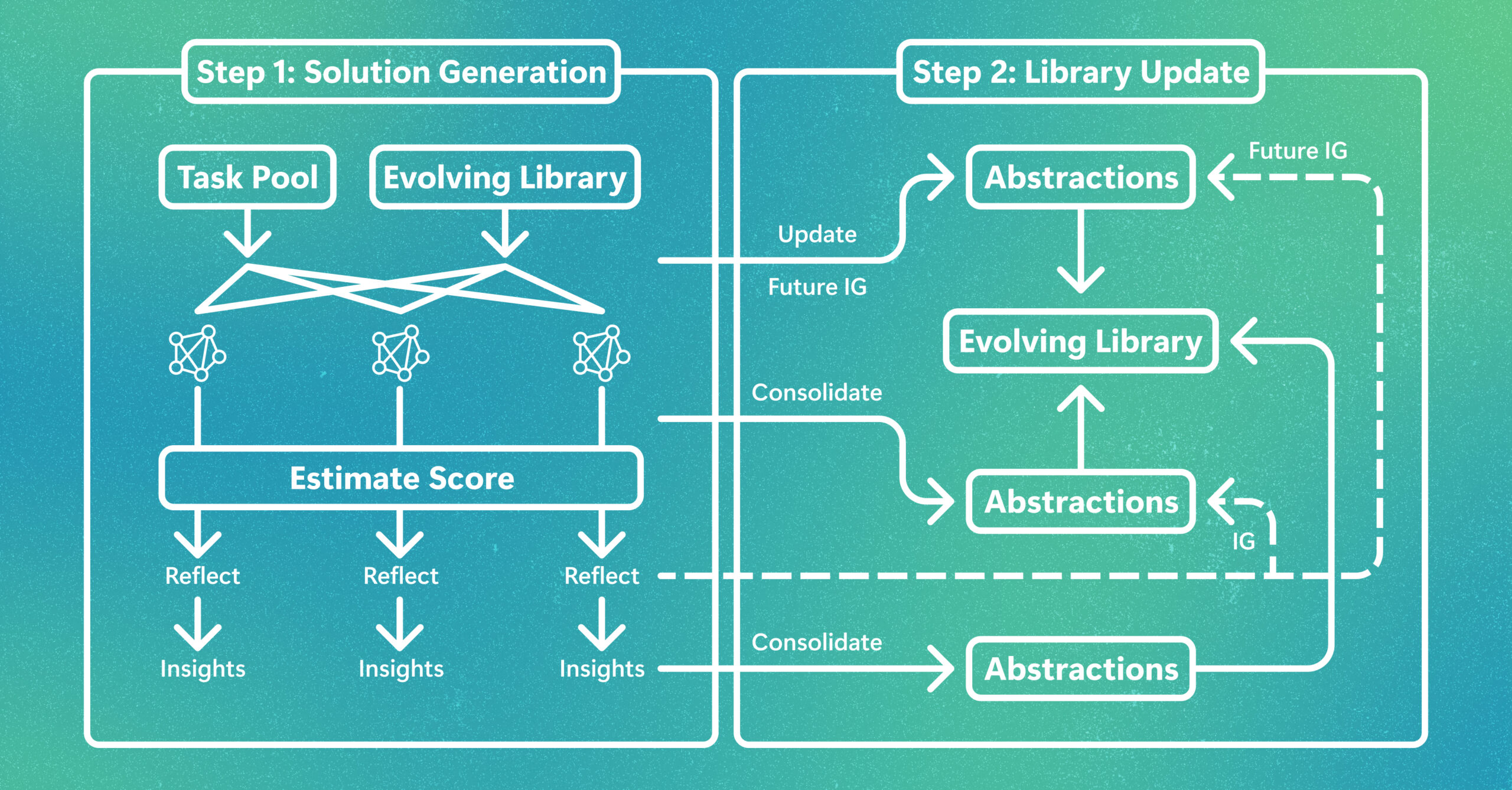
LLMs do not get smarter just by remembering more. EvoLib turns experience into evolving knowledge, taking reusable skills and insights that help models learn and adapt across tasks long after deployment. The post EvoLib: Turning experience into evolving knowledge appeared first on Microsoft Research.
We use cookies to run the site and, with your consent, for analytics and to show ads.
See our Cookie Policy.