It is found that starting performance and subsequent growth are associated with different capabilities: within a task category, similar early scores can precede different later gains, and a continuation policy to save time and compute with limited score loss is derived.
Abstract
Long-horizon agents improve solutions through sustained interaction, execution, and task feedback. Scaling studies relate performance to resources and capabilities, yet how existing capabilities shape returns to extended interaction remains less understood. To address this gap, we analyze AutoLab and EdgeBench, two long-horizon benchmarks. We find that starting performance and subsequent growth are associated with different capabilities: within a task category, similar early scores can precede different later gains. To formalize this finding, we model capability-time scaling with category-specific logistic power laws shared across models. Fitted to early trajectories, these curves extrapolate the observed models'category-average scores to later computation. However, rising average scores mask narrowing improvement opportunities: later gains concentrate among fewer improving models. High final scores and continued improvement also have distinct capability profiles. Predicted mean gains estimate each model's fraction of improving tasks; averaging these estimates forecasts the average share of improving models. These uneven returns motivate deciding whether a specific run should continue. We therefore derive a continuation policy to save time and compute with limited score loss. The policy conditions growth predictions on the run's observed progress and weighs immediate and delayed gains against computation costs. In replay with training and price calibration based on other models'histories, the policy saves roughly one-third of full-run time, with relative score losses of 2.4% on AutoLab individual runs and 3.3% on EdgeBench published mean curves. Our repository is available at https://github.com/Chihaya-Anon-chan/long-horizon-scaling.

The framework, Recursive Environment Scaling (RES), transforms existing benchmark environments while preserving their objectives and completion requirements and identifies recursive inheritance and dependency composition as important contributors to increased difficulty.
Lin Jing, Zheng-Bo Jiao, Yi-Chen Xiang et al.· 0 citations
Beyond-Local Policy Optimization (BLPO), which estimates task-progress advantages from experience shared across tasks and training updates, and accumulates context-relative returns in a global memory with balanced aggregation and reliability weighting to control bias and noise from heterogeneous tasks.
Xuan-Ren Chen, Chong-Yang Tao, Wen-Peng Hu et al.· 0 citations
GRAFT (Gated Replacement of Answer-Failed groups with peer Trajectories), an off-policy-aware framework that replaces all-fail groups with informative peer groups and transfers both successful and unsuccessful peer responses with peer-computed advantages, while controlling cross-model mismatch through sequence-level co...
Doohyuk Jang, Y. Park, Gyouk Chu et al.· arXiv.org· 0 citations
The results show that candidate value depends on the evolving portfolio and submission order, and motivate evaluating self-evolving research capabilities through end-to-end outcomes, conditional capability value, and the consequences of experience-based decisions.
Si-Yuan Li, Jiang-Feng Zhang, Rui Yao et al.· arXiv.org· 0 citations
The results distinguish nominal-budget failure from completed computation and identify a common dynamical signature of completion across two recurrent architectures.
H. Krishna, Shubham Singh, Stephen Ebert et al.· arXiv.org· 1 citation
Group Relative Policy Optimization (GRPO) provides no reward-relative learning signal when all rollouts receive identical rewards. In long-horizon tasks that require multiple interactions, rewards are given only upon successful task completion, making all-fail groups common early in training and limiting opportunities...
Minchan Kim, Sungho Bae, Young-Jin Kim et al.· 0 citations
Related blog posts
MIT News · Artificial Intelligence· news.mit.eduNov 17, 2026
By studying the computational foundations of language learning, Associate Professor Jacob Andreas builds intelligent systems that can communicate effectively with humans.
Microsoft Research Blog· microsoft.comNov 16, 2026
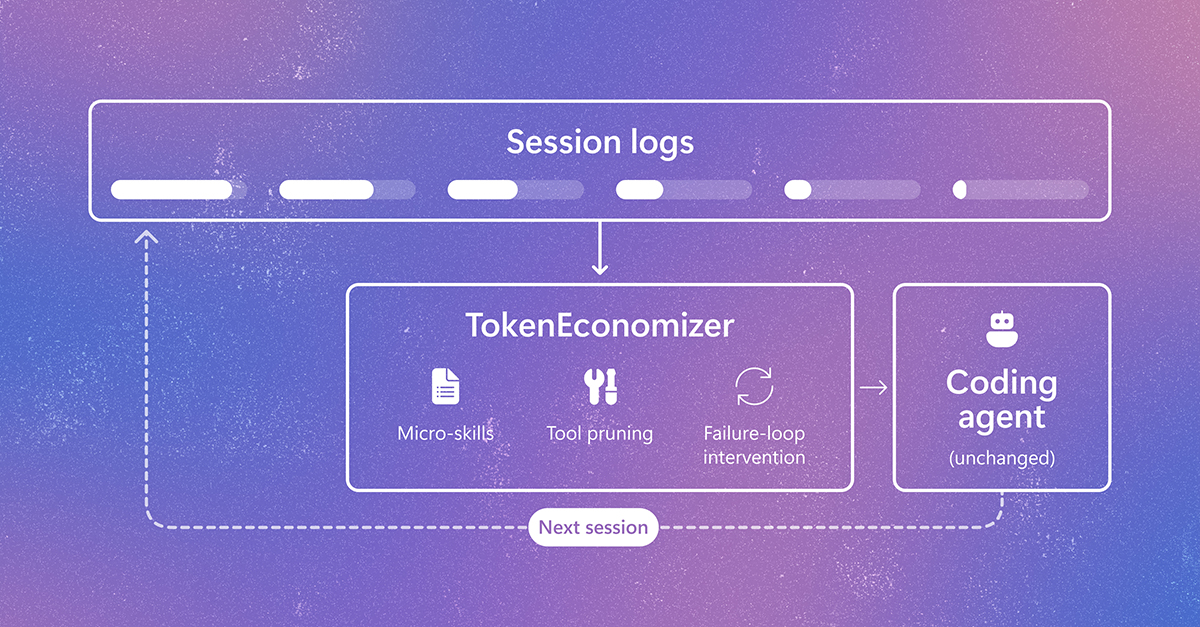
AI coding agents are increasingly help developers fix bugs and build features largely on their own, but every interaction with their models consumes tokens. In each session, an agent sends instructions, tool descriptions, and session history to its model. Most efforts to reduce this cost focus on individual tasks. Yet developers return to the same […] The post TokenEconomizer: Learning from Experience to Make AI Coding Agents More Efficient appeared first on Microsoft Research.
MIT News · Artificial Intelligence· news.mit.eduNov 13, 2026