LS-B observes the first tasks through a frozen fMRI encoding model of twelve human visual areas and commits task-specific capacity once to the blocks whose readouts vary most across tasks relative to their stable structure, yielding stable, backbone-specific allocations.
Abstract
Continual learners that keep a task-specific adapter in every block of a pre-trained vision transformer accumulate storage linearly with the number of tasks; keeping task-specific adapters in only a few blocks curbs this growth but raises the question of where to place them. We investigate this question from two perspectives. Algorithmically, training all contiguous four-block placements yields an inverted U: final accuracy peaks at intermediate depth and varies by up to 3.5 percentage points (pp), while inexpensive criteria based on weight spectra or activation statistics favor the deepest blocks. From neuroscience, the hierarchical organization and intermediate-stage plasticity of the visual cortex motivate us to ask whether a measurement taken outside the learner can guide layer specialization without placement search. LS-B observes the first tasks through a frozen fMRI encoding model of twelve human visual areas and commits task-specific capacity once to the blocks whose readouts vary most across tasks relative to their stable structure. Across three ViT-B/16 backbones, LS-B yields stable, backbone-specific allocations. On the two backbones with placement search, AugReg and iBOT, the selected blocks overlap the intermediate-depth region identified by search. Under matched storage and observation budgets, the selected blocks outperform the shallowest and deepest four-block configurations. On Split ImageNet-R, LS-B uses 60% of full-BiLoRA adapter storage while remaining within 1.5 pp of its final accuracy. The allocation requires no labels or backpropagation, adds under 0.6% runtime, and exhibits backbone-specific cortical signatures.

Findings support organizing fMRI pretraining and adaptation by measured learning relations rather than treating domains and tasks as independent flat sets.
Jun-Feng Xia, Wen-Hao Ye, Jun-Xiang Zhang et al.· 2 citations
Visual perceptual learning is often highly specific to the trained retinal location, a hallmark observation that is traditionally interpreted as evidence that training-induced plasticity occurs in retinotopic early visual cortex. However, under properly designed training conditions, such as double training, adaptation...
Lin Zhong, Gong-Liang Zhang, Jun-Yun Zhang et al.· NeuroImage· 0 citations
Discriminating between two stimuli requires that their neural representations become separable by downstream readouts. This can be achieved geometrically, by disentangling the manifolds that population responses form in neural state space. Such reorganization has been observed in associative and motor areas, but never...
Julien Corbo, L. R. Çağlar, O. Erkat et al.· bioRxiv· 0 citations
Inference in LLMs is conventionally a fixed-depth, fixed-order forward pass through every layer, regardless of how difficult the input is. The human brain does not work this way: using the thalamus as a central hub, it routes information flexibly to all regions of the cortex according to demand. Li et al. (2026) recent...
Justus Westerhoff, Stephan Olbrich, Hatem Oraby et al.· 1 citation
An agent that moves must recognise a place from a viewpoint it has never seen. We introduce 4MT-VLM, a dataset of procedurally generated landscapes, each rendered across five stimulus modes that remove appearance cues while holding layout fixed: shape and colour, shape only, colour only, bare terrain peaks with no obje...
This work proposes MAPA, an otherwise vanilla masked autoencoder with two spatial encodings, an anatomical region embedding and a relative positional encoding that together enable it to learn neural representations that transfer to unseen subjects and across various tasks.
Ben-Ting Tang, Z. Spalding, G. Cogan· arXiv.org· 0 citations
Related blog posts
MIT News · Artificial Intelligence· news.mit.eduOct 28, 2026
Professor Paris Smaragdis develops computers with superhuman hearing for applications like speech recognition, music understanding, and environmental monitoring.
Exploring how generative AI could make machine vision more accessible to businesses. The post GenEye in a Box: Making Machine Vision Something You Can Just Ask For appeared first on GPT-Lab.
Microsoft Research Blog· microsoft.comAug 11, 2026
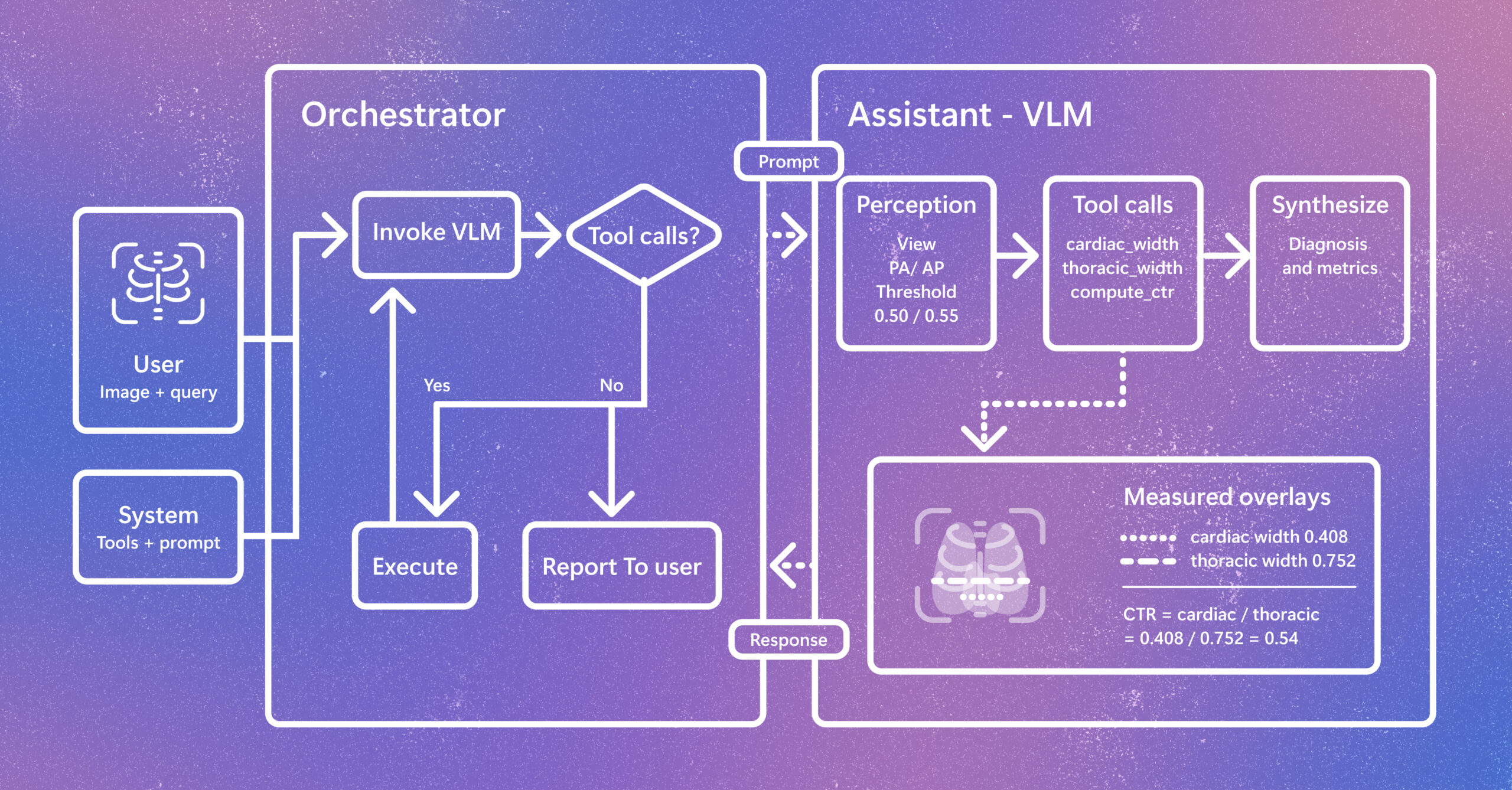
Radiology AI is evolving beyond report generation. CARE-X explores a unified approach that combines flexible reasoning, calibrated predictions, and measurement-based tools for chest X-ray interpretation. The post Introducing CARE-X: Towards Clinically Useful Radiology VLMs with Auxiliary Supervision, Reward-Aligned Learning, and Tool-Augmented Measurement appeared first on Microsoft Research.