Coverage-Aware Reasoning with Medical Tokens for Diagnosis Prediction
Kaisong ZhangHaotian FangJunmeng ZhouHang LvYulan PanYanchao Tan
Oct 2026
Artificial IntelligenceMachine Learning
Abstract
Large language models (LLMs) offer promising potential for next-visit diagnosis prediction, owing to their ability to integrate longitudinal clinical evidence and reason over it in natural language. However, reinforcement learning for LLM reasoning commonly rewards each trajectory according to the correctness of its final answer. In next-visit diagnosis prediction, multiple diagnoses can be simultaneously valid, but independently rewarding one diagnosis per trajectory does not distinguish repeated hits from coverage of different diagnoses. The policy can therefore concentrate on a few correct diagnoses, leaving others uncovered. Meanwhile, LLM tokenizers can split ICD codes into several generic tokens with limited clinical meaning, requiring multiple decoding steps to predict each diagnosis and hindering reasoning over a large disease vocabulary. To address both challenges, we propose CARing, a framework that represents diagnoses with compositional Semantic IDs (SIDs) and optimizes reasoning trajectories for multi-label coverage. Concretely, we first encode ontology-enriched disease semantics into compact SIDs through residual quantization, and ground the resulting SID tokens in natural language and longitudinal EHR contexts through multi-task alignment and reasoning-enriched training to unlock transferable LLM reasoning. CARing further improves unordered multi-label prediction through a coverage reward for reinforcement learning and multi-positive supervision. At inference time, the model supports both efficient direct constrained decoding and multi-chain reasoning with rank fusion. On MIMIC-III and MIMIC-IV, CARing exceeds all EHR-trained baselines in weighted F1 and attains the highest top-k recall at every reported cutoff, including R@30 of 46.04% and 46.52% in reasoning mode. Our codes and logs are available at https://github.com/zmlxzyh/CARing-Codes-Logs.

This paper investigates developing real-world perception for active agents, proposes Gibson Environment for this purpose, and showcases a set of perceptual tasks learned therein.
F. Xia, Amir Zamir, Zhi-Yang He et al.· 2018 IEEE/CVF Conference on...· 1,069 citations· ⚡112
The results indicate that software engineering work practices are chosen opportunistically, adapted and configured to provide value under the constrains imposed by the startup context.
Nicolò Paternoster, Carmine Giardino, M. Unterkalmsteiner et al.· Information and Software Tec...· 394 citations· ⚡54
The possibility of inferring high-dimensional data inference in a model that consists of a prior and an auxiliary differentiable constraint given some additional information is considered, thereby allowing a range of potential applications in adapting models to new domains and tasks.
Alexandros Graikos, Esmeralda S. Whitammer, N. Jojic et al.· Neural Information Processin...· 316 citations· ⚡15
It is proved that any global minimizer of the trajectory balance objective can define a policy that samples exactly from the target distribution, and empirically demonstrate the benefits of the trajectories balance objective for GFlowNet convergence, diversity of generated samples, and robustness to long action sequenc...
Esmeralda S. Whitammer, Moksh Jain, Emmanuel Bengio et al.· Neural Information Processin...· 302 citations· ⚡60
GAOKAO-Bench is introduced, an intuitive benchmark that employs questions from the Chinese GAOKAO examination as test samples, including both subjective and objective questions that contribute a robust evaluation benchmark for future large language models and offers valuable insights into the advantages and limitations...
Xiaotian Zhang, Chun-yan Li, Yi Zong et al.· arXiv.org· 216 citations· ⚡17
An algorithm is proposed which leverages disentangled semantic factors to generate adversarial perturbation by altering controlled semantic attributes to fool the learner towards various "adversarial" targets.
Haonan Qiu, Chaowei Xiao, Lei Yang et al.· arXiv.org· 208 citations· ⚡17
Related blog posts
MIT News · Artificial Intelligence· news.mit.eduOct 13, 2026
Machine-learning networks can learn without detailed instructions from a designer. Those that do may offer insight into how the brain reorganizes itself during learning.
MIT News · Artificial Intelligence· news.mit.eduSep 29, 2026
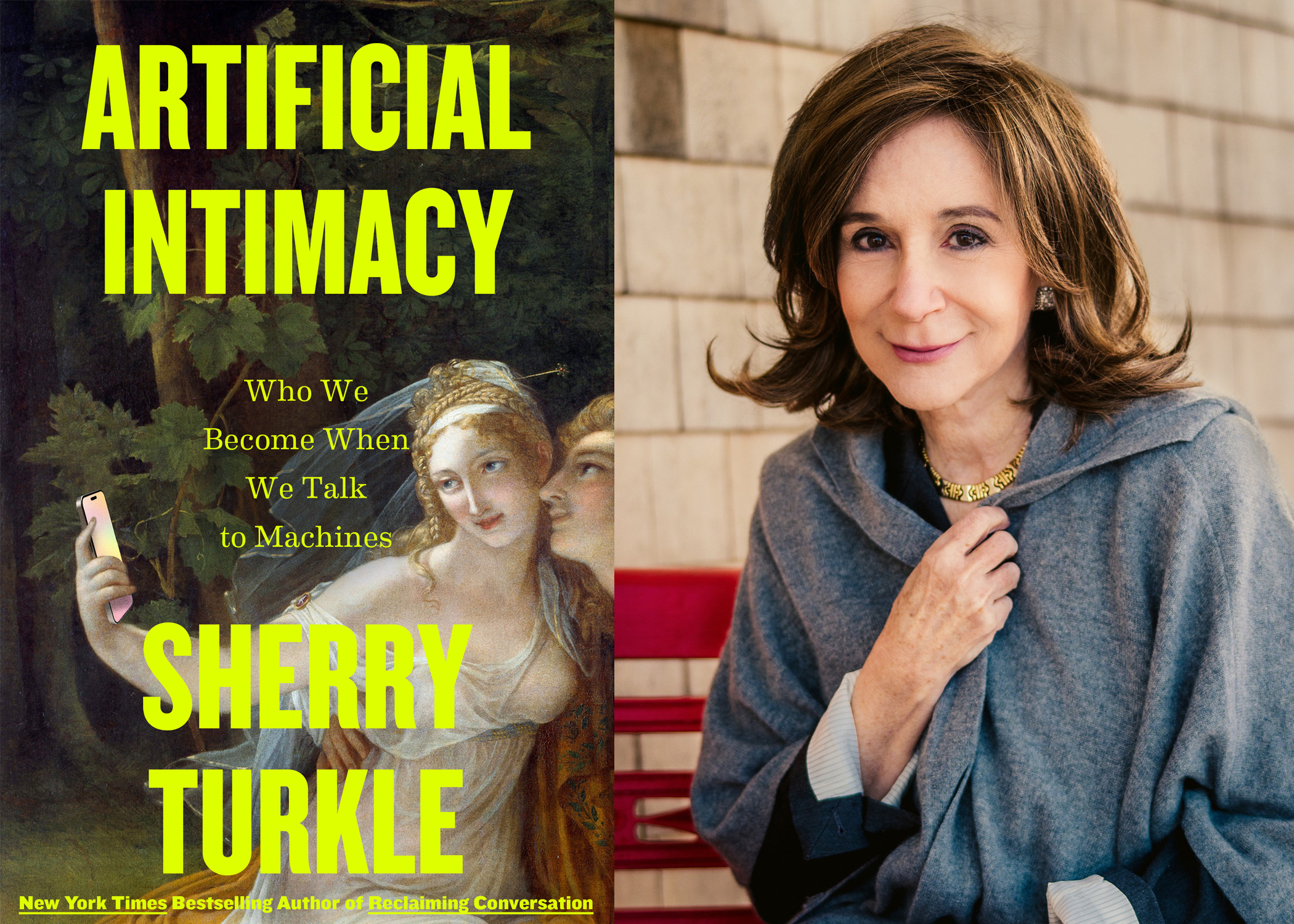
Professor Sherry Turkle’s new book, “Artificial Intimacy,” offers a withering critique of chatbots and the antisocial dynamics she believes they encourage.