Open-Vocabulary Audio-Visual Event Localization (OV-AVEL) labels each video segment with an event class, including classes that were never seen during training. The dominant pipeline uses a frozen multimodal foundation model (e.g. ImageBind) to embed the visual frame, the audio mel-spectrogram, and each candidate class name into a shared space, then computes two cosine similarities for each segment against each class: visual-text and audio-text. Existing methods then collapse this pair into a single scalar score with a fixed rule (geometric mean, weighted average) before taking the argmax. Instead, we compute complex-valued similarities and learn their fusion using a complex-valued neural network (CVNN). Each modality's standard representation becomes the real part of our pipeline, and a paired companion stream supplies the imaginary part. We use imaginary part of iHSV for visual modality and CycleGAN-translated phase spectrogram for audio modality as these companion streams. This results in two complex similarities, which are then fused. While the vision and audio encoders remain frozen, only the temporal-attention blocks and the fusion CVNN are trained. The four-stream complex architecture sets a new state of the art on both OV-AVEL benchmarks. On the open (unseen-class) split of OV-AVEBench we reach 66.5/59.1/54.1% Acc/Seg-F1/Event-F1 (+1.6/+4.1/+6.6 over the previously reported fine-tuned baseline), with consistent gains for seen classes as well. We also modify AVE dataset for this task and observe that our architecture reaches 60.7/51.9/50.4% Acc/Seg-F1/Event-F1, achieving state-of-the-art OV-AVEL results on it as well. We also propose a two-stream alternative, which also sees great improvements over the baseline.

This paper investigates developing real-world perception for active agents, proposes Gibson Environment for this purpose, and showcases a set of perceptual tasks learned therein.
F. Xia, Amir Zamir, Zhi-Yang He et al.· 2018 IEEE/CVF Conference on...· 1,069 citations· ⚡112
This publication proposes a definition and a classification of agile software development approaches and analyses ten software development methods that can be characterized as being "agile" against the defined criterion.
P. Abrahamsson, O. Salo, Jussi Ronkainen et al.· arXiv.org· 727 citations· ⚡54
The study shows that agile practices improve both informal and formal communication, but indicates that, in larger development situations involving multiple external stakeholders, a mismatch of adequate communication mechanisms can sometimes even hinder the communication.
M. Pikkarainen, Jukka Haikara, O. Salo et al.· Empirical Software Engineeri...· 401 citations· ⚡48
The results indicate that software engineering work practices are chosen opportunistically, adapted and configured to provide value under the constrains imposed by the startup context.
Nicolò Paternoster, Carmine Giardino, M. Unterkalmsteiner et al.· Information and Software Tec...· 394 citations· ⚡54
The possibility of inferring high-dimensional data inference in a model that consists of a prior and an auxiliary differentiable constraint given some additional information is considered, thereby allowing a range of potential applications in adapting models to new domains and tasks.
Alexandros Graikos, Esmeralda S. Whitammer, N. Jojic et al.· Neural Information Processin...· 316 citations· ⚡15
Exploring how generative AI could make machine vision more accessible to businesses. The post GenEye in a Box: Making Machine Vision Something You Can Just Ask For appeared first on GPT-Lab.
Microsoft Research Blog· microsoft.comAug 11, 2026
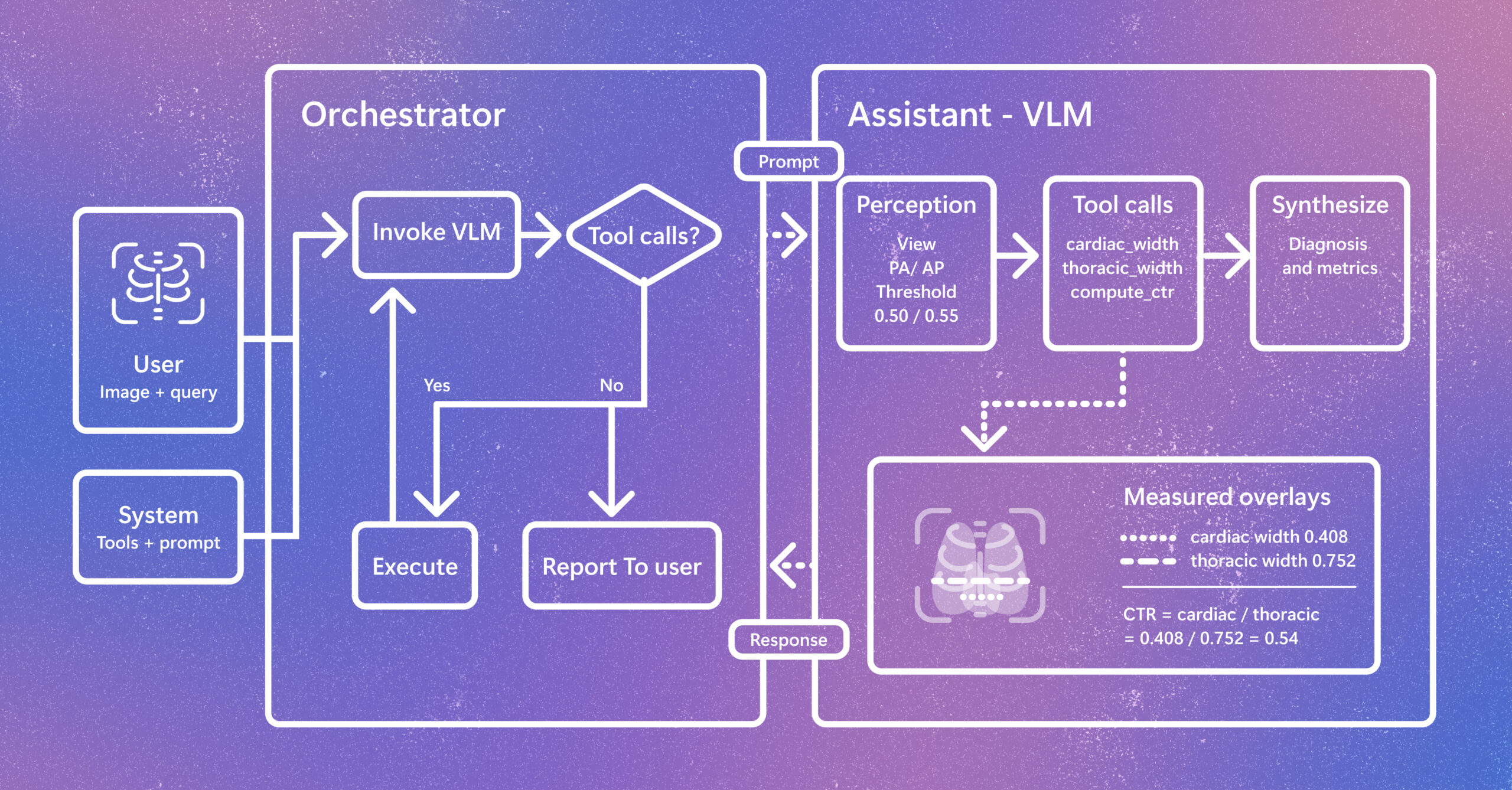
Radiology AI is evolving beyond report generation. CARE-X explores a unified approach that combines flexible reasoning, calibrated predictions, and measurement-based tools for chest X-ray interpretation. The post Introducing CARE-X: Towards Clinically Useful Radiology VLMs with Auxiliary Supervision, Reward-Aligned Learning, and Tool-Augmented Measurement appeared first on Microsoft Research.