Oct 2026· Cluster Computing· Vol 29· 0 citations· 34 references
Smart Grid Security and Resilience
TL;DR
FED-XID provides a scalable, lightweight, and deployable solution for anomaly detection in resource-constrained smart grid environments, and significantly reduces privacy exposure through data locality sharing only compact tree structures rather than raw consumption data.
The proliferation of Internet of Things (IoT) devices in Smart City infrastructures has introduced unprecedented opportunities for automation, healthcare, and transportation, while simultaneously exposing the ecosystem to complex and multi-dimensional cyberattacks. Conventional intrusion detection systems (IDS) either...
Shakila Basheer, G. Aldehim, A. Alluhaidan et al.· Wireless networks· 1 citation
FedFusion-IDS is a new privacy-preserving federated framework for intrusion detection based on federated learning, multi-objective feature selection with NSGA-II and SHAP second-level filter, hybrid deep learning architecture with CNN, BiLSTM, and Attention mechanisms, explainability through SHAP and LIME, and zero-day...
S.SaiKishore Reddy, S. S. Santhosh Kumar· Scientific Reports· 0 citations
Federated Learning is investigated as a decentralized approach to intrusion detection that enables local model training on IoT edge devices while transmitting only encrypted model updates to a central server, thereby preserving data privacy and reducing communication overhead.
Mohammed Ajuji, Y. M. Malgwi, A. Ahmadu et al.· International Journal of Edu...· 0 citations
This study introduces a novel Federated Learning (FL)-based IDS, integrated with Sharpness-Aware Minimisation (SAM), to enhance intrusion detection while preserving data privacy and minimising the attack surface inherent in centralised data transmissions.
This paper proposes FedCAMP-IDS, a Federated Cluster-Aware Memory-Augmented Prototypical Network for privacy-preserving intrusion detection in distributed network environments, and integrates Cluster-Aware Contrastive Pretraining, memory-augmented few-shot prototypical learning, adaptive prototype mixing, and Extreme V...
A. Yadav, V. Pawar, Roshni Yadav· Cluster Computing· 0 citations
The rapid proliferation of 6G-enabled Industrial Internet of Things (IIoT) devices has driven unprecedented advancements in ultra-low-latency wireless communications, edge intelligence, and AI-native mobile computing, enabling largescale industrial automation and real-time situational awareness. Despite these benefits,...
Aymene Selamnia, Hajar Moudoud, L. Khoukhi et al.· 2026 International Conferenc...· 0 citations
Related blog posts
MIT News · Artificial Intelligence· news.mit.eduNov 17, 2026
By studying the computational foundations of language learning, Associate Professor Jacob Andreas builds intelligent systems that can communicate effectively with humans.
MIT News · Artificial Intelligence· news.mit.eduNov 17, 2026
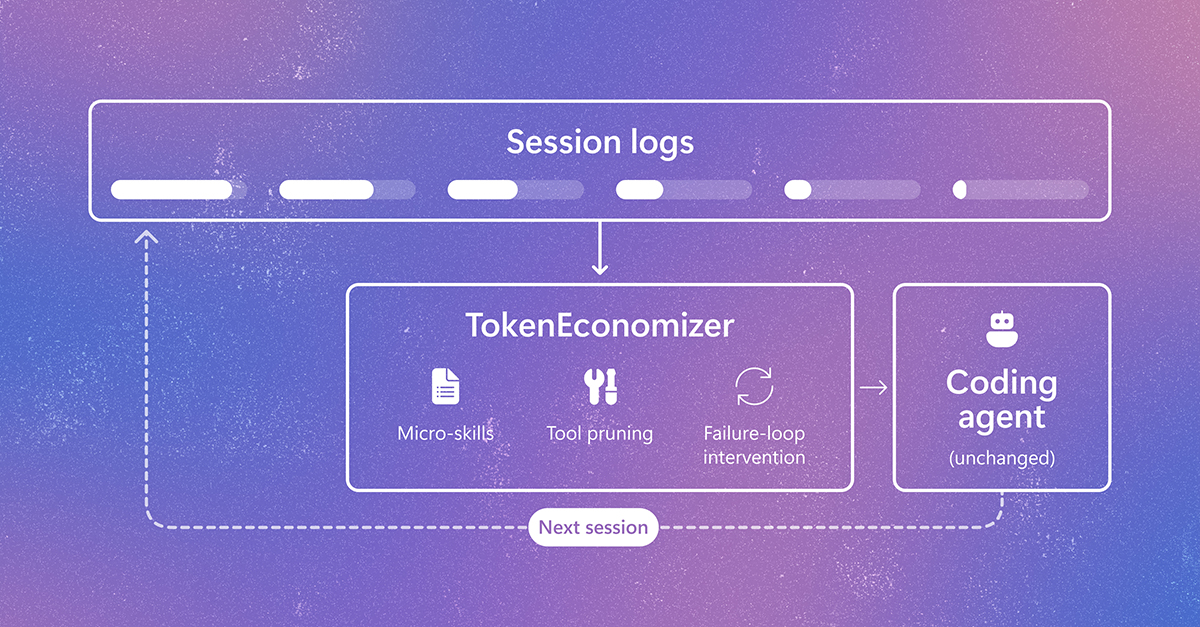
AI coding agents are increasingly help developers fix bugs and build features largely on their own, but every interaction with their models consumes tokens. In each session, an agent sends instructions, tool descriptions, and session history to its model. Most efforts to reduce this cost focus on individual tasks. Yet developers return to the same […] The post TokenEconomizer: Learning from Experience to Make AI Coding Agents More Efficient appeared first on Microsoft Research.
MIT News · Artificial Intelligence· news.mit.eduNov 9, 2026