Aug 2026· International Conference on Smart Energy and New Power Systems· Vol 14310, pp. 143100C - 143100C-10· 0 citations· 13 references
Engineering
Abstract
This study addresses the challenges of privacy leakage and data silos in multi-source heterogeneous data interaction within smart grids by designing a federated multi-source data fusion architecture that combines adaptive local differential privacy with feature space alignment. This architecture utilizes Hessian matrix trace perception to adaptively adjust the local noise budget and introduces a dynamic aggregation selection mechanism based on the maximum mean difference, reconciling the conflict between differential privacy perturbations and feature manifold losses. Experimental results show that, while ensuring strict differential privacy boundaries, the system improves test accuracy by 7.45%, achieves a model inference speed of 45 FPS, and reduces communication resource overhead by 36.5%. Even under extreme conditions such as nonindependent identically distributed skew and 15% Byzantine poisoning attacks, it maintains a 98.40% attack interception rate and robust generalization fusion performance, providing a feasible system solution for building a highly reliable and resilient situational awareness and control foundation for the distribution IoT.
A federated deep learning framework that systematically integrates adaptive privacy noise mechanisms and trust-weighted aggregation within a distributed architecture that ensures the protection of sensitive data during collaborative analysis through precise differential privacy control and advanced neural network model...
A hierarchical privacy protection and poisoning-robust defense framework for industrial federated learning is proposed and can effectively suppress global-model degradation under multiple poisoning attacks and achieves a favorable balance among privacy protection strength, robustness, and training efficiency.
Huan Yin, Cong Chen, Jing-Yi Zhang et al.· Italian National Conference...· 0 citations
This paper proposes a Federated Learning Framework for Privacy-Preserving Smart Infrastructure Monitoring (FL-PSIM), which enables decentralized model training without transferring raw infrastructure data and optimizes global learning while maintaining local data privacy.
Mahabala H. N.· International Journal of Mod...· 0 citations
This research introduces a decentralized optimization framework for improved operational performance of 11kV, 32-bus Nsukka Radial Distribution Network (RDN), using a privacy-preserving decentralized optimization framework known as Federated Learning (FL).
Gerald I. Okwe, Ijeoma Uneze, Isidore U. Uju et al.· International journal of rec...· 0 citations
A protocol where each participant simulates multiple virtual users to report target functions through distinct, anonymized messages is proposed, which improves utility for tested multi‐target aggregation tasks compared to representative decentralized DP baselines, simplifies privacy amplification analysis through group...
Sen-Qiao Liu, Wei-Guo Wu, Shaowei Wang et al.· Transactions on Emerging Tel...· 0 citations
Martin Trust Center Managing Director Bill Aulet introduces Dear Dreamer, a free platform for middle and high school students who want to learn about entrepreneurship.
Microsoft Research Blog· microsoft.comSep 30, 2026
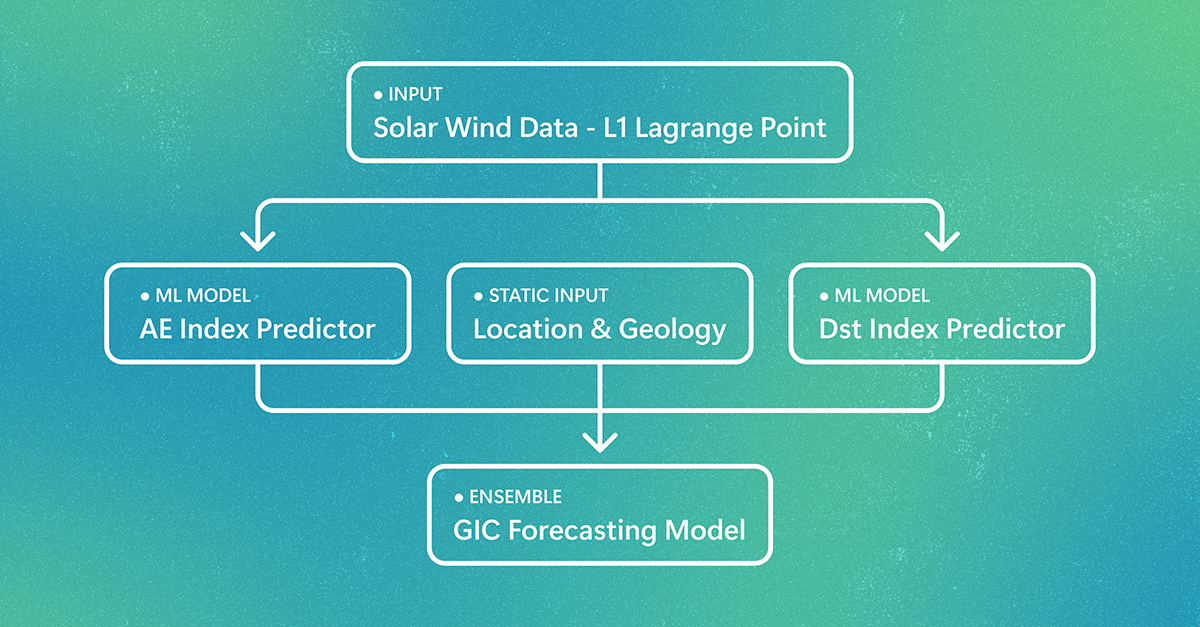
Extreme space-weather events can damage power systems on Earth and degrade GPS accuracy and satellite operations. A new machine learning system can predict where damage is likely to occur 30-60 minutes before a storm arrives. The post Forecasting space weather risks on power grids appeared first on Microsoft Research.
We use cookies to run the site and, with your consent, for analytics and to show ads.
See our Cookie Policy.