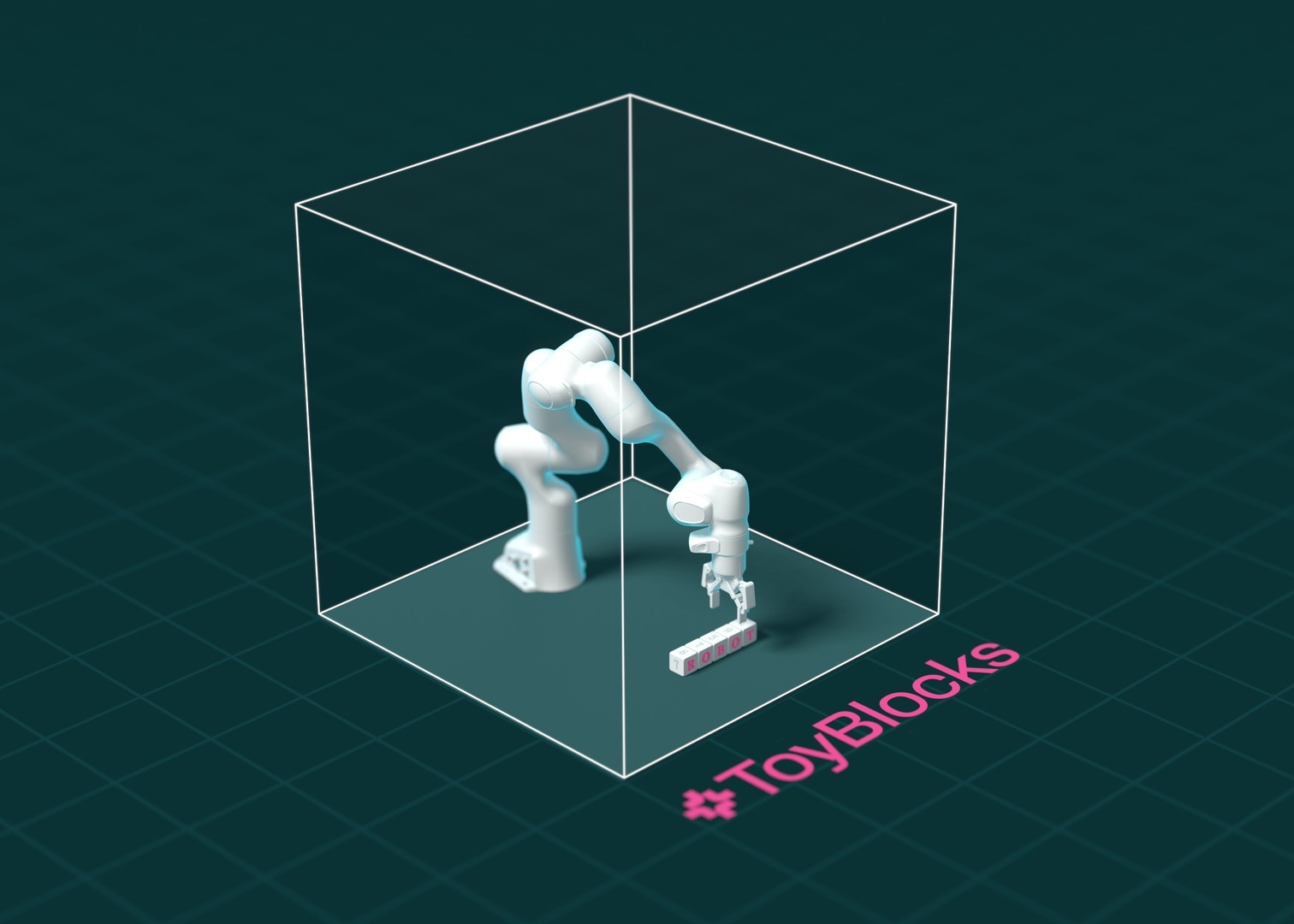
Generalist robot policies often fail at one step of a task they can otherwise perform. We ask whether such a failure can be repaired by editing the policy's weights directly, without gradients, training data, or a change to the instruction. Told to put the cube then the banana in the bowl, a zero-shot $\pi_{0.5}$ vision-language-action policy in RoboLab releases the cube before it reaches the bowl. Replaying 21 of these decisions under rewordings shows that it binds"in the bowl"to the wrong object. Closed-form instruction distillation copies the per-layer effect of an explicit rewording into the language model's MLP weights. On 128 held-out seeds, success rises from 27 to 106 episodes, with 81 fixed and 2 broken ($p=7\times10^{-22}$), while an update of the same size in random directions leaves success unchanged. The edit also lifts two other tasks without detectable harm on the remaining 13, and a variant that stores 0.16% of the parameter count keeps most of its effect. Placed in the action expert or action head instead, the same distillation helps less or not at all. Our released tool reproduced the fix end to end on new held-out seeds, from 8/64 to 36/64. Edits aimed at perception, a missing grasp, contact physics, or the gripper threshold did not help, and of seven blind Claude Opus editors, only the one given the misread instruction produced an edit that passed held-out scoring. These results suggest that weight edits work best when a known-good input already exists to distil. Because reruns with unchanged weights flip about a third of paired outcomes, evaluations should pair seeds, rerun the unedited policy, and confirm gains on held-out seeds.

It is found that Llama 3 delivers comparable quality to leading language models such as GPT-4 on a plethora of tasks, and performs competitively with the state-of-the-art on image, video, and speech recognition tasks.
This paper investigates developing real-world perception for active agents, proposes Gibson Environment for this purpose, and showcases a set of perceptual tasks learned therein.
F. Xia, Amir Zamir, Zhi-Yang He et al.· 2018 IEEE/CVF Conference on...· 1,069 citations· ⚡112
The results indicate that software engineering work practices are chosen opportunistically, adapted and configured to provide value under the constrains imposed by the startup context.
Nicolò Paternoster, Carmine Giardino, M. Unterkalmsteiner et al.· Information and Software Tec...· 394 citations· ⚡54
The possibility of inferring high-dimensional data inference in a model that consists of a prior and an auxiliary differentiable constraint given some additional information is considered, thereby allowing a range of potential applications in adapting models to new domains and tasks.
Alexandros Graikos, Esmeralda S. Whitammer, N. Jojic et al.· Neural Information Processin...· 316 citations· ⚡15
It is proved that any global minimizer of the trajectory balance objective can define a policy that samples exactly from the target distribution, and empirically demonstrate the benefits of the trajectories balance objective for GFlowNet convergence, diversity of generated samples, and robustness to long action sequenc...
Esmeralda S. Whitammer, Moksh Jain, Emmanuel Bengio et al.· Neural Information Processin...· 302 citations· ⚡60
GAOKAO-Bench is introduced, an intuitive benchmark that employs questions from the Chinese GAOKAO examination as test samples, including both subjective and objective questions that contribute a robust evaluation benchmark for future large language models and offers valuable insights into the advantages and limitations...
Xiaotian Zhang, Chun-yan Li, Yi Zong et al.· arXiv.org· 216 citations· ⚡17
Related blog posts
MIT News · Artificial Intelligence· news.mit.eduNov 9, 2026
Machine-learning networks can learn without detailed instructions from a designer. Those that do may offer insight into how the brain reorganizes itself during learning.
We use cookies to run the site and, with your consent, for analytics and to show ads.
See our Cookie Policy.